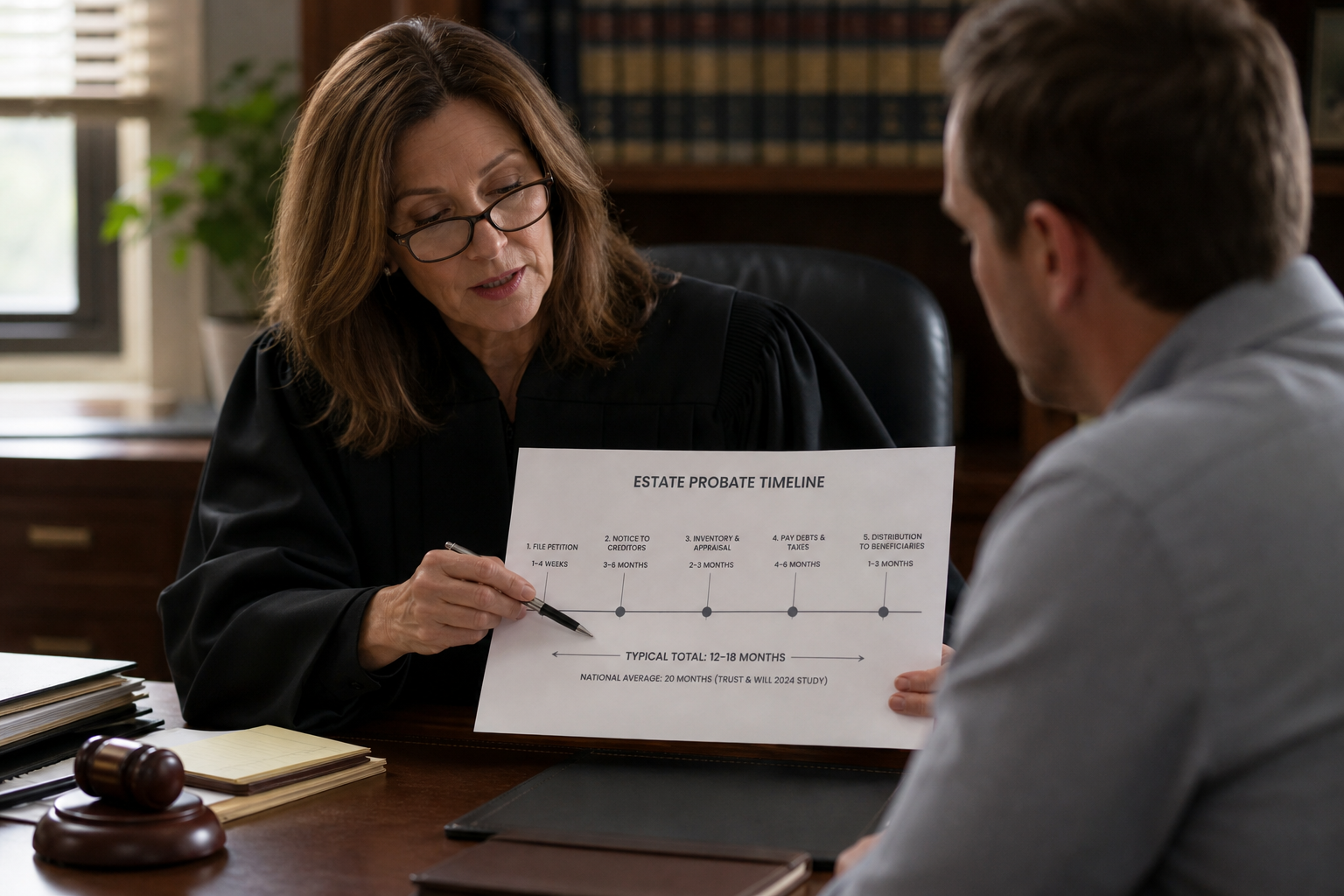
Probate often takes 6 to 18 months, but there is no single national deadline. State law, court schedules, creditor notice periods, the estate's assets, and family disputes all affect the finish date.
Official guidance illustrates the range: Oregon courts say probate averages 6 to 9 months, Alaska courts say most cases take 6 to 12 months, and California courts say formal probate typically takes 9 to 18 months.
The probate case is only one part of what to do after a death. You may also need to secure property, find accounts, handle bills, file taxes, and transfer assets outside probate.
Probate timeline at a glance
| Situation | Official timing example | What controls the timeline |
|---|---|---|
| Straightforward probate | Oregon courts: 6 to 9 months on average | Creditor periods, inventory, taxes, court scheduling, and accurate filings |
| Most probate cases | Alaska courts: 6 to 12 months | Estate complexity and whether disputes arise |
| Formal probate | California courts: typically 9 to 18 months | Hearings, notice, appraisal, accounting, and court approval |
| Simple formal administration | The Florida Bar: about 5 to 6 months | The required creditor period and whether the estate is ready to close |
| Small-estate transfer | State-specific procedure outside full probate | State eligibility rules, asset value, property type, and waiting periods |
These are planning ranges, not promises. A court can move faster or slower, and a complicated or contested estate can remain open for years.
The probate process, step by step
1. Prepare and file the petition
The person asking to manage the estate gathers the will, death certificates, family information, and an initial list of assets and debts. They then file in the correct probate court. Missing documents or filing in the wrong county can create an avoidable delay.
2. Receive authority from the court
The court confirms who can act for the estate and issues the document financial institutions request. States use different names for that document. Until it is issued, access to estate accounts and certain transactions is limited.
3. Notify interested people and creditors
The court-appointed executor or administrator follows state notice rules for beneficiaries and creditors. The estate generally cannot close before required claim periods expire. Florida, for example, generally bars most creditor claims filed later than three months after first publication of notice or 30 days after direct service, whichever is later, subject to statutory exceptions. See Florida Statute 733.702.
4. Find, protect, and value assets
This work can include bank accounts, real estate, vehicles, investments, personal property, and business interests. California requires the inventory and appraisal within four months after letters are first issued, unless the court allows more time. See California Probate Code section 8800. Use an executor checklist to track documents and deadlines.
5. Resolve debts, expenses, and taxes
The court-appointed executor or administrator reviews claims, pays valid obligations in the required order, and files applicable tax returns. If a federal estate tax return is required, Form 706 is generally due nine months after death, although an extension to file may be available. See the IRS Form 706 instructions.
6. Distribute assets and close the estate
After obligations are resolved, the representative prepares any required accounting, asks for approval when needed, transfers the remaining property, and files closing documents. Selling a home, waiting for tax clearance, or correcting earlier records can push this phase back.
What can make probate take longer?
Common causes include:
- a will contest or disagreement among beneficiaries
- missing heirs, records, or account information
- real estate in more than one state
- a home or business that must be valued or sold
- disputed creditor claims or tax questions
- incomplete filings and court requests for corrections
- limited court availability
Having a will can clarify who should act and who should inherit, but it does not guarantee a shorter case. Without a will, state intestacy law controls inheritance and the court appoints an administrator. That can require more family records and heir identification, but there is no reliable nationwide rule that it adds a fixed number of months.
Can a small estate avoid full probate?
Possibly. States offer different transfer procedures based on the estate's value, asset types, and time since death. California, for example, requires a 40-day wait before certain personal-property transfers and applies state-specific value limits. Review the current California Courts small-estate guidance or the rules for the state where the property is located.
Do not assume that a procedure called “summary,” “informal,” or “small estate” works the same everywhere. Check eligibility before transferring property or paying beneficiaries. Our guide to when probate is required explains which assets may pass outside the court process.
Who handles what during probate?
A probate lawyer performs licensed legal work, such as giving legal advice, representing the estate in court, and handling disputes. Estate administration also involves a large operational workload: gathering records, contacting institutions, tracking tasks, coordinating valuations, and keeping the process moving.
Alix provides end-to-end estate settlement support. Your Estate Settlement Specialist coordinates the work, and legal support from a network attorney is included when needed, all within one transparent fee. You keep control of decisions while the right professional handles each part. If you are comparing support options, read whether you need a probate lawyer and how much probate costs.
Talk with an Alix expert if you want one team to organize the estate, coordinate legal support, and help prevent avoidable delays.
Probate is only one part of the full settlement timeline. Alix estate settlement services can manage the court, financial, property, tax, and distribution work as one process.
Frequently asked questions
How long does probate take with a will?
A will can make the person's wishes and choice of executor clearer, but the estate must still follow state notice, creditor, inventory, tax, and court requirements. A straightforward case may fit within the 6 to 18 month planning range, but the will alone does not set the timeline.
How long does probate take without a will?
State law, rather than a nationwide formula, sets the process. Intestacy law determines who inherits, and the court appoints an administrator. Unclear family relationships, missing heirs, or disagreement over who should manage the estate can extend the case.
Is there a minimum probate period?
The answer depends on state law and whether full probate is required. Some estates qualify for a small-estate transfer procedure after a statutory waiting period. Others must remain open through creditor notice and court review. Confirm the current rules before treating any online estimate as a deadline.
Can an executor distribute assets before probate ends?
Sometimes partial distributions are allowed, but distributing too early can create risk if debts, taxes, expenses, or later claims remain unpaid. The representative should preserve enough estate property to cover obligations and follow local court rules. Get legal advice for the estate's state before making an early distribution.
Can probate move faster?
You cannot skip statutory waiting periods, but complete records and prompt, accurate filings can prevent avoidable delays. Start the asset and debt inventory early, respond quickly to court requests, track deadlines, and resolve disagreements before they become litigation. Professional help can keep operational tasks from stalling.
Related resources