Intestate: Definition, What It Means, and How It Affects Estate Settlement July 2026
When there's no valid will, an estate is considered intestate, and that status hands control to state law instead of to anything the decedent may have wanted. The court appoints an administrator, confirms who legally qualifies as an heir, and oversees every distribution, and you can't move forward on any of it until that process runs its course. Intestate cases also tend to take longer than estates with a will, so the sooner you understand what you're working with, the better positioned you are to move through it.
Key Takeaways:
- Intestate means dying without a valid will, which hands asset distribution to state law, not your wishes.
- State intestacy laws follow a fixed heir hierarchy: spouse and children first, then parents, siblings, and extended family.
- Unmarried partners, stepchildren, and close friends receive nothing under intestate law regardless of the relationship.
- You cannot distribute any assets until the court appoints you administrator and confirms legal heirs, or you risk personal liability.
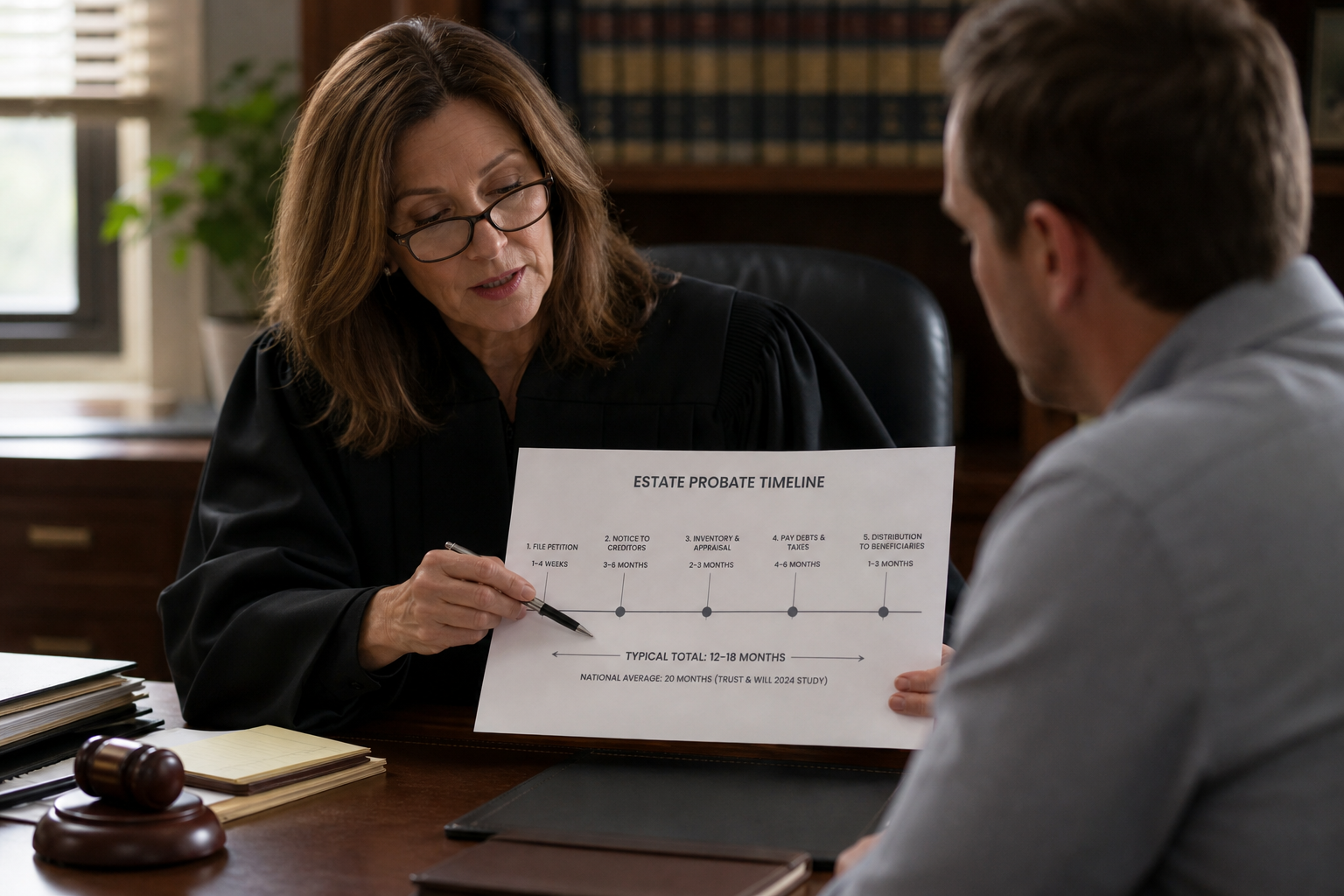
- A Trust & Will 2024 study found the national average probate timeline is 20 months; intestate cases often run longer.
What is Intestate?
The word itself comes from the Latin intestatus, meaning "not having made a will." In legal terms, intestate refers to the status of a deceased person who left behind no legally valid will directing how their assets should pass to others. It also describes the situation itself: an intestate estate, an intestate death, intestate succession.
What trips people up is that dying intestate is more common than most expect. Studies suggest roughly half of Americans die without a valid will, making intestate estates a frequent reality, not an edge case. A will being present does not automatically mean it is valid. A document can be disqualified if it was signed under duress, lacks the required witnesses, was never properly executed under state law, or was revoked before death. In any of those cases, the estate is treated as intestate even if a physical document exists, and understanding when probate is required becomes especially important.
What Changes When There Is No Valid Will
When an estate is intestate, the decedent's assets do not simply pass to the people who might have expected them. State intestacy laws take over, and those laws follow a fixed hierarchy of heirs that has nothing to do with personal relationships, informal promises, or family expectations.
That hierarchy typically runs in this order:
- A surviving spouse, who often receives a portion or all of the estate depending on whether children are also surviving
- Biological and legally adopted children, who share equally in most states
- Parents of the decedent, if no spouse or children survive
- Siblings, then more distant relatives, if no closer heirs exist
If no qualifying heirs can be located at all, the estate may escheat to the state, meaning the government takes ownership of the assets. That outcome is rare but real.
A few important things intestacy laws cannot do: they cannot recognize a partner who was never legally married, even after decades together. They cannot honor a verbal promise the decedent made to a friend or caregiver. They generally do not recognize stepchildren unless the decedent legally adopted them. The law sees only legal relationships.
What "Intestate Succession" Means in Practice
Intestate succession is the legal mechanism states use to distribute assets when no will controls the outcome. Each state has its own version, codified in statute, and the rules vary enough that the same family situation can produce very different outcomes depending on where the decedent lived.
For you as executor or administrator, intestate succession means your job gets more procedurally complex, not less. You are not executing someone's documented wishes. You are following a court-supervised process that determines who the legal heirs are, validates their status, and distributes assets according to a formula the decedent never agreed to.
The probate court takes on a more active role in intestate cases. Instead of confirming and executing an existing plan, the court must identify the rightful heirs, resolve any disputes about who qualifies, and approve each distribution. That adds time and administrative work to a process that is already measured in months.
It is also worth noting that intestacy only governs assets that would have passed through a will in the first place. Assets with named beneficiaries, such as life insurance policies, retirement accounts, and payable-on-death bank accounts, pass outside of probate regardless of whether a will exists. Those designations control their own outcomes. The intestate rules apply to what remains: the assets held solely in the decedent's name with no beneficiary designation attached.
Intestate Succession Laws Explained
When someone dies without a will, state law steps in to answer a question the deceased never answered: who gets what? The set of rules that governs this is called intestate succession, and every state has its own version of it.
Intestate succession laws rank potential heirs in a specific order, moving outward from closest family to more distant relatives. The state distributes the estate according to that hierarchy, regardless of what the deceased may have wanted or what family members believe is fair. intestate succession laws by state vary enough that the same family situation can produce very different outcomes depending on where the decedent lived. Understanding how that hierarchy works gives you a clearer picture of what to expect as you move through settlement.
How the Hierarchy Typically Works
Most states follow a similar general structure, even if the exact shares differ. The order typically runs like this:
- Surviving spouse and children are first in line. If the deceased was married and had children, the estate is usually split between them, though the exact proportions vary by state and whether the children are from the current marriage or a prior one.
- Children inherit directly if there is no surviving spouse. The estate is divided equally among them. If a child has predeceased the parent, that child's share typically passes to their own children (the grandchildren of the deceased) through a rule called "per stirpes" distribution.
- Parents and siblings come next when there is no surviving spouse or children. Most states treat parents as the next eligible heirs, followed by siblings if the parents have also passed.
- Extended family takes priority over the state. Aunts, uncles, cousins, and more distant relatives can inherit in many states, but only after closer relatives have been ruled out entirely.
- If no living relatives can be identified, the estate escheats to the state, meaning the government takes ownership of the remaining assets. For context on how the process begins, see finding the will and starting probate.
What Counts as an "Heir" Under Intestate Law
Intestate succession laws are more specific about who qualifies as an heir than most people expect. A few points worth knowing:
- Adopted children are treated the same as biological children in virtually every state. Stepchildren, on the other hand, typically do not inherit under intestate succession unless they were legally adopted.
- Children born outside of marriage can inherit from a parent, but some states require that paternity or maternity be legally documented, either through acknowledgment, court order, or other official records.
- Domestic partners and unmarried long-term partners receive no inheritance rights under intestate law in most states. This is one of the starkest consequences of dying without a will, and it also raises the question of whether all wills go through probate for couples who never legally married.
- Half-siblings generally inherit equally alongside full siblings in most states, though this varies.
Community Property vs. Common Law States
Where you live shapes how intestate succession plays out, especially for married couples.
| Property System | States | How It Affects Inheritance |
|---|---|---|
| Community property | Arizona, California, Idaho, Louisiana, Nevada, New Mexico, Texas, Washington, Wisconsin | Each spouse already owns half of marital assets. At death, the deceased's half passes through intestate succession. |
| Common law | All other states | Asset ownership is based on whose name is on the title or account. The surviving spouse's share under intestacy depends on state law and what heirs exist. |
In community property states, the surviving spouse typically inherits the deceased's half of community property outright when there are no children, and may share it with children in others. In common law states, the calculus is more variable and depends heavily on the specific state's statutes and the composition of the family.

Why This Matters for You as Executor
As executor of an intestate estate, you are not simply distributing assets, you are also responsible for correctly identifying who qualifies as an heir under the applicable state law, gathering documentation to prove those relationships, and notifying all potential heirs of the proceeding. Missing a rightful heir or misclassifying a relationship can create personal liability down the line, which is why understanding your role as executor and first steps matters so much. Courts take heir identification seriously, and creditors or overlooked relatives can challenge a distribution long after it has been made.
This is one of the areas where the structural complexity of intestate settlement becomes most visible. The law provides a framework, but applying it to a real family with blended relationships, distant relatives, or unclear paternity records requires careful documentation and, in many cases, coordination with legal counsel.
Intestate Heirs and the Order of Inheritance
When someone dies without a will, state law steps in to decide who inherits. The legal framework that governs this is called intestate succession, and it follows a strict priority order based on family relationships. Understanding who qualifies as an heir and where they fall in that order is one of the first things you will need to sort out as an executor or administrator.
States generally organize heirs into tiers. The closer the biological or legal relationship to the decedent, the higher the tier and the stronger the claim on the estate. Here is how that hierarchy typically looks across most states:
- Spouse and children come first. In most states, a surviving spouse and the decedent's children share the estate. How the split is calculated varies by state and by whether the children are also the spouse's children or from a prior relationship.
- If there is no spouse or children, parents inherit. The decedent's living parents typically receive the entire estate when no spouse or direct descendants survive.
- Siblings follow if both parents have died. Full siblings usually receive equal shares; some states treat half-siblings differently.
- Extended family comes next. Grandparents, aunts, uncles, nieces, nephews, and cousins may inherit if no closer relatives survive, each in descending priority depending on the state's statute.
- The state inherits last. If no qualifying relative can be identified, the estate escheats to the state. This is relatively rare but does happen, particularly in cases where family ties have been lost or documentation is unavailable.
How Spouses Are Treated Under Intestate Succession
A surviving spouse's share is one of the more complicated parts of intestate law because it depends heavily on where the decedent lived. Community property states, including California, Texas, and Arizona, treat assets acquired during marriage as jointly owned, so the surviving spouse generally owns half of those assets outright, absent a prenuptial agreement or other modification. The intestate share then applies only to the decedent's separate property.
In common law states, the surviving spouse typically receives a share that ranges from one-third to the entire estate, depending on whether children or other relatives survive. Some states give the spouse the first portion off the top before any remaining balance is divided among children.
Children and the Rights of Descendants
Biological children and legally adopted children have equal inheritance rights under intestate law in virtually every state. Stepchildren, however, do not automatically inherit unless they were formally adopted. Children born outside of marriage may also have inheritance rights, though some states require proof of paternity.
If a child of the decedent has already died but left their own children (the decedent's grandchildren), those grandchildren may inherit the share their parent would have received. This is called per stirpes distribution, and it is a common feature of intestate statutes across the country.
What Disqualifies an Heir
Not every family member who appears on the family tree will be eligible to inherit. Several circumstances can disqualify an otherwise valid heir:
- A person convicted of killing the decedent is barred from inheriting under slayer statutes that exist in most states.
- A spouse who abandoned the decedent or committed certain forms of marital misconduct may lose their intestate share in some jurisdictions.
- An heir who formally disclaimed their inheritance within the required timeframe gives up their right to receive assets, and their share passes down to the next person in line.
- Debts owed to the estate by an heir can complicate distribution, though this does not automatically disqualify them from inheriting.
Identifying the correct heirs, verifying their relationships, and understanding which rules apply in the decedent's state is work that needs to happen early in settlement. Getting this wrong can delay distribution, create legal exposure, or result in assets going to the wrong people entirely.
Intestate Estates and the Probate Process
When someone dies without a valid will, their estate typically must pass through probate, the court-supervised process by which a deceased person's debts are settled and remaining assets are distributed to heirs. For intestate estates, probate is almost always required, because there is no legally appointed executor and no testamentary instructions for the court to follow.
The probate court steps in to fill that gap. A judge appoints an administrator, usually the closest surviving relative, who takes on the same legal and fiduciary responsibilities an executor would carry under a will. From there, the process follows a court-defined sequence that leaves little room for flexibility or family preference.

Here is how that sequence generally unfolds:
- The court formally opens the estate and appoints an administrator, granting them letters of administration, which serve as legal proof of their authority to act on behalf of the estate.
- The administrator takes an inventory of the decedent's assets, locating accounts, property, personal belongings, and any outstanding debts or liabilities.
- Managing debts and creditor claims is a required step: creditors are notified and given a legally defined window to submit claims against the estate. No assets can be distributed until this window closes, and distributing early exposes the administrator to personal liability.
- The court applies the state's intestacy laws to determine who inherits what, and in what proportions, based entirely on legal family relationships, not personal relationships or the decedent's wishes.
- Once debts are settled and the court approves the distribution plan, assets are transferred to heirs and the estate is formally closed.
Why Intestate Probate Tends to Take Longer
Probate is rarely fast, but intestate cases carry a few structural reasons they often run longer than estates with a will.
Without a will, there is no named executor ready to step in immediately. The court must first receive a petition, schedule a hearing, and formally appoint an administrator before any substantive work can begin. That appointment process alone can add weeks or months to the timeline before a single asset is inventoried.
Locating heirs can also become its own administrative project. If the decedent had a complex family structure, such as children from multiple relationships, estranged relatives, or heirs in other states or countries, you may need to conduct formal heir searches and notify parties who may not even know they have a claim. Any dispute over who qualifies as an heir, or what share they are owed, can trigger contested proceedings that extend the timeline considerably.
A Trust & Will 2024 study found the national average is 20 months. Many intestate cases land at or beyond that figure, particularly when family disagreements or hard-to-locate heirs are involved.
How This Affects You as Administrator
If you have been appointed administrator of an intestate estate, the probate court's involvement does not end at appointment. You remain accountable to the court throughout the entire settlement process, filing status updates, obtaining approval for certain financial decisions, and submitting a formal accounting before the estate can close.
That accountability is not optional and it is not ceremonial. Missteps, like paying the wrong creditor first, distributing assets before the claim window closes, or failing to properly inventory an asset, can expose you to personal liability. The court's oversight exists partly to protect heirs, but it also protects you when you follow the process correctly.
The administrative workload in an intestate probate estate covers the same scope as any other settlement: gathering financial records, managing and maintaining property, handling creditor correspondence, coordinating appraisals, closing accounts, and filing tax returns, all while meeting court-imposed deadlines. The difference is that you are doing it without a roadmap from the person whose estate you are settling.
Why Intestate Matters in Estate Settlement
When someone dies without a valid will, intestate succession laws take over completely. The state steps in and applies its own formula for who inherits what, regardless of any informal wishes the deceased may have expressed. That shift has real consequences for you as executor or administrator, because you are no longer distributing assets according to a document someone carefully prepared. You are working through a statutory framework that may not reflect the decedent's actual intentions at all.
The practical weight of this shows up quickly. Intestate estates frequently require full probate, meaning court supervision over the entire administration process. That adds time, filing requirements, and procedural steps that a well-drafted will sometimes allows you to skip. Intestate cases often push toward the longer end of that range because the court has to confirm heirship before administration can proceed, with 20 months on average.
There are a few specific ways this affects how you carry out your role:
- You cannot begin distributing assets until the court formally appoints you as administrator and confirms who the legal heirs are. Even if it seems obvious who should inherit, you have no authority to act on that assumption until the court says so.
- Heirs determined by intestate succession laws may not match what the decedent would have wanted. A long-term partner who was never legally married, a close friend, or a favorite charity receives nothing under most intestate statutes, regardless of how meaningful those relationships were.
- Family disputes are more common in intestate estates because there is no document to point to. Without a will, relatives who feel entitled to a share may contest the distribution, and you are left managing that conflict while also handling the administrative workload.
- Asset discovery becomes more involved when there is no will to use as a starting point. A will often identifies accounts, property, and other assets explicitly. Without one, you are building that picture from scratch, which takes more time and more coordination.
How This Affects You as Executor
Your authority as administrator of an intestate estate flows entirely from the court, not from a document the decedent left behind. That distinction matters because it means every consequential action you take, from accessing accounts to coordinating property, depends on having your letters of administration in hand first.
It also means the scope of your work expands. You are responsible for locating heirs who may be difficult to find, gathering documentation to confirm family relationships, and working through a distribution structure set by state law instead of by the decedent's clear instructions. In estates with any real complexity, whether that means real property, investment accounts, business interests, or outstanding debts, the administrative layer is substantial.
The creditor claim process still applies in full. You are personally at risk if you distribute assets before that window closes and creditor claims go unpaid. Intestate status does not change that obligation or reduce your exposure.
The combination of court dependency, heir confirmation, and asset discovery means intestate estates generally demand more of you as administrator, not less, than estates where a valid will guides the estate settlement process from start to finish.
Final Thoughts on Understanding the Intestate Definition and Its Impact
Understanding the intestate definition is really the first step in understanding why estate settlement gets more complicated without a will. The court controls the timeline, the state controls the distribution, and you are responsible for making sure the process runs correctly, all without a roadmap from the decedent. That is a lot to carry. If you are managing an intestate estate, start your Alix onboarding today.
FAQ
What does intestate mean, and how does it affect who inherits an estate?
Intestate means a person died without a legally valid will, which hands control of asset distribution to your state's intestacy laws, not the decedent's documented wishes. Those laws follow a fixed hierarchy based strictly on legal relationships, starting with a surviving spouse and children, moving outward to parents, siblings, and more distant relatives. A long-term partner who was never legally married, a close friend, or a favorite charity receives nothing under most intestate statutes, regardless of how meaningful those relationships were.
Can a will exist and the estate still be treated as intestate?
Yes. A physical document does not automatically mean it is valid. A will can be disqualified if it was signed under duress, lacked required witnesses, was never properly executed under state law, or was revoked before death. In any of those situations, the estate proceeds through intestate succession exactly as if no document existed at all.
What's the difference between intestate succession and probate in terms of what you actually have to do as executor?
Intestate succession is the legal formula that determines who inherits; probate is the court-supervised process you work through to apply it. In an intestate estate, both run together and reinforce each other's complexity: the probate court must formally appoint you as administrator, confirm who the legal heirs are through documented proof of family relationships, and approve each distribution before you have authority to act. Per a Trust & Will 2024 study, the national average probate timeline is 20 months, and intestate cases frequently push toward the longer end of that range because heir confirmation has to happen before administration can move forward.
How do community property states like California and Texas handle intestate succession differently than common law states?
In community property states, including California, Texas, and Arizona, each spouse already owns half of assets acquired during the marriage, so the intestate rules apply only to the decedent's separate half of those assets. In common law states, asset ownership follows whose name is on the title or account, and the surviving spouse's intestate share ranges from roughly one-third to the entire estate depending on state statute and which other relatives survive. The same family situation can produce meaningfully different outcomes depending on where the decedent lived.
What assets does intestate succession actually control, and what falls outside it?
Intestate succession only governs assets that would have passed through a will in the first place, meaning property held solely in the decedent's name with no beneficiary designation attached. Life insurance policies, retirement accounts, and payable-on-death bank accounts pass directly to their named beneficiaries regardless of whether a will exists, so intestate laws have no effect on those. The intestate rules govern what remains after those designated assets are set aside.
.png)
Related resources