You might be asking yourself what a probate lawyer does that you couldn't handle on your own with court forms and a little patience. It's a fair question, especially when you're already managing grief, family dynamics, and a pile of paperwork that seems to grow every time you open a drawer. The honest answer is that it depends on the estate, but the stakes of getting it wrong are real: missed creditor deadlines can expose you to personal liability, incorrectly distributed assets can trigger legal disputes, and court filings done out of sequence can delay the entire process by months. This article walks through what a probate attorney actually does, when you need one, how much it costs, and where professional estate settlement support can handle the work without the hourly billing.
Key Takeaways:
- A probate attorney manages the court-supervised process of settling a deceased person's estate after death
- Estates without a will require probate attorneys more urgently, as intestacy laws determine distribution
- Attorney fees are $150 to $400 per hour or 1 to 4% of estate value, though rates vary widely by state and complexity
- Alix handles the substantial administrative work that probate attorneys often bill for at legal rates
- Probate cases typically take 12 to 20 months, involving court filings, creditor claims, and asset distribution
What Is a Probate Attorney?
A probate attorney is a licensed lawyer who manages the court-supervised process of settling a deceased person's estate: validating the will, paying outstanding debts, and distributing assets to the rightful heirs or beneficiaries. When someone dies, their assets, debts, and remaining affairs don't resolve themselves automatically — that legal work falls to the probate attorney.
The role sits at the intersection of law, finance, and family, which is part of what makes it so demanding. Probate attorneys may represent executors (also called personal representatives), beneficiaries, or the estate itself, depending on the circumstances of a given case.
What a Probate Attorney Actually Does
The scope of work varies by estate, but a probate attorney generally handles:
- Filing the petition to open probate with the appropriate court and securing the appointment of the executor or administrator named in the will
- Identifying, valuing, and inventorying estate assets, which may include real property, financial accounts, business interests, and personal property
- Notifying creditors and managing the process of settling valid debts and claims against the estate
- Preparing and filing the required court documents throughout the probate proceeding
- Advising the executor on their fiduciary duties to avoid personal liability
- Distributing remaining assets to beneficiaries in accordance with the will or, if no will exists, applicable state intestacy laws
What Does a Probate Attorney Cost?
Fee structures vary by state and the complexity of the estate. Common arrangements include:
- Hourly billing: The most common structure. Rates are commonly reported in the $150 to $400 per hour range for standard estate work, though attorneys in major metropolitan markets often charge more.
- Flat fees: Sometimes offered for straightforward, uncontested probate cases, typically in the $1,500-$3,000 range. Any complications during the process may add to the total.
- Percentage-based fees: Used in states where attorney fees are set by statute as a percentage of the gross estate value. In California, for example, attorneys may charge 4% on the first $100,000, 3% on the next $100,000, and declining percentages thereafter.
In states like California and Texas, statutory fee schedules are set by law, which means the court, not negotiation alone, determines what attorneys can charge for standard probate work.
What Does a Probate Attorney Do?
Probate attorneys handle the legal work required to settle an estate after someone dies. Their role spans both procedural and substantive legal tasks, many of which require court involvement, creditor negotiation, or formal filings that a non-attorney simply cannot complete alone.
At the core of the work, a probate attorney guides the executor or administrator of an estate through the probate court process.
That includes filing the petition to open probate, notifying creditors and beneficiaries, preparing and submitting an inventory of assets, handling any disputes that arise, and eventually securing the court's approval to distribute what remains to heirs.
Here is a closer look at what that work typically covers:
- Filing and managing probate court proceedings, including petitions, notices, and required documentation at each stage of the process
- Interpreting the will and advising the executor on their legal obligations under state law, including fiduciary duties owed to beneficiaries
- Identifying, valuing, and marshaling estate assets, which may include real property, financial accounts, business interests, and personal property
- Resolving creditor claims, including verifying which debts are valid and negotiating or contesting those that may not be
- Handling estate tax returns and any income tax obligations that arise during the administration period
- Representing the estate in contested proceedings, such as will challenges, disputes over asset ownership, or disagreements among beneficiaries
Probate Attorney vs. Estate Attorney
Estate attorneys tend to focus on planning work done before death, such as drafting wills, setting up trusts, and structuring assets to minimize tax exposure. Probate attorneys focus on what happens after death: the court-supervised process of validating a will and settling an estate.
Many attorneys do both. The overlap is real, and in smaller markets, especially, a single attorney may handle a client's estate plan and later represent their executor in probate. The relevant question to ask any attorney you consult is: where does the majority of their practice time go?
Probate Attorney vs. Probate Litigation Attorney
A probate litigation attorney is a more specialized role. Where a general probate attorney manages routine administration, a probate litigation attorney steps in when the estate faces a legal dispute, such as a contested will, a claim of undue influence, allegations of executor misconduct, or a fight over beneficiary rights. These cases go to court and require a litigator's skill set.
Probate Attorney vs Estate Planning Attorney: Understanding the Difference
People often use "probate attorney" and "estate planning attorney" interchangeably, but they serve very different functions at very different points in time.
An estate planning attorney works with people who are still alive to prepare for what happens after death. They draft wills, set up trusts, create powers of attorney, and structure assets to minimize taxes and avoid probate where possible. Their work is forward-looking and preventive.
A probate attorney steps in after someone has died. Their job is to handle the legal process of settling the estate through the court system, whether or not a will exists. The work is reactive and procedural, tied to a specific court process with deadlines, filings, and legal requirements.
Where the Roles Overlap
The distinction gets blurry in practice. Many attorneys handle both areas, and some firms market themselves under either label depending on the client's situation. A few things worth knowing:
- An estate planning attorney who drafted a will may not be the right person to handle probate if litigation arises, since contested estates require a different skill set.
- A probate attorney can also advise on post-death trust administration, which sits outside probate but is closely related.
- If an estate includes complex assets like a business or real property across multiple states, you may end up working with attorneys who specialize in each area separately.
What Is a Probate Litigation Attorney?
Within probate law, there is a further specialization worth knowing. A probate litigation attorney handles disputes that arise during the probate process, such as a contested will, a challenge to the executor's conduct, or a claim that a beneficiary was improperly excluded. This is distinct from general probate work, which is largely administrative. If an estate is heading toward a court dispute rather than a straightforward settlement, a probate litigation attorney is the appropriate specialist.
The short version: if you are preparing for the future, you want an estate planning attorney. If you are dealing with a death that has already occurred and assets need to pass through the court system, you need a probate attorney. And if that process becomes adversarial, you may need someone who specializes in probate litigation specifically.
When Do You Need a Probate Attorney?
Not every estate requires professional legal help, but many do. The circumstances surrounding someone's death, the complexity of their assets, and the relationships among beneficiaries all factor into whether hiring a probate attorney makes sense.
There are several situations where working with a probate attorney is worth serious consideration:
- The deceased did not leave a will, meaning the estate passes under state intestacy laws. Without clear written instructions, disputes over who inherits what are far more likely, and the court process becomes more involved.
- The estate includes real property, business interests, or assets held in multiple states, each of which may require separate legal filings and carry their own procedural requirements.
- Beneficiaries or heirs are contesting the will or disputing how assets should be distributed. These situations can escalate quickly and often require formal legal representation.
- There are outstanding debts, creditor claims, or unresolved tax obligations tied to the estate that need to be properly settled before assets can be distributed.
- The executor named in the will is unfamiliar with probate procedure and wants guidance to avoid personal liability for mistakes made during administration.
- The estate involves a minor beneficiary or a person with special needs, which introduces additional legal requirements regarding trusts and guardianship.
When You Might Not Need One
Simpler estates can sometimes move through probate without an attorney. If the estate is small, assets were held jointly or passed through beneficiary designations, and there are no disputes, some executors handle the process themselves using court-provided forms and instructions.
Many states have simplified or summary probate procedures for estates below a certain value threshold. California, for example, has a small estate affidavit process for estates valued at $208,850 or less (for deaths on or after April 1, 2025) that bypasses formal probate entirely.
That said, even straightforward estates can surface unexpected complications: a missing deed, a creditor claim, or a dispute among family members. Having an attorney available, even in a limited capacity, can prevent costly errors that would otherwise fall on the executor personally.
Key Takeaways
- You likely need a probate attorney if the estate has no will, involves contested assets, holds real property, or carries outstanding debt.
- You may be able to handle probate without an attorney if the estate is small, assets pass automatically, and there are no disputes.
- Simplified procedures exist in some states, but even those cases can benefit from at least a consultation.
Do I Need a Probate Lawyer If There Is No Will?
When someone dies without a will, the estate is considered "intestate." The short answer to whether you need a probate lawyer in that situation: yes, and often more urgently than if a will existed.
Without a will, no one has been legally designated to manage the estate. The probate court must appoint an administrator, typically the closest surviving relative, who carries the same fiduciary duties as a named executor. The difference is that they have no written instructions to follow. Every decision about how to handle assets, pay debts, and distribute what remains falls back on state law, not on what the deceased actually wanted.
How Intestate Succession Works
Each state has its own intestacy laws that determine who inherits and in what order. The hierarchy generally follows a fixed priority:
- Surviving spouses are typically first in line, receiving either all or a portion of the estate, depending on whether children or other relatives survive.
- Children come next, including legally adopted children, but stepchildren without a formal adoption are often excluded from the default inheritance order.
- If no spouse or children survive, assets pass to parents, then siblings, then more distant relatives according to the state's specific succession framework.
- If no qualifying heirs exist at all, the estate may escheat to the state, meaning the government takes possession of remaining assets.
These rules can produce outcomes nobody expected or wanted. A long-term unmarried partner may receive nothing regardless of their relationship with the deceased. A child from a prior relationship may have legal rights that complicate distribution. Blended families are particularly prone to conflict when intestacy laws are applied mechanically.
Why a Probate Attorney Matters More, Not Less
A will, even an imperfect one, provides a framework. Without it, the attorney's role moves from executing documented wishes to interpreting state law and managing the proceedings from scratch. That includes advising the administrator on their legal obligations, handling creditor notifications, and helping resolve family disputes before they escalate into formal litigation.
Some families assume that because there is no will, the process must be simpler. In practice, the opposite tends to be true. Contested heirship, unclear asset ownership, and family disagreements over perceived fairness all surface more frequently when there is no guiding document. A probate attorney provides the legal structure that fills that gap.
If you are managing an intestate estate, consult with a probate attorney early in the process. The cost of that conversation is small compared to the liability an administrator can face if assets are distributed incorrectly or creditor deadlines are missed.
How Much Does a Probate Lawyer Cost?
Probate attorney fees vary widely depending on the size and complexity of the estate, the state where probate is filed, and how the attorney structures their billing.
There are three common fee arrangements you'll encounter:
- Hourly billing is the most common structure, with rates that vary widely by region and experience. $150 to $400 per hour for standard estate work, though attorneys in major metropolitan markets often charge considerably more.
- Flat fees are sometimes offered for straightforward, uncontested probate cases. These give families a predictable cost upfront, though any complications during the process may add to the total.
- Percentage-based fees are used in some states, including California, where attorney fees are set by statute as a percentage of the gross estate value. For example, California allows attorneys to charge 4% on the first $100,000, 3% on the next $100,000, and declining percentages thereafter.
What Drives the Total Cost Up
Even with a straightforward fee arrangement, the final bill depends heavily on what the estate actually requires. Contested wills, disputes among beneficiaries, real property in multiple states, business interests, and outstanding debts or tax liabilities all add hours and complexity.
For a simple estate with a clear will and cooperative heirs, total legal fees are often in the low thousands of dollars, though exact figures vary by attorney and state. For a contested or complex estate, costs can run into the tens of thousands of dollars.
It's worth asking any attorney you consult whether they bill hourly or offer a flat rate, and what falls outside that arrangement. Some charge separately for court filings, document preparation, and correspondence, so understanding the full scope of billing before you hire matters.
Key Takeaways
| Fee Type | Typical Range | Best For |
|---|---|---|
| Hourly | Varies by region and experience; rates are commonly reported in the $150 to $400+ per hour range | Complex or unpredictable estates |
| Flat fee | $1,500 to $3,000 | Simple, uncontested probate |
| Percentage-based | Varies by state statute | States like California have set rules |
What to Expect From a Probate Attorney Throughout the Process
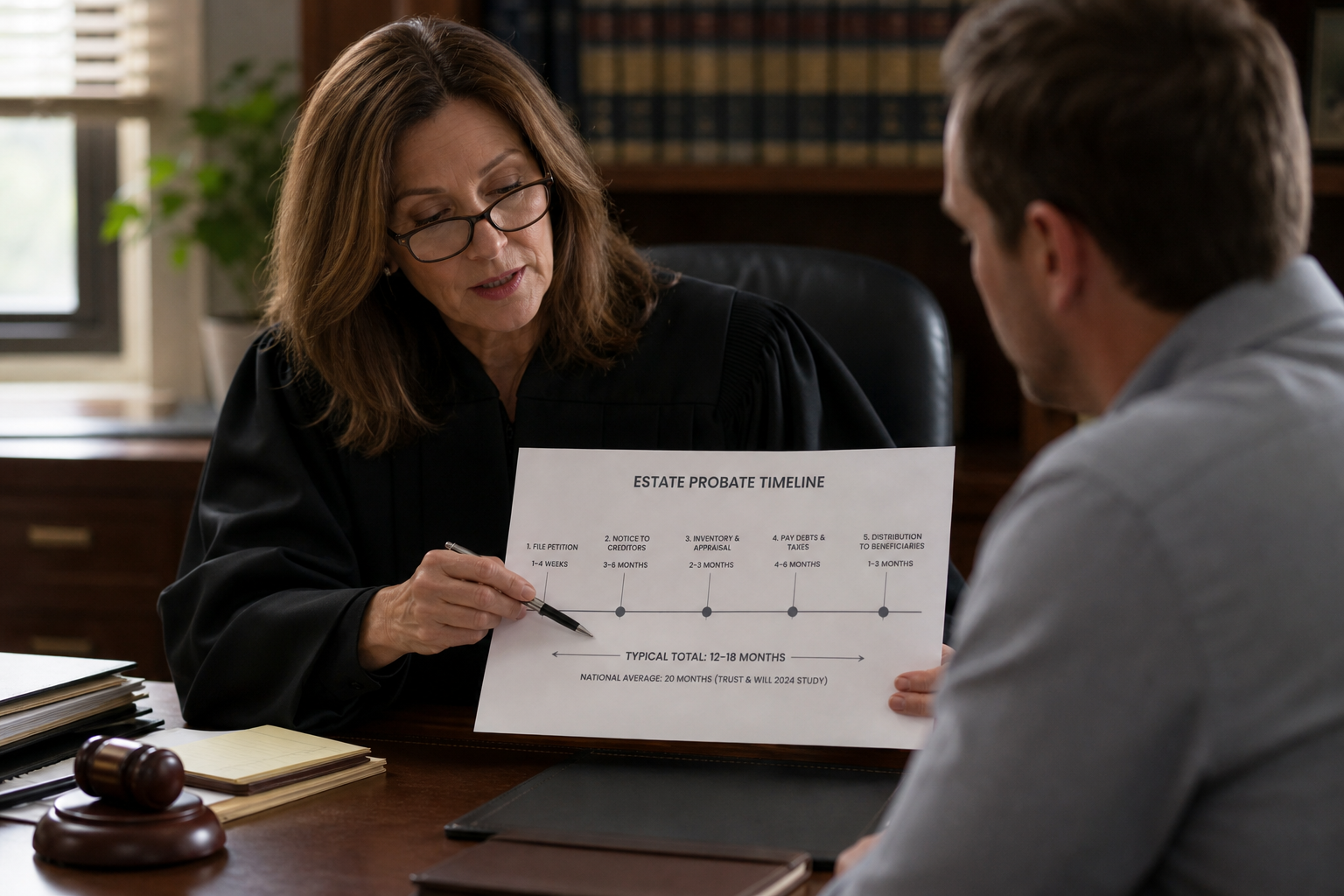
The average probate case takes 20 months from start to finish, according to Alix estate settlement data.
The Initial Consultation
Most probate attorneys offer a free or low-cost initial consultation. Come prepared with a copy of the will (if one exists), a recent list of the deceased's assets and liabilities, and at least one certified death certificate. The attorney will assess the estate's complexity, explain which type of probate proceeding applies in your state, and outline their fee structure. Ask directly how they communicate with clients, who on their team handles day-to-day questions, and what triggers a status update from their office.
Key Milestones in the Timeline
Once you engage an attorney, the process moves through a fairly predictable sequence, though the timing varies by state and estate complexity:
- Weeks 1 to 4: The attorney files the petition to open probate, submits the will for validation, and secures the court's appointment of the executor or administrator.
- Months 1 to 4: Creditors are formally notified. Most states require a waiting period of three to six months before any assets can be distributed, giving creditors time to file claims.
- Months 2 to 6: The attorney prepares a formal inventory of estate assets, often working with appraisers for real property, business interests, or collectibles.
- Months 6 to 12: Valid debts are paid, tax obligations are handled, and the attorney prepares the accounting required by the court before distribution can proceed.
- Months 12 to 20+: Final distributions are made to beneficiaries, the court reviews and approves the final accounting, and the estate is formally closed.
What Communication Actually Looks Like
Most of the waiting during probate is driven by courts and creditor deadlines, not by attorney pace. Weeks can go by without meaningful activity. A good probate attorney will set expectations about that upfront and communicate proactively at each milestone, instead of leaving you to follow up repeatedly.
"Estate settlement is totally opaque, uncharted territory. There's no way to know what you don't know. You only understand the scope of the process once you're in over your head."
That is a common experience for executors working through probate for the first time. The clearer your attorney is about timelines and responsibilities from the start, the less anxious that uncertainty becomes. If yours isn't communicating proactively, it is reasonable to ask for a monthly check-in call or written status summary at each major milestone.
Understanding Probate Attorney Costs
According to ZipRecruiter's May 2026 salary data, the average annual salary for a probate attorney in the United States is $108,160. Geography and experience drive considerable variation, with attorneys in major markets earning more than those in smaller regions.
For executors hiring an attorney, understanding this context matters. A probate attorney billing $300 per hour reflects both market rate and the professional risk they assume when advising on decisions that carry real personal liability. Attorneys who handle contested cases or high-value estates command higher fees because the professional exposure and required knowledge are genuinely greater.
How Alix Simplifies What Probate Attorneys Handle
Probate is one of the most process-heavy things a family can face after a loss, and the legal fees that come with it add up fast. Alix was built to handle the administrative and logistical weight of estate settlement so that families aren't left figuring it out alone or paying attorney rates for work that doesn't require a law degree.

Where a probate attorney focuses on court filings, legal interpretations, and formal representation, Alix handles the broader scope of what actually needs to get done after someone passes. That includes collecting and inventorying assets, notifying financial institutions, closing accounts, transferring titles, filing final tax returns, and distributing property to beneficiaries. These are the tasks that consume hundreds of hours of executor time and often get delayed for months simply because no one knows where to start.
What Alix Takes Off Your Plate
Executors frequently hire probate attorneys not because they need legal representation, but because they need someone to tell them what to do and in what order. Alix fills that role directly, with experienced professionals who know estate settlement inside and out.
Here is a sense of what Alix handles:
- Locating and documenting all estate assets, including financial accounts, real property, vehicles, and personal belongings
- Coordinating with banks, brokerages, and government agencies to transfer or close accounts
- Managing the sale of real estate or other property that needs to be liquidated
- Preparing and filing estate and final income tax returns
- Managing creditor claims and debt payoff
- Calculating and distributing inheritances to beneficiaries according to the will or applicable state law
When legal representation is genuinely required, such as contested claims, court hearings, or complex tax disputes, Alix works alongside attorneys instead of replacing them. The goal is to ensure families aren't paying an attorney's hourly rate for work that falls outside legal practice.
When You Still Need an Attorney
There are situations in which legal counsel is mandatory. A creditor dispute that escalates to litigation, a will contest among beneficiaries, or a taxable estate with real complexity will require a licensed probate attorney. Alix is built to recognize those moments and coordinate accordingly.
For the many straightforward or moderately complex estates, though, the combination of Alix's estate settlement professionals and a clear process often eliminates the need for ongoing legal retainers entirely. Families get the expertise they need without the billing structure that makes probate feel out of reach.
Final thoughts on when you need a probate attorney
Knowing what a probate attorney does and when you actually need one puts you in a far better position to make smart decisions after a loss. For estates with contested assets, missing wills, real property, or unresolved debt, a probate attorney is the right call. For everything else, the administrative and logistical work that makes up most of estate settlement can be handled by professionals who don't bill by the hour. Alix was built for exactly that. If you're managing an estate and want support from people who do this every day, get started with Alix and see how much of the burden we can take off your plate.
FAQs
What is a probate attorney?
A probate attorney is a licensed lawyer who handles the court-supervised process of settling a deceased person's estate, including validating the will, paying debts, and distributing assets to heirs. They work on the back end, after death, managing legal filings and guiding executors through their fiduciary duties.
Probate attorney vs estate planning attorney: which do I need?
An estate planning attorney helps living clients prepare wills and trusts before death, while a probate attorney handles the legal administration after someone dies. If you're managing a loved one's estate now, you need probate experience, not planning credentials.
Do I need a probate lawyer if there is no will?
Yes, and often more urgently than if a will existed. Without a will, the estate is intestate, meaning the court must appoint an administrator and apply state succession laws to determine who inherits. A probate attorney provides the legal structure that fills the gap left by missing instructions.
What does a probate lawyer cost?
Fees typically range from $150 to $300+ per hour for standard work, though some attorneys offer flat fees of $1,500 to $3,000 for straightforward cases. California and certain other states use statutory percentage-based fees calculated on the gross estate value.
What to expect from a probate attorney after death?
The process takes about 20 months on average, moving through petition filing, creditor notification, asset inventory, debt payment, and final distribution. Most waiting is driven by court schedules and creditor deadlines, and a good attorney will communicate proactively at each milestone rather than leaving you to follow up.
.png)
Related resources