What Is Probate Court? How It Works and What Executors Should Expect (May 2026)
Most people get a letter from probate court and realize they have no idea what it actually is or what happens next. Probate court is the state court division that supervises estates after someone dies. It is mandatory only when the decedent owned assets in their name alone that need a court order to transfer, real estate without joint ownership, bank accounts without beneficiaries, or estates above your state's small estate threshold. The process typically takes 12 to 18 months and, according to LegalMatch, costs between 3 and 8% of the estate's value. Here is what probate court does, what happens when there is or is not a will, and what executors should expect.
Key Takeaways:
- Probate court supervises estate settlement after death, validating wills and appointing executors to manage assets
- Expect 12 to 18 months and 3% to 8% of estate value in costs for court filings, attorney fees, appraisals, and executor compensation
- Skip probate through revocable living trusts, beneficiary designations on accounts, joint ownership with survivorship rights, or small-estate affidavits when the total value falls below your state's threshold
- A will does not avoid probate; it directs the court on how to distribute assets within the probate process
- Alix coordinates the asset discovery, creditor management, property oversight, and beneficiary communication that runs alongside your attorney's court filings
What Is Probate Court and What Does It Do?
Probate court is a specialized division of the state court system with one job: to supervise what happens to a person's estate after they die. It is not a general civil court that happens to hear estate cases on certain days. It exists specifically to resolve the legal and financial loose ends a death creates, and it has real authority to do so.
When someone dies, that person can no longer sign documents, pay bills, transfer property, or defend themselves against creditors. Probate court steps in to fill that gap. A judge oversees the process of confirming who is legally authorized to act on behalf of the estate, so that debts are paid before any assets are distributed to heirs, and formally transferring ownership of property held in the decedent's name alone.
There are a few core functions the court handles in most estates:
- Validating the will, if there is one, to confirm it meets the legal requirements of the state and was not created under fraud or undue influence.
- Appointing an executor (named in the will) or an administrator (appointed by the court when there is no will) to manage the estate through the process.
- Notifying creditors and giving them a defined window to submit claims against the estate before any distributions happen.
- Resolving disputes among heirs, creditors, or other interested parties when they arise.
- Approving the final accounting and authorizing distribution of what remains to the rightful beneficiaries.
Not every asset goes through probate. Jointly held property, accounts with named beneficiaries, and assets held in trust typically pass outside of court entirely. What probate courts deal with are assets titled solely in the decedent's name with no automatic transfer mechanism.
One thing worth knowing early: probate is a state-level process, and the rules vary considerably by jurisdiction. Timelines, filing fees, required notices, and court procedures in California differ significantly from those in Texas, Massachusetts, or Georgia. The general structure above applies broadly, but the specifics always depend on where the decedent lived and where the property is located.
When Is Probate Court Required?
Probate is required whenever a deceased person owned assets solely in their own name that need to be legally transferred to heirs or creditors. The court process exists because financial institutions, government agencies, and title companies will not transfer ownership of those assets without a court order confirming who has legal authority to act.
That said, not every death triggers probate. Several situations allow an estate to skip the process entirely.
When probate is typically required
- The decedent owned real estate in their name alone, with no joint tenant or transfer-on-death deed in place. Title cannot change hands without a court-issued order.
- Bank or investment accounts lack a named beneficiary or payable-on-death designation, leaving no automatic transfer mechanism.
- The estate holds personal property above your state's small-estate threshold. California, for example, sets this at $208,850 for deaths before April 1, 2026, and $239,700 for deaths on or after that date.
- There is no will, and the state needs to appoint an administrator to manage the estate under intestacy laws.
When probate is generally not required
- Assets held in a revocable living trust pass directly to beneficiaries outside of court.
- Accounts with valid payable-on-death or transfer-on-death designations transfer automatically upon presenting a death certificate.
- Jointly held property with right of survivorship passes to the surviving owner by operation of law.
- The total probate estate falls below your state's small-estate threshold, which varies widely. Many states allow heirs to collect assets using a simple affidavit instead.
Whether probate is mandatory depends on what the decedent owned and how those assets were titled. Two people can die with similar net worth, and one estate goes straight to probate while the other wraps up in a few weeks. Ownership structure, not estate size alone, is what drives that outcome.
What Happens in Probate Court When There Is a Will
When a will exists, probate court follows a more structured path than intestate cases, but it still requires court oversight to make everything official. The will does not automatically transfer assets or grant the named executor any legal authority the moment someone dies. That authority comes from the court.

The process typically starts when the executor named in the will files a petition with the local probate court, along with the original will and a certified death certificate. The court then schedules a hearing to admit the will to probate, which is the legal step that validates the document as genuine and legally binding. In some states, if the will was signed by the testator and witnesses before a notary, it may qualify as self-proving, thereby skipping or shortening this hearing.
Once the will is admitted, the court issues Letters Testamentary. These are the documents that give you, as executor, the actual authority to act on behalf of the estate. Without them, banks, brokerage firms, title companies, and government agencies will not recognize your authority to move assets, close accounts, or transfer property.
From there, the court-supervised process moves through several stages:
- Notice to beneficiaries and heirs: You are required to formally notify everyone named in the will, as well as certain relatives who may have legal standing even if they are not beneficiaries.
- Creditor claim period: Most states require a waiting period, typically 3 to 6 months, during which creditors can file claims against the estate. You cannot distribute assets to beneficiaries until this window closes.
- Inventory and appraisal: You must file a formal inventory of the estate's assets with the court, often accompanied by professional appraisals for real property and other major holdings.
- Court approval of distributions: Before anything is distributed to beneficiaries, many courts require you to file a formal accounting showing exactly what came in, what went out, and what each beneficiary will receive.
Even when a will is clear and all parties agree, probate typically runs 12 to 18 months from filing to final distribution. Contested wills, complex assets, or delayed creditor claims can significantly lengthen that timeline.
One thing worth knowing: a will does not avoid probate. The will determines how assets are distributed in probate, but the process itself is still required for most estates unless the assets are already titled to pass outside of court, such as through beneficiary designations or joint ownership.
What Happens in Probate Court When There Is No Will
When someone dies without a will, the estate is called "intestate," and probate court takes on a larger role than it would in a straightforward testate case. There is no document telling the court who should receive what, so the process relies entirely on state intestacy laws to fill that gap.
The first thing probate court does is appoint an administrator, which is the intestate equivalent of an executor. If no one has been named to manage the estate, the court follows a statutory priority list that typically starts with a surviving spouse, then adult children, then parents, then siblings. If no family members step forward, the court can appoint a public administrator.
Once an administrator is in place, the estate moves through a court-supervised process that mirrors standard probate but with less flexibility.
How Intestacy Laws Divide Assets
State intestacy statutes spell out exactly who inherits and in what shares. The rules vary, but some patterns hold across most states:
- Surviving spouse: typically receives a large share, though the exact portion depends on whether the decedent had children from a prior relationship.
- Children: inherit equally in most states, regardless of age. Stepchildren are excluded unless legally adopted.
- No spouse or children: assets pass to parents, then siblings, then more distant relatives in descending order.
- No living relatives: assets escheat to the state.
- Informal partners: a long-term partner who was never legally married receives nothing under intestacy statutes, regardless of the relationship's length or the decedent's intent.
What the Court Actually Oversees
Without a will to validate, the court's role shifts toward approving the administrator's authority, supervising asset inventory and appraisal, confirming that creditors are paid in the correct order, and signing off on the final distribution. Every step requires court approval, which is part of why intestate estates often take longer to close than testate ones.
According to Trust & Will's 2024 study, the national average is 20 months, and intestate cases frequently run longer because of added procedural requirements and, in some families, contested claims about who qualifies as an heir.
If you are administering an intestate estate, the practical reality is that you have less latitude to honor what the decedent likely wanted and more obligation to follow a fixed statutory formula. That can create friction with surviving family members who expected a different outcome.
What Happens at a Probate Court Hearing
Most executors picture something adversarial when they hear "probate court hearing." The reality is usually quieter and more procedural than that. The judge is not evaluating your competence or your relationship with the decedent. They are reviewing documents and confirming that legal requirements have been met before the court takes any official action.
The Initial Hearing
The first hearing is typically the petition to open probate and appoint you as executor or administrator. You arrive with the original will, a certified death certificate, and your completed petition. The judge reviews these to confirm the will looks valid, that you are the correct person to serve, and that the court has jurisdiction. In uncontested cases, there is no opposing party in the room, no cross-examination, and no dramatic back-and-forth. A judge may ask a few clarifying questions about your relationship to the decedent or whether you are aware of any other version of the will. The hearing itself often wraps up in under 30 minutes.
What you leave with is Letters Testamentary, or Letters of Administration in intestate cases. That document is the practical outcome of showing up.
Intermediate and Final Hearings
Not every estate requires additional hearings after the initial one. But some actions trigger them: selling real property from the estate, approving attorney fees or professional expenses, or handling a dispute among heirs.
The final hearing closes the estate. Before it takes place, you file a complete accounting with the court showing every asset that came in, every expense paid out, and the proposed distribution to each beneficiary. The judge reviews the accounting, confirms the creditor-claim window has closed, and issues the final distribution order.
Probate hearings are largely a paper exercise. The judge is confirming that the procedural requirements were followed correctly, not auditing your judgment in real time.
Where hearings get complicated is when paperwork is incomplete, required notices were not sent on time, or a beneficiary raises an objection. Any of those can result in a continuance, pushing the hearing back by weeks and extending your overall timeline. Coming in with clean, complete filings does more to keep a hearing short than anything else you can control.
How Long Does the Probate Court Process Take?
Most executors are surprised to learn that probate rarely wraps up quickly. According to a 2024 study by Trust & Will, the national average runs about 20 months from filing to close. In California, timelines routinely stretch well past a year, and complex estates or contested matters can take several years.
These five factors most directly affect how long your specific probate will take:
- The size and complexity of the estate matter more than most people expect. An estate with a single bank account and no real property moves faster than one with a house, brokerage accounts, a vehicle, and out-of-state assets that each need separate handling.
- Whether there is a valid will. If the decedent died without a will, the court must apply intestacy rules, which add procedural steps before distributions can happen.
- Whether any interested party contests the will or challenges your authority as executor. Even a single objection can add months of hearings and filings.
- How backed up is the local probate court? Urban courts in California and Texas, for instance, often have longer scheduling delays than rural jurisdictions.
- How quickly creditors respond. Most states require a creditor notice period, and you cannot close the estate or distribute assets until that window has passed.
What the Timeline Looks Like in Practice
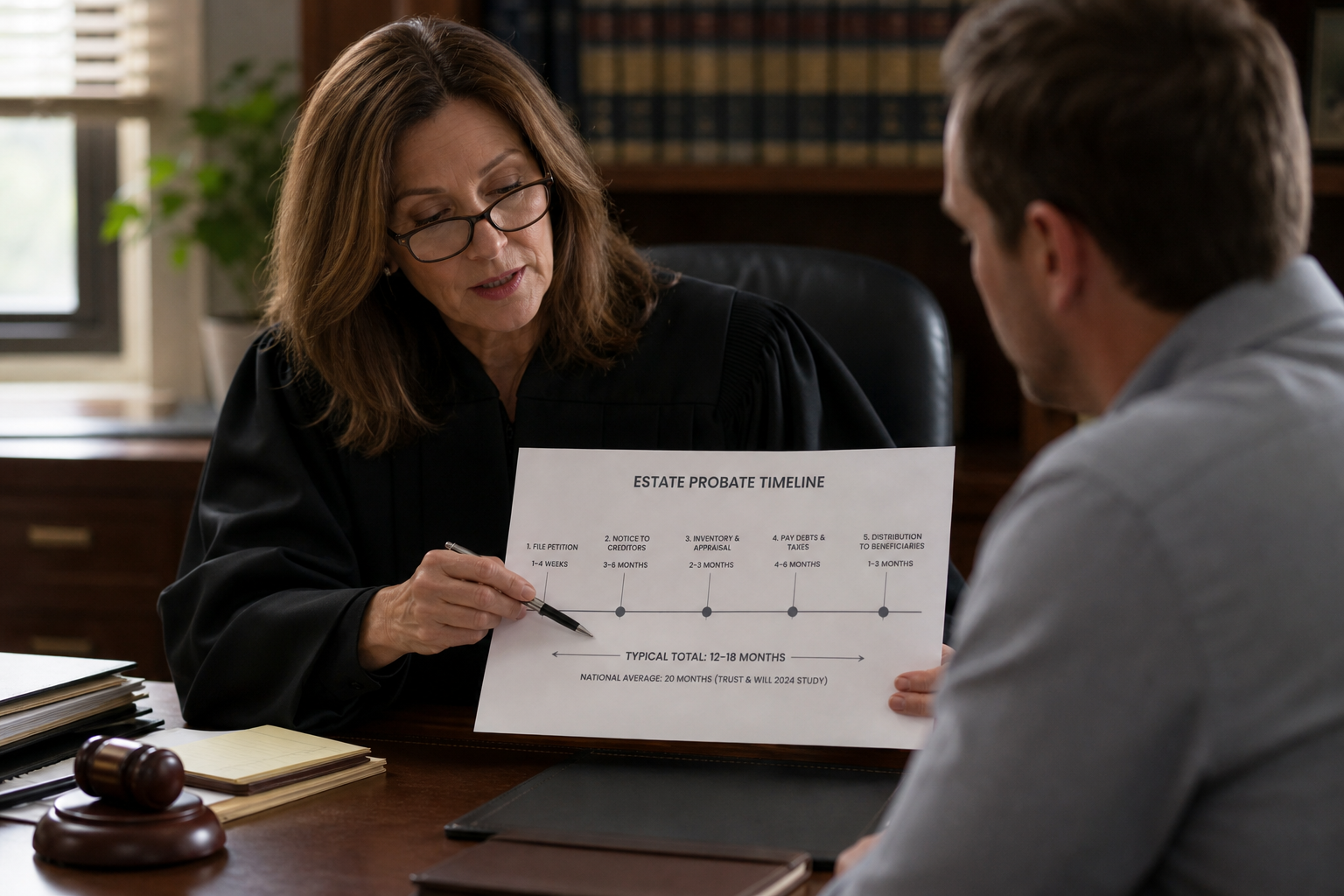
The process moves through broad phases rather than a single clock. Opening the estate and getting appointed typically takes a few weeks to a couple of months, depending on court scheduling. The inventory and appraisal phase that follows can take several additional months if the estate holds real property or business interests. Creditor claim periods often run for 4 to 6 months on their own. After creditors are resolved, preparing the final accounting and obtaining court approval for distribution adds more time.
For most executors, 12 to 18 months is a reasonable working estimate for a moderately complex estate with no disputes. Contested estates, or those involving real property sales, tax complications, or missing heirs, often run longer.
The practical takeaway is to avoid planning distributions around an early end date. Distributing assets before creditor deadlines expire creates personal liability for the executor, regardless of how straightforward the estate appears.
Is Probate Court Expensive?
Probate costs vary widely depending on where you live, what the estate holds, and how contested the process becomes. That said, most executors are surprised by how much adds up before a single dollar reaches a beneficiary.
The main cost categories you'll encounter include:
- Court filing fees, which typically run between $200 and $1,000 depending on the state and the size of the estate.
- Attorney fees, which many states allow to be calculated as a percentage of the gross estate value. In California, for example, statutory attorney fees on a $500,000 estate can reach $13,000 or more before any contested issues arise.
- Executor fees, which follow similar percentage-based formulas in many states and are often comparable to attorney compensation.
- Appraisal and accounting costs, since most probate courts require a formal inventory of estate assets, which typically means hiring a certified appraiser and sometimes a CPA.
- Publication fees, because most states require you to publish a creditor notice in a local newspaper, which can cost several hundred dollars.
How Costs Stack Up by State
According to LegalMatch's state-by-state cost comparison, probate fees as a percentage of estate value tend to cluster between 3% and 8% in most states, though contested estates or those with real property complications can push well above that range. California is frequently cited as one of the more expensive states due to its statutory fee structure. Florida also uses a percentage-based attorney fee model. States like Wisconsin and Michigan tend to have lower filing costs, though attorney rates still vary significantly by county.
Applying that 3% to 8% range to a $400,000 estate puts total probate costs between $12,000 and $32,000 when you include attorney fees, court costs, appraisals, and executor compensation. That range assumes no major disputes. Add a contested will or a creditor challenge and costs can climb well beyond it.
Who Actually Pays These Fees
Probate fees are paid out of the estate itself, not out of the executor's own pocket. The estate covers court costs, attorney fees, and appraiser's bills before any distributions are made to beneficiaries. That means your beneficiaries receive less. The executor is entitled to compensation from the estate as well, though many choose to waive it when they are also a primary beneficiary.
One practical note: if the estate is cash-poor but asset-rich (a common situation when the main asset is a house), costs still have to be funded somehow. In those cases, executors sometimes advance expenses and seek reimbursement from the estate once assets are liquidated.
How to Avoid Probate Court
Probate is not always required, and in many cases, you can take steps now or during settlement to keep assets out of the court process entirely. The right approach depends on the size of the estate, the types of assets involved, and the extent of planning before death.

| Probate Avoidance Method | How Assets Transfer | What It Covers | Key Requirement |
|---|---|---|---|
| Revocable Living Trust | Assets titled in the trust name pass directly to beneficiaries through the trust document without court involvement | Real estate, bank accounts, investment accounts, and personal property | Assets must be transferred into the trust during the owner's lifetime or the trust remains unfunded |
| Beneficiary Designations | Retirement accounts, life insurance policies, and POD or TOD accounts transfer directly to named beneficiaries upon presenting a death certificate | 401(k)s, IRAs, life insurance, bank accounts, and brokerage accounts with payable-on-death or transfer-on-death setup | Beneficiary designations must be current because they override what a will says |
| Joint Ownership with Rights of Survivorship | Property passes automatically to the surviving owner by operation of law, the moment the co-owner dies | Real estate held as joint tenants and other jointly owned property with survivorship rights | Property must be titled with joint tenancy or rights of survivorship language, not tenancy in common |
| Small Estate Affidavit | Heirs collect assets with a sworn statement filed with the institution holding the asset, bypassing formal probate entirely | Estates below the state threshold, which is $208,850 in California for deaths before April 1, 2026, or $239,700 after | Total probate estate value must fall below your state's statutory threshold and the state must offer this procedure |
Revocable Living Trusts
A revocable living trust is one of the most reliable ways to avoid probate on a broad range of assets. When assets are titled in the trust during the owner's lifetime, they pass directly to beneficiaries under the trust document after the owner's death, without court involvement. The trust itself does not go through probate because, legally, the trust owns the assets rather than the individual. This works for real estate, bank accounts, investment accounts, and personal property. The American Bar Association explains how probate works and why trusts effectively bypass it.
The catch: a trust only covers assets that were actually transferred into it. Anything left in the decedent's individual name may still require probate, which is why "funding" the trust correctly during life matters as much as creating it.
Beneficiary Designations and Joint Ownership
Several asset types pass outside of probate by design:
- Retirement accounts (401(k)s, IRAs) and life insurance policies transfer directly to named beneficiaries, bypassing the estate entirely, regardless of what a will says.
- Bank and brokerage accounts set up with a payable-on-death (POD) or transfer-on-death (TOD) designation move to the named person upon death without any court filing.
- Jointly owned property with rights of survivorship, including real estate held as joint tenants, passes automatically to the surviving owner.
These designations are worth reviewing regularly. An outdated beneficiary designation, like an ex-spouse still listed on a retirement account, will override anything written in a will.
Small Estate Procedures
Most states offer simplified procedures for estates that fall below a certain value threshold. In California, for example, estates valued under $208,850 (for deaths before April 1, 2026) or $239,700 (for deaths on or after April 1, 2026) may qualify for a small estate affidavit, allowing heirs to collect assets with a simple sworn statement rather than opening a formal probate case.
Texas and many other states have similar small estate affidavit options, though the thresholds and qualifying rules vary by state. If the estate qualifies, this can resolve the entire administration process in a matter of weeks rather than months.
What a Will Alone Does Not Do
Having a will does not avoid probate. A will must be submitted to and validated by the probate court before it has any legal effect on asset transfers. The will tells the court who gets what, but the court still controls the process. Only the asset-titling strategies above, trusts, beneficiary designations, and joint ownership actually keep assets outside of court.
If none of these were in place before death, probate is likely required, and the path forward is working through the court process as efficiently as possible.
Why Would You Get a Letter from Probate Court?
Receiving a letter with "Probate Court" on the return address can feel alarming, especially if you had no idea an estate was even open. Most people's first instinct is to wonder whether they owe money or are being sued. In almost every case, neither is true.
Courts send a formal notice to anyone who has a legal interest in the estate being probated. That includes a wide range of people, and getting a letter is typically the court doing its job, not signaling a problem with you personally.
The most common reasons you might receive one:
- You are named as a beneficiary in the decedent's will, and the executor is required by law to notify you that probate has opened and what you stand to receive.
- You are a legal heir under state intestacy laws, which means the court considers you a potential inheritor even if you were not named in any document. Relatives who are not named in a will still receive notice in many states because they have standing to contest the proceedings.
- You are a creditor, or the estate believes you may have a claim. Executors are required to notify known creditors so they can submit claims within the court-specified window.
- You are being informed of a hearing date, either one you may attend as an interested party or one where an objection deadline applies to you.
- The estate involves property or accounts you are connected to, and the court or executor needs to confirm your relationship to those assets before proceeding.
Receiving probate court notice does not mean you are a party to a lawsuit or that any claim is being made against you. It means the court has recognized your legal stake in the outcome.
What you should do when the letter arrives depends entirely on its contents. Read it carefully. If it is a notice of beneficiary status, it typically requires no immediate action other than tracking the estate's progress. If it includes a response deadline, an objection window, or a hearing date, those dates are binding, and missing them can affect your legal rights. When in doubt, an estate attorney can read the notice and tell you within a short consultation exactly what, if anything, you need to do.
How Alix Handles the Work That Turns Probate Into a Year-Long Process
Probate creates a long queue of administrative work that sits between the court's legal process and the moment you can actually close the estate. The hearings, filings, and creditor deadlines are only part of it. What consumes most of an executor's time is everything that runs alongside those court milestones: tracking down accounts, notifying institutions, managing property, coordinating appraisals, handling creditor disputes, and keeping beneficiaries informed through a process that typically runs 12 to 18 months.
Alix is built for exactly that layer of work. When you are appointed executor, and the probate clock starts, Alix assigns you a dedicated estate specialist who takes on the non-legal administrative work so you are not spending evenings on hold with banks or weekends organizing paperwork.
Here is what that looks like in practice:
- Asset discovery and documentation: your specialist identifies and inventories financial accounts, real property, vehicles, and personal property, including overlooked items like safe deposit boxes, uncashed checks, brokerage accounts held at smaller institutions, and digital assets, so nothing falls through the cracks before the estate inventory deadline.
- Institution outreach: Alix contacts banks, brokerages, retirement plan administrators, and insurance companies on your behalf to request account statements, gather balances, obtain account freeze or closure forms, and follow up on pending transfers that stall without a dedicated point of contact.
- Creditor and debt coordination: incoming creditor claims — medical bills, credit card balances, mortgage servicer notices, and utility arrears, among them, get organized, tracked against the state's claim period, and escalated to your attorney when a claim requires legal response. Alix does not advise you to distribute assets before that window closes.
- Property coordination: if the estate includes real estate, Alix coordinates locksmith access, utility transfers, insurance continuation, routine maintenance, appraisals, and sale logistics alongside your attorney and any real estate professionals involved.
- Beneficiary communication: your specialist keeps beneficiaries updated throughout the process — fielding questions about distribution timelines, explaining what each person is set to receive, and relaying status updates — reducing the calls and emails that otherwise land on you personally.
- Tax and document coordination: Alix organizes prior-year returns, 1099s, cost-basis records, and account statements for the estate's tax filings and works with your accountant or attorney to confirm nothing is missing when the nine-month federal estate return deadline and other filing dates arrive.
Your attorney handles what requires a law license: court filings, formal accountings, creditor notices, and hearings. Alix handles the 100-plus administrative tasks that surround that work. The two run in parallel so the estate moves as efficiently as the probate timeline allows, instead of stalling between court dates because the administrative side hasn't kept pace.
If the estate you're settling has meaningful assets, real property, or any complexity at all, that coordination gap is where delays and personal liability risk actually live. Alix closes it.
Final Thoughts on Understanding Probate Court
Probate court steps in when someone dies and owns assets that require legal transfer, and the process typically takes 12 to 18 months from start to finish. Whether you're dealing with a will or intestacy, the court follows a structured timeline with creditor notice periods, mandatory hearings, and formal accountings before any distributions happen. Most executors underestimate how much administrative work sits between those court dates. Get started with Alix so your estate keeps moving forward rather than stalling between filings.
FAQ
Can I avoid probate court without a will?
Yes, if assets are titled to pass outside of probate court, you can avoid the process entirely, even without a will. Revocable living trusts, payable-on-death or transfer-on-death designations on accounts, jointly owned property with rights of survivorship, and estates below your state's small-estate threshold all bypass probate regardless of whether a will exists.
What happens in probate court when there is no will?
The court appoints an administrator (instead of an executor) and distributes assets according to state intestacy laws instead of the decedent's wishes. Intestacy statutes follow a fixed formula, typically giving shares to a surviving spouse and children first, then parents and siblings, with no exceptions for informal relationships or unwritten intentions.
Is probate court expensive?
Probate costs typically run between 3% and 8% of the estate's gross value, though contested cases can push higher. On a $400,000 estate, total costs commonly fall between $12,000 and $32,000 when you include court filing fees, attorney fees, executor compensation, appraisals, and creditor publication costs.
How long does it take to get letters testamentary?
You typically receive letters testamentary within a few weeks to a couple of months after filing your petition to open probate, depending on court scheduling in your jurisdiction. The initial hearing itself often wraps up in under 30 minutes if the will is uncontested and your paperwork is complete.
Probate costs by state: which are the most expensive?
California and Florida rank among the most expensive states due to statutory percentage-based fee structures for attorneys and executors. States like Wisconsin and Michigan tend to have lower filing costs, though attorney hourly rates still vary widely by county, and contested matters drive up costs everywhere
.png)
Related resources