How Long Does Probating a Will Take in 2026? Complete Timeline Guide
Probate takes 12-18 months for most estates in June 2026, with a national average of 20 months. Learn the actual timeline by state, phase, and scenario.
Your father passed away in March, you filed probate in April, and now it's November, and you're still waiting on the court to approve the final accounting. Everyone keeps asking when they'll get their inheritance, and you have no idea when this actually ends. The realistic answer in 2026 is that most estates take 12 to 18 months for straightforward cases and 20 months on average nationally, with California and New York routinely running well past two years. The old 6 to 12-month estimate you see everywhere is outdated. Here's the actual timeline by state, by scenario, and by the five phases every estate moves through from filing to final distribution.
Key Takeaways:
- Probate takes 12 to 18 months for most estates in 2026, with a national average of 20 months.
- Mandatory creditor windows (3 to 6 months) and tax clearance delays stretch timelines beyond court filing dates.
- State matters: California runs 12 to 24+ months, while Michigan often closes in 6 to 12 months.
- You can't distribute to beneficiaries until creditors are paid and the court approves your final accounting.
- Alix handles asset discovery, creditor management, and property coordination alongside your attorney's legal filings.
What Does Probate Actually Take (And Why Nobody Estimates It Correctly)

Probate looks straightforward on paper: file the will, appoint an executor, pay the debts, distribute the assets. What most executors quickly find is that the calendar rarely cooperates with that logic.
The national average sits at 20 months, according to Trust & Will's 2024 probate study. That number surprises most people because the commonly quoted range of 6 to 12 months is outdated. The current realistic baseline is 12 to 18 months for a typical estate, and many run longer.
The gap between expectation and reality comes from a few structural realities that are easy to underestimate before you're in them.
Where the Time Actually Goes
Courts set the pace for the mandatory waiting periods baked into probate, and you have no control over those. But the delays that accumulate on top of court schedules tend to come from a few predictable sources:
- Creditor notice periods run 3 to 6 months in most states, and you cannot legally distribute assets to beneficiaries until that window closes. Rushing this exposes you to personal liability.
- Real property takes time to appraise, prepare, list, negotiate, and close. A house that sits on the market for two months adds two months to your timeline, minimum.
- Missing or contested documents, especially when a will is unfiled or contested, can stall the court appointment process before anything else even starts.
- Tax clearance often creates a second waiting period near the end. Federal estate tax returns are due 9 months after the date of death, but refunds and clearances from the IRS can lag well beyond that.
- Multi-state assets require probate in each state where real property is held, running those processes in parallel or sequence, depending on the estate.
The Difference Between Simple and Complex
Not every estate takes 20 months. Small estates with a single bank account, no real property, and no creditor disputes can sometimes be closed in a few months, particularly in states with simplified small-estate procedures. Larger estates with real property, retirement accounts, business interests, or family disagreements often take 2 to 3 years.
The variables that most reliably extend timelines are contested wills, uncooperative institutions, missing beneficiaries, and property that requires significant preparation before sale. Any one of those factors can add months.
The Five Phases That Determine Your Timeline
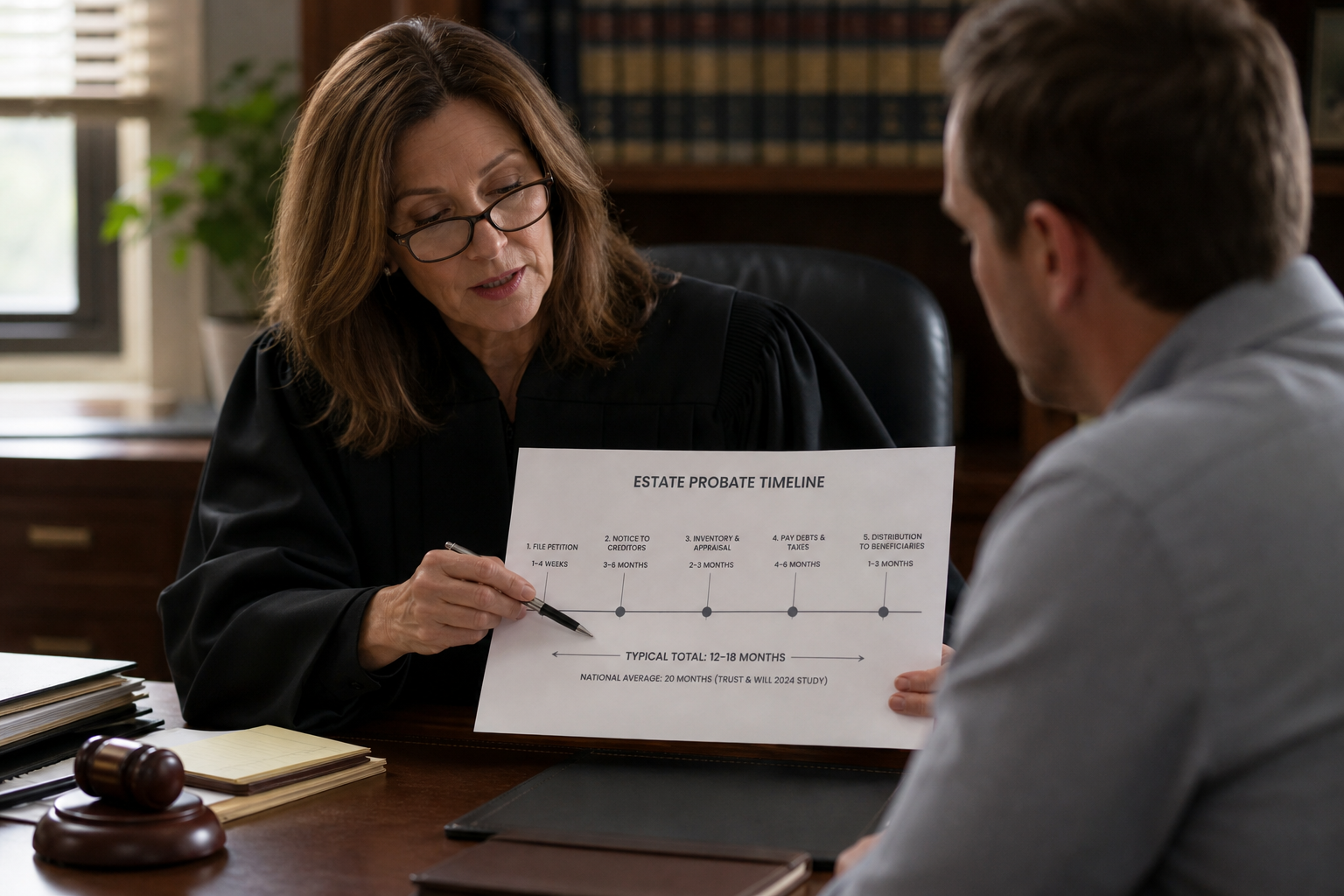
Probate moves through five distinct phases, and the total time you spend in each one depends heavily on estate complexity, your state's court backlog, and how quickly creditors and beneficiaries respond. Most estates take 12 to 18 months to complete all five phases, though the national average is closer to 20 months, according to Trust & Will's 2024 study.
Phase 1: Filing and Appointment (Weeks 1 to 8)
The clock starts when you file the will and petition for probate with the court. Depending on your county's docket, you may wait anywhere from two to eight weeks just to get a hearing date. Once the judge approves the petition, you receive Letters Testamentary, the legal document that gives you authority to act on behalf of the estate. Without it, banks, brokers, and title companies will not work with you.
Phase 2: Inventory and Appraisal (Months 2 to 5)
After your appointment, you have a court-imposed deadline, typically 60 to 90 days in most states, to file a formal inventory of all estate assets. Real property requires a licensed appraisal. Retirement accounts, brokerage accounts, and business interests each have their own valuation requirements. Missing this window can draw scrutiny from the court or beneficiaries.
Phase 3: Creditor Notification and Claims Period (Months 3 to 7)
You are required to publish a creditor notice in a local newspaper and notify known creditors directly. Most states keep the claims period open for 3 to 6 months. You cannot distribute anything to beneficiaries until this window closes and all valid claims are resolved. Distributing early exposes you to personal liability for any unpaid debts.
Phase 4: Tax Filings and Clearance (Months 6 to 14)
The estate's final income tax return and, where applicable, an estate income tax return must be filed before distribution. If the estate is large enough to trigger a federal estate tax return, that filing is due nine months after the date of death. Waiting on IRS clearance or a closing letter from state tax authorities routinely adds several months to the total timeline.
Phase 5: Distribution and Closing (Months 12 to 20+)
Once creditors are paid and tax matters are cleared, you can distribute assets to beneficiaries and file a final accounting with the court. Contested wills, real property that takes time to sell, or a slow court calendar can push this phase well past the 18-month mark. Only after the court approves the final accounting is the estate formally closed.
How Probate Timelines Vary by State in 2026
State law governs every stage of probate, which means where the decedent lived at the time of death may matter as much as the size or complexity of the estate. The timelines below reflect typical ranges in 2026, accounting for court backlogs, mandatory waiting periods, and creditor notice requirements that differ across jurisdictions.
California
California probate routinely runs well over a year, and in contested or complex cases, it can stretch to two years or more. Courts in Los Angeles and the Bay Area carry heavy dockets, which adds wait time at nearly every filing step. The small-estate threshold is $239,700 for deaths on or after April 1, 2026 (and $208,850 for deaths before that date), so estates under those values may sidestep formal probate entirely through a simplified affidavit process.
Florida
Florida sets a 3-month creditor claim window after the date of first publication of the Notice to Creditors, and that window alone anchors the minimum timeline. Most Florida estates close in 9 to 18 months. Formal administration is required for estates above $75,000, while summary administration is available for estates valued under that threshold or where the decedent has been deceased for more than two years.
New Jersey
New Jersey probate is often faster than the national average because the state does not require court approval for most routine filings. Many NJ estates wrap up in 9 to 12 months, though a mandatory 9-month window exists before an executor can make final distributions, which sets a hard floor on the timeline regardless of how quickly paperwork moves.
Michigan
Michigan follows a relatively straightforward process for unsupervised informal probate, which most estates qualify for. Typical timelines run 6 to 12 months, though supervised administration or contested matters can push that well past a year. Michigan also allows small-estate affidavits for estates valued at $25,000 or less.
New York
New York probate moves slowly compared to most states. Surrogate's Court proceedings in counties like New York and Kings can take 18 to 24 months or longer for larger or contested estates. Even uncomplicated matters in less congested counties often take 12 to 18 months.
Oregon
Oregon uses a creditor claim period of 4 months from the date of first publication of the Notice to Creditors. Most Oregon estates close in 6 to 12 months under informal probate, though formal proceedings or disputes can extend that range. Real property valued at $275,000 or less and personal property valued at $75,000 or less may qualify for a small-estate affidavit.
South Carolina
South Carolina probate typically runs 8 to 12 months for straightforward estates. The state requires a minimum 8-month creditor notice period, which sets a practical floor similar to New Jersey's. More complex estates involving real property disputes or multiple beneficiaries can take 18 months or more.
State-by-State Probate Timeline Summary
| State | Typical Timeline | Small Estate Threshold | Key Factor |
|---|---|---|---|
| California | 12 to 24+ months | $239,700 (deaths on/after Apr 1, 2026) | Court backlog, high asset values |
| Florida | 9 to 18 months | $75,000 | 3-month creditor window |
| New Jersey | 9 to 12 months | $20,000 | 9-month distribution hold |
| Michigan | 6 to 12 months | $25,000 | Informal probate availability |
| New York | 12 to 24+ months | $50,000 | Surrogate's Court congestion |
| Oregon | 6 to 12 months | $275,000 real / $75,000 personal | 4-month creditor period |
| South Carolina | 8 to 18 months | $25,000 | 8-month creditor notice requirement |
How Long Probate Takes Without a Will
When someone dies without a will, the probate process follows intestacy laws instead of the decedent's wishes, and that shift in legal footing almost always adds time.
The core reason is the appointment. Without a will naming an executor, the court must appoint an administrator, typically a spouse, adult child, or other close relative. That appointment process requires additional hearings and paperwork before anyone has legal authority to act on the estate. In contested situations, where multiple relatives want the role or disagree on who should serve, that phase alone can stretch by several months.
From there, the estate still moves through the same core steps as a testate estate: inventory, creditor notice period, debt resolution, and distribution. The difference is that intestacy formulas govern who gets what, and those formulas are rigid. If the family's actual circumstances don't align neatly with the state's distribution rules, disputes are more likely, which slows everything down.
How Long It Typically Takes by State
Timelines vary considerably depending on estate complexity and local court backlog. California intestate cases often run 12 to 24+ months, while Florida typically takes 9 to 18 months. New York and New Jersey both commonly run 9 to 18 months. Michigan moves faster at 5 to 12 months, Oregon at 4 to 12 months, and South Carolina at 8 to 12 months.
These ranges reflect general court timelines and assume no major disputes. Real-world cases with creditor complications, real property, or family disagreements routinely land at the longer end.
One firm deadline worth knowing: most states give you a specific window to open probate after death, even without a will. In Florida, for example, there is no hard statutory deadline to file, but waiting too long can complicate asset access and creditor matters. In California, you generally have a few years before the statute of limitations on certain claims creates problems, but delays in filing still carry practical costs.
If the estate falls below your state's small estate threshold, you may be able to skip formal probate entirely using an affidavit procedure, even without a will. California's current threshold is $239,700 for deaths on or after April 1, 2026, and $208,850 for deaths before that date. Other states set their own figures, many of which are lower.
What Actually Delays Probate (And What You Can Control)
Probate rarely runs long because the process itself is complicated. It runs long because of what piles up around it: missing paperwork, unresponsive institutions, family disputes, and court backlogs that no one warned you about. Knowing which delays are structural and which ones you can actually influence makes a real difference in how long you end up waiting.
Delays You Can't Control
Some slowdowns are built into the process by law or circumstance.
- Court scheduling backlogs are common in high-volume counties. In some California and New York jurisdictions, getting a hearing date alone can take several months. You file, you wait, and the court moves at its own pace.
- Mandatory creditor notice periods exist in every state. Most states require creditors to be given between two and six months to submit claims after being notified. You cannot legally distribute assets until that window closes.
- Tax clearance requirements can considerably extend timelines. If the estate owes state or federal taxes, the IRS and state agencies have their own review timelines before they issue clearance. Distributions are often held until those are resolved.
- Contested wills or disputed asset ownership require court hearings to resolve. If a beneficiary challenges the will's validity or a family member disputes who owns a specific asset, the probate case can stall for months or longer while litigation proceeds.
Delays You Can Control
A considerable portion of probate delays stems from matters within a prepared executor's reach.
- Filing delays caused by incomplete paperwork. Missing death certificates, unfiled inventory forms, or incorrectly completed petitions all send your case back to square one. Having every document organized before you file is one of the highest-impact things you can do.
- Slow asset discovery. If the estate holds accounts, policies, or property you haven't located yet, the inventory can't be completed and the estate can't be closed. Thorough asset discovery early in the process prevents this from becoming a bottleneck later.
- Communication gaps with beneficiaries. When beneficiaries don't receive regular updates, questions turn into formal objections that require court time to resolve. Proactive communication keeps the process moving.
- Hiring professionals late. Attorneys, appraisers, and accountants all have their own availability constraints. Waiting until you need them to start looking for them adds entirely avoidable lag time.
The honest answer to how long probate takes is that the timeline is partly fixed and partly up to you.
Small Estate Shortcuts That Bypass Full Probate
Not every estate has to go through full probate. Most states have created expedited alternatives for smaller estates, and knowing which one applies to you can save months of waiting and thousands in court costs.
Affidavit Procedures (Small Estate Affidavits)
Many states allow heirs to collect assets directly from financial institutions using a sworn affidavit, with no court involvement. The asset value thresholds vary widely by state:
- California allows affidavit collection for estates worth $208,850 or less (for deaths before April 1, 2026) or $239,700 or less (for deaths on or after April 1, 2026), covering personal property only.
- Texas sets its threshold at $75,000 in personal property.
- Florida has no traditional small estate affidavit for general use, but does offer a simplified summary administration process for estates under $75,000 or where the decedent has been dead for more than two years.
With a valid affidavit, you can typically collect bank balances, retirement accounts, and other personal property within a few weeks instead of waiting out the full probate calendar.
Summary Administration
For estates that exceed the affidavit threshold but still fall below the state's full probate threshold, summary administration offers a middle path. Court involvement is required, but the timeline is far shorter. In Florida, for example, summary administration can wrap up in as little as 4 to 8 weeks, compared to the 9 to 24 months a formal probate case can take.
What Determines Whether You Qualify
| Factor | Why It Matters |
|---|---|
| Total gross estate value | Must fall below the state's statutory threshold |
| Asset types involved | Real property usually cannot go through affidavit procedures |
| Time since death | Some states require a waiting period before simplified procedures are available |
| Whether a will exists | Intestate estates may face different rules than testate ones |
It is worth noting that even if the estate qualifies for a shortcut on paper, creditor claims, disputes among heirs, or jointly titled assets can complicate or disqualify the estate from simplified proceedings. If any of those factors are in play, you may end up in standard probate regardless of the estate's size.
How Long After Probate Granted Will You Get Your Money
The question most beneficiaries are really asking has nothing to do with court filings. It's simpler: when does the money actually arrive?
When a court grants probate, it confirms that the will is valid and formally appoints an executor. That appointment marks the start of the executor's legal authority, not the point at which distributions can happen. According to Keystone Law's estate settlement timeline, most beneficiaries receive their inheritance within 12 to 18 months after probate has been initiated, once all debts are paid and the court approves the final accounting.
The type of bequest you're owed affects your specific wait. There are two categories worth understanding here.
- Specific bequests are named dollar amounts or particular assets left directly to you. These can sometimes be paid out after the creditor claims window closes, even before the estate fully wraps up. If the executor is confident the estate can cover its debts, a judge may authorize early distribution of specific bequests.
- Residual bequests represent your share of whatever remains after debts, taxes, and specific gifts are satisfied. These cannot be calculated or distributed until the estate is completely settled. If you're a residual beneficiary, your timeline is tied to the estate's closing date, and extends past the creditor period alone.
What Has to Happen Before You Get Paid
Once the court grants probate, several steps still stand between that order and a check in your hands. The executor must notify and pay creditors, file any outstanding tax returns, obtain court approval of the final accounting, and then petition for an order authorizing distribution. Only after the order is signed can funds legally be transferred to the beneficiaries.
In practice, that sequence takes time. An estate with a straightforward asset list and no disputes might wrap distribution within a year of probate being granted. One with real property to sell, contested creditor claims, or a required estate tax return can run well past 18 months before beneficiaries see anything.
When You Know an Estate Is Actually Settled
"Settled" gets used loosely, and that loose usage creates real confusion for beneficiaries waiting on their share.
An estate is officially settled when the court issues an order of discharge, releasing the executor from their duties. That order only comes after a specific sequence of events: all valid debts are paid, outstanding tax returns are filed and cleared, any disputes are resolved, and the remaining assets have been distributed to beneficiaries according to the will or intestacy rules.
There are four concrete milestones worth watching as signals that settlement is close:
- The executor files a final accounting with the court, showing every dollar that entered and left the estate during the administration period.
- The court schedules a hearing to review and approve that accounting, which may invite objections from beneficiaries before approval is granted.
- Beneficiaries receive a notice of final distribution, often with a proposed schedule showing what each person is owed and when they can expect payment.
- The executor petitions for discharge, formally requesting that the court confirm that all duties have been completed and that the estate may be closed.
Why the Discharge Order Matters
The discharge order is the finish line. Until it exists, the estate is still legally open regardless of how much time has passed. If you are a beneficiary waiting on funds, ask whether the discharge order has been entered, and not merely whether distribution has happened. Those two events can be separated by weeks, and only one closes the estate.
How Estate Complexity Affects Your Timeline
Not all estates move at the same pace. A single bank account with no real property can close in a few months; an estate with a house, multiple accounts, business interests, or out-of-state assets can stretch well past two years. The biggest variable is what the estate actually contains, not which state you're in.
Several factors consistently push timelines longer:
- Real property that needs to be appraised, maintained, and eventually sold or transferred adds months to the process, particularly if the property is in a different state than where probate is filed.
- Disputes among beneficiaries or creditor claims that require court intervention can stall proceedings indefinitely until the court issues a ruling.
- Missing or incomplete documentation, like unfiled tax returns or accounts without clear ownership records, creates delays at nearly every step.
- Business interests or investment assets require formal valuation, which takes time and often involves outside professionals.
- Estates with debts require a creditor notice period before any distributions can happen. Most states mandate a waiting period of several months before an executor can legally pay beneficiaries.
The size of the estate matters too, though perhaps not in the way you'd expect. Larger estates don't automatically take longer, but they tend to carry more of the complications listed above. A modest estate with a contested will can take far longer than a larger one where everything is clean and undisputed.
When Complexity Compounds
The harder cases are those in which multiple complications stack. A house that can't sell until a title issue is resolved, combined with a creditor dispute and a beneficiary who's contesting the will, can push an estate well beyond the national average of 20 months that Trust & Will's 2024 study found. In those situations, the executor's ability to stay organized, track deadlines, and coordinate across attorneys, appraisers, and financial institutions becomes the single biggest factor in how fast the estate actually closes.
How Alix Handles the Work That Turns Probate Into a Year-Plus Commitment

Probate stretches past a year for most estates, and the reason is rarely the legal process itself. It's everything that has to happen around it.
While the court moves at its own pace, you're fielding calls from creditors, tracking down accounts at institutions that want original death certificates, coordinating property appraisals, managing a house that may sit vacant for months, and keeping beneficiaries informed through a process that gives them almost no visibility by default. That administrative weight is where the time goes.
Alix handles that layer. Working alongside your attorney, Alix handles the administrative coordination that bridges the gap between "probate opened" and "estate closed." That includes:
- Asset discovery across financial institutions, so you're not contacting every bank, brokerage, and custodian one at a time.
- Document organization and tracking, keeping death certificates, court orders, and account paperwork ready when institutions request them.
- Creditor management and outreach, so claims get handled methodically before distributions go out.
- Property coordination with appraisers, real estate agents, and title companies when the estate includes a home or vehicle.
- Beneficiary communication, so heirs receive accurate updates without every question landing on you.
- Account closures and transfers across retirement, brokerage, and payable-on-death accounts.
Your attorney handles the filings, creditor notices, court appearances, and formal estate accountings. Alix handles the 100-plus administrative tasks that surround that legal work and that no one tells you about when you agree to serve as executor.
For estates with real property, multiple accounts, or any complexity, that division of responsibility is what keeps a 12 to 18-month process from stretching well past two years. If you're already in the middle of it and wondering how much further you have to go, talking to an Alix specialist is a good place to start.
Final Thoughts on What Drives Probate Length
Your timeline is partly fixed by statute and partly determined by how quickly you can move through asset discovery, creditor resolution, and property coordination. The 20-month national average isn't a worst-case number. It's what happens when you account for everything that has to happen after the court approves your petition. If you want a clearer picture of what's ahead for your specific estate, an Alix specialist can map that out based on what you're actually dealing with.
FAQ
How long does probating a will take in California vs Florida in 2026?
California probate routinely runs 12 to 24+ months, often longer due to court backlogs in counties like Los Angeles and the Bay Area. Florida estates typically close in 9 to 18 months, with a mandatory 3-month creditor claim window following the first publication of the Notice to Creditors.
How long does probate take without a will?
Probate without a will typically takes longer than with one, except 9 to 18 months for straightforward intestate estates, though complex cases can stretch to 3+ years. The additional time comes from the court appointment process for an administrator and the increased likelihood of family disputes over distribution under state intestacy formulas.
How long after probate is granted will I get my money?
Beneficiaries typically receive their inheritance 6 to 18 months after probate is granted, according to Keystone Law. The court granting probate only confirms the will's validity and appoints the executor. You still have to wait for the creditor claims window to close, tax returns to be filed and cleared, and the final accounting to be approved before distributions can happen.
Can I skip full probate for a small estate?
Yes. Most states offer affidavit procedures or summary administration for estates below specific thresholds, letting you collect assets in weeks instead of waiting out the full probate calendar. California allows affidavit collection for estates worth $208,850 or less (deaths before April 1, 2026) or $239,700 or less (deaths on or after April 1, 2026), covering personal property only.
How do you know when an estate is settled?
An estate is officially settled when the court issues an order of discharge, releasing the executor from their duties. That order only comes after all valid debts are paid, outstanding tax returns are filed and cleared, any disputes are resolved, and the remaining assets have been distributed to beneficiaries according to the will or intestacy rules.
.png)
Related resources