What Is Estate Administration? Duties and Process
Estate administration is the work of identifying, protecting, managing, and transferring your loved one's property while addressing valid expenses, debts, taxes, records, and beneficiary rights. It can include...
Estate administration is the work of identifying, protecting, managing, and transferring your loved one's property while addressing valid expenses, debts, taxes, records, and beneficiary rights. It can include probate, but it is broader than probate because many estates also involve trusts, beneficiary-designated accounts, jointly owned property, personal responsibilities, and assets that transfer outside court.
The goal is not simply to "get through probate." The goal is to create an accurate, defensible path from the person's affairs at death to completed transfers, resolved obligations, reliable records, and formal closure where required.
What is estate administration in plain English?
Administration is the complete management project after a death. Someone must determine what exists, who controls it, what must be preserved or paid, who is entitled to receive property, and what evidence proves the work was completed properly.
There may be more than one person in charge of different parts:
- An executor or administrator, sometimes called the executor or administrator, handles probate property under court authority.
- A successor trustee handles trust property under the trust and applicable law.
- A surviving joint owner handles property received by survivorship.
- A named beneficiary submits claims for insurance or beneficiary-designated accounts.
- Family members may handle funeral, household, pet, or personal matters without controlling estate assets.
One person may hold several roles, but the source and limits of authority are different for each role.
How is estate administration different from probate?
| Estate administration | Probate |
|---|---|
| The complete work of settling affairs after death | A court-supervised or court-authorized legal process |
| Can include probate, trusts, contracts, joint ownership, taxes, and personal tasks | Primarily addresses probate property and court requirements |
| May involve several people with a legal duty to protect the assets and specialists | Centers on the court-appointed executor or administrator |
| Continues until all relevant work is completed | Ends through the court's applicable closing procedure |
An estate can require administration without a full probate. It can also require both probate and trust administration at the same time.
For the court process, read What Is Probate?. For the operational sequence, read How to Settle an Estate.
Who administers an estate, and what authority do they have?
The word "administrator" has a specific probate meaning: a person the court appoints when there is no acting executor. This commonly happens when someone dies without a valid will. Confirm the title used by the court handling the estate. In everyday conversation, people may use "estate administrator" more broadly for anyone handling the estate.
Use the court's terminology in filings and institutional communications. A person named in a will usually must still be appointed before acting for the probate estate. A power of attorney generally ends at death and does not authorize post-death estate transactions.
The authority map
Before acting, match each task to the correct authority.
| Task | Person who may have authority | Evidence commonly requested |
|---|---|---|
| Manage probate bank account | Executor or administrator | Death certificate, court-issued authority papers, EIN |
| Manage trust account | Successor trustee | Death certificate, trust certificate or relevant trust provisions |
| Claim life insurance | Named beneficiary | Death certificate and carrier claim forms |
| Collect POD or TOD account | Named beneficiary | Death certificate, identification, institution forms |
| Transfer jointly owned property | Surviving owner | Death certificate and title-specific documents |
| Sell probate real estate | Court-appointed representative, subject to local rules | Letters, deed, approvals or notices where required |
| File final tax return | Executor, administrator, or other authorized filer | Tax records and applicable authority |
Institutions can require additional documents. Never use another person's login or sign their name as a shortcut.
What are the core duties in estate administration?
Protect property
Secure residences, vehicles, valuables, mail, records, and digital devices. Maintain necessary insurance and reasonable care. Record the condition of significant property and prevent unauthorized removal.
Identify and classify assets
Create an inventory that records the name on the title or account, beneficiary designation, account or policy information, date-of-death value, liens, location, documents, and transfer path. Classifying an asset correctly determines who can act and which rules apply.
Obtain and preserve authority
File for probate authority when required, accept trusteeship properly, and provide institutions with appropriate evidence. Follow any court limits, bond requirements, trust restrictions, or co-executor, administrator, or trustee rules.
Keep property and money separate
Use estate or trust accounts with the correct owner name and authority. Do not mix estate or trust money with personal funds. Maintain supporting documents for every receipt, payment, reimbursement, sale, and transfer.
Address expenses and creditor claims
Identify obligations, follow required notice procedures, evaluate claims, and apply the relevant payment priority. Preserve defenses and do not pay questionable or lower-priority claims reflexively.
Complete tax responsibilities
Coordinate the person's final income-tax return, estate or trust income-tax filings, information reporting to beneficiaries, and any estate, inheritance, property, or business tax work that applies.
Communicate with beneficiaries
Provide accurate, consistent updates without promising outcomes that depend on claims, taxes, sales, valuations, or court approval. Document substantive communications and requests.
Account and distribute
Reconcile the administration, establish a supportable reserve, prepare the distribution plan, transfer assets correctly, and obtain receipts or approvals.
Close and retain records
Complete required court, tax, account, title, and institutional steps. Retain an organized final file so the executor, administrator, or trustee can explain what happened after the active work ends.
What are the six phases of estate administration?
The six phases of estate administration are stabilize, discover, route, administer, reconcile, then distribute and close.
Phase 1: Stabilize
Protect people, pets, property, insurance, records, and access. Obtain death certificates and establish a communication point for the family.
Phase 2: Discover
Locate the will, trust, deeds, statements, tax returns, insurance, business documents, digital records, debts, and professional contacts. Search for assets systematically rather than relying on memory.
Phase 3: Route
Classify each asset as probate, trust, beneficiary-designated, jointly owned, contract-controlled, or eligible for a simplified procedure. Identify who has authority for every route.
Phase 4: Administer
Obtain authority, notify institutions and interested parties, inventory and value property, maintain accounts and insurance, collect income, handle claims, and complete tax work.
Phase 5: Reconcile
Confirm what came in, what changed value, what was sold, what was paid, what remains, and what reserve is necessary. Resolve discrepancies before distribution.
Phase 6: Distribute and close
Transfer property under the controlling will, trust, contract, title, or intestacy rule. Obtain receipts, close accounts, complete court procedures, and preserve the final record.
How does a will change estate administration?
What changes when there is a will?
A valid will can nominate an executor and direct probate-property distributions. It may also grant administrative powers, create trusts, and waive bond where allowed. It does not automatically avoid probate and generally does not override valid beneficiary designations or survivorship ownership.
The administrator must still identify property, handle obligations, follow legal procedure, and document distributions.
What changes when there is no will?
Without a valid will, state intestacy law governs probate property and the court appoints an eligible administrator. The estate still requires the same basic discovery, preservation, claim, tax, accounting, and transfer work.
Beneficiary-designated, trust, and jointly owned assets may continue to transfer outside probate. "No will" and "everything goes through probate" are not equivalent.
How do probate, trust, and non-probate work fit together?
Consider an estate with a home held individually, an investment account in a trust, a retirement account naming an adult child, and a joint checking account with a spouse. The home may require probate, the trustee manages the investment account, the retirement custodian pays the beneficiary, and the joint account may pass to the surviving owner.
The administration plan must coordinate all four paths because taxes, liquidity, beneficiary expectations, expenses, and records can overlap even when legal ownership does not.
Records every estate administrator should maintain
- Master contact list for beneficiaries, heirs, professionals, institutions, and creditors.
- Authority file containing the will, trust, letters, orders, and identification documents.
- Asset-routing inventory with ownership, value, status, and transfer path.
- Deadline calendar for court, claims, tax, insurance, and property work.
- Receipt and expense ledger with supporting statements and invoices.
- Creditor register showing notice, evaluation, priority, and disposition.
- Communication log recording significant updates and decisions.
- Distribution schedule and signed receipts.
- Complete record of assets, money, distributions, and closing documents.
These records are not busywork. They are the evidence that allows an executor or trustee to answer beneficiaries, prepare returns, complete accountings, and defend decisions.
How long does estate administration take?
The slowest necessary workstream controls the schedule. A non-probate account may transfer quickly while real estate, claims, taxes, or a probate case remains open. The administration is not complete merely because the court appointed an executor or because some beneficiaries received property.
Factors that extend the process include asset sales, business interests, missing records, disputes, creditor periods, tax filings, property in several states, trust questions, and premature decisions that must be corrected.
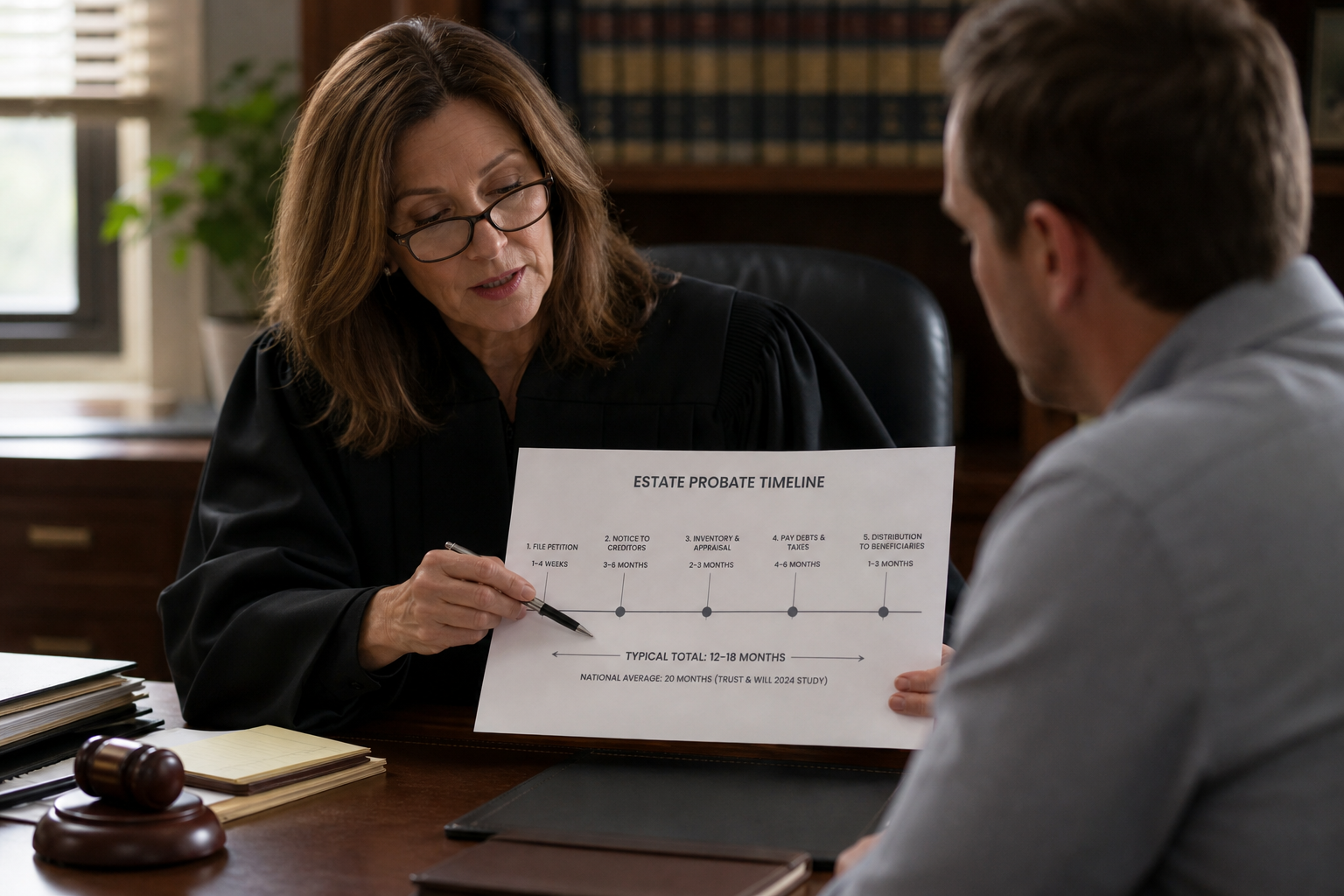
For probate-specific timing, see How Long Does Probate Take?.
When is professional help important, and what does completion look like?
Professional help becomes important when authority, documents, finances, taxes, property, or beneficiary rights are unclear, while completion requires every workstream to be resolved and documented.
When professional help is important
Consider legal, tax, valuation, real-estate, investment, or operational support when:
- Authority or document meaning is unclear.
- The estate may be insolvent.
- Beneficiaries or people with a legal duty to protect the assets are in conflict.
- There is a business, lawsuit, unusual asset, or property in several states.
- A surviving spouse, minor, disabled beneficiary, or missing person has rights to protect.
- Tax returns, elections, or valuations are material.
- The executor lacks time or systems to coordinate the work.
A lawyer, accountant, appraiser, broker, and estate-settlement specialist perform different functions. Define each scope and assign ownership for every task.
Use Do I Need a Lawyer for Probate? to evaluate the legal-support decision.
What completion looks like
Estate administration is complete when the relevant property has been identified and transferred, required obligations and taxes are resolved or properly provided for, beneficiaries have received appropriate information and property, required court and institutional procedures are complete, executor, administrator, or trustee accounts are reconciled, and the final record supports every material action.
A practical completion test asks:
- Can every known asset be traced to its final transfer or disposition?
- Can every payment be tied to a valid purpose and supporting document?
- Are claims, taxes, reserves, and professional fees resolved?
- Did each beneficiary receive the correct property and documentation?
- Are court, trust, title, and account-closing requirements complete?
- Can the executor, administrator, or trustee produce an understandable complete record of assets and money?
If any answer is no, the administration still has an open workstream.
How Alix fits into estate administration
You may already have an attorney for legal work and an accountant for taxes but still lack someone managing documents, institutions, timelines, property, specialists, and beneficiary updates. Alix is a Done-for-You provider of estate settlement services that manages the process from start to finish. A dedicated Estate Settlement Specialist handles more than 150 operational tasks. Licensed attorneys handle court filings, legal advice, hearings, and other work requiring a lawyer. You can use an attorney from Alix's network, included in one transparent fee, or your own attorney.
Frequently asked questions
Is estate administration the same as probate?
No. Probate is the court process for property that needs court authority to transfer. Estate administration includes probate plus trust work, beneficiary claims, jointly owned property, taxes, debts, records, property tasks, and other responsibilities required to complete your loved one's affairs.
Who can administer an estate?
A court-appointed executor or administrator handles probate property. A successor trustee handles trust property, and named beneficiaries claim certain accounts or insurance. One person may hold several roles, but each role has a different source of authority and different limits.
What records should an estate administrator keep?
Keep the will, trust, court papers, asset inventory, account statements, valuations, receipts, claim records, tax filings, beneficiary communications, distribution approvals, and transfer proof. The final record should clearly explain where every asset went and why every estate payment was made.
When is estate administration complete?
The work is complete when assets have reached the correct recipients, valid obligations and taxes are resolved, required court and institution steps are finished, accounts are reconciled, beneficiaries have received appropriate information, and the executor or trustee can produce a clear record of the administration.
Does estate administration always require probate?
No. Estate administration can include property transferred through a trust, named beneficiary, joint ownership, contract, or simplified state procedure. Probate is one possible court route within the broader administration. Review every asset's ownership and transfer instructions before assuming that the whole estate belongs in one court process.
What should you do next?
Start with one document that lists every known asset, whose name appears on the title or account, any beneficiary, its approximate value, the person believed to have authority, and the next required action. That routing inventory will reveal whether the estate needs probate, trust administration, direct claims, simplified procedures, or several paths at once.
Then use the complete estate settlement checklist to manage the work in order.
Related Alix guides for the work ahead
- Use the complete estate-settlement process to put the administration phases in order.
- Understand the probate process before opening a court case.
- Decide when probate counsel is appropriate and which operational tasks remain.
- Open an estate account and obtain an EIN for estate receipts and payments.
- Handle credit-card accounts after death within the creditor workstream.
- Transfer a vehicle after death through the correct title route.
References
.png)
Related resources