Many people going through probate without a will are surprised to learn the court doesn't try to guess what the deceased wanted. It applies a statute, and that statute was written for the average family, not yours. Understanding how that plays out, and what the rules look like in your state heading into 2026, makes the process much less disorienting.
Key Takeaways:
- Dying without a will does not skip probate; it typically makes the process longer and more contested.
- State intestacy law controls who inherits, in what shares, and in what order, with no room for the deceased's actual wishes.
- Retirement accounts, life insurance, and accounts with named beneficiaries pass outside probate entirely, regardless of intestacy rules.
- Per a Trust & Will 2024 study, the national average probate timeline is 20 months; intestate estates often take longer because heirs must be identified.
- Alix coordinates 150+ administrative tasks across account closures, creditor correspondence, and property work as a single estate-funded process.
What It Means to Die Without a Will
When someone dies without a valid will, the legal term is "intestate." Contrary to what many people assume, dying intestate doesn't skip probate. It typically makes probate longer, more contested, and more procedurally rigid.
With a will in place (the legal term is "testate"), the deceased named their beneficiaries, chose an executor, and gave the court a roadmap to follow. Without one, the court steps into that role entirely. State law decides who inherits, in what shares, and in what order. Whatever the deceased preferred, or what your parent, sibling, or loved one would have wanted, those preferences carry no legal weight.
Every state has its own intestate succession laws that function as a default inheritance scheme. They generally place spouses and children first, then parents, then siblings, and so on down the family tree. The problem is that this legal hierarchy rarely matches the real shape of a family:
- A long-term partner who wasn't legally married may receive nothing, regardless of how many years the relationship lasted.
- A child from a prior relationship may inherit ahead of a stepchild the deceased raised for decades.
- Estranged relatives can surface and receive a share simply because the statute puts them in line.
One further complication is worth naming directly. Without a named executor, the court appoints an administrator instead. That person takes on the same responsibilities an executor would carry, including gathering assets, notifying creditors, and managing the estate through probate, but without any guidance from the deceased about who they trusted or what they wanted. The administrator is bound by statute, not by the person's wishes.
The court isn't trying to honor the person who died. It's applying a statute written for the average case, which may bear little resemblance to yours.
That's the core shift in an intestate estate: the deceased no longer has a voice in the outcome. The probate court becomes the decision-maker, and the process moves entirely on the court's terms.
How Probate Without a Will Works Step by Step
The probate process follows the same broad arc in most states, though the paperwork, fees, and timelines differ. Here is how it typically unfolds.
1. File a Petition to Open the Estate
Someone files a petition with the probate court in the county where the deceased lived. In an intestate case, this petition asks the court to open the estate and appoint an administrator. You will also need to submit the death certificate and any filing fees, which vary by state and sometimes by estate size.
2. The Court Appoints an Administrator
Once the court accepts the petition, the judge appoints an administrator, usually the surviving spouse, an adult child, or another close relative who volunteered or was nominated. The court issues Letters of Administration, a formal document that gives the administrator legal authority to act on behalf of the estate.
3. Notify Creditors and Heirs
Most states require the administrator to publish a public notice to creditors, often in a local newspaper, for a set period. During this period, creditors may file claims against the estate. Heirs identified under the state's intestacy laws must also be formally notified.
4. Inventory and Appraise Assets
The administrator locates and values everything the deceased owned: bank accounts, real property, investments, vehicles, personal property. Many states require a formal inventory to be filed with the court within 60 to 90 days of appointment.
5. Pay Debts, Taxes, and Expenses
Valid creditor claims, estate administration costs, and any applicable taxes get paid before heirs see anything. This order is fixed by law, and distributing assets before the creditor claim window closes can expose the administrator to personal liability.
6. Distribute What Remains to Heirs
After debts are settled, the remaining assets go to heirs in the shares the state's intestacy statute determines. The administrator files a final accounting with the court, and once the judge approves it, the estate closes.
One important note: the court does not move at your pace. Each phase requires filings, waiting periods, and approvals. That is a large part of why intestate estates commonly run longer than testate ones.
Who Can Initiate Probate and Serve as Administrator
When there is no will, someone still has to take the first step to open probate, and the court answers who has legal standing through a statutory priority list.
Most states follow a similar hierarchy for who can petition to open probate and who the court will appoint as administrator:
- The surviving spouse has first priority in nearly every state and typically has the strongest claim to serve.
- Adult children of the deceased come next, and any one of them can step forward if the spouse declines or there is no surviving spouse.
- Parents of the deceased follow, then siblings, then other next of kin in descending order of relation.
If no family member volunteers or qualifies, many states allow the court to appoint a public administrator, often a county official, to manage the estate instead.
The Difference Between an Administrator and an Executor
The person appointed in a no-will estate is called an administrator, not an executor. An executor named in a will carries out stated wishes, sometimes with a letter of instruction to guide judgment calls. The court appoints an administrator, who is bound entirely by statute, with no guidance from the deceased. The legal responsibilities are the same; the source of authority is not.
How the Appointment Actually Works
To start the process, whoever wants to serve files a petition for administration with the probate court in the county where the deceased resided. Most states also require notice to other potential heirs before confirming the appointment, giving relatives a chance to object or put forward a different candidate.
Once the court approves the petition, it issues Letters of Administration, which give the administrator legal authority to access accounts, manage property, and act on behalf of the estate.
A few common situations worth knowing:
- If two people of equal priority both want the role, such as two adult children, the court decides between them.
- If someone with higher priority declines, they typically file a written waiver so the court can move to the next person in line.
- Appointment doesn't happen instantly; the notice period and any objections can add weeks before the court issues Letters of Administration.
What an Administrator Is Legally Allowed to Do
Being appointed administrator gives you real legal authority over the estate, but that authority has clear boundaries. Courts don't hand over control without oversight, and the administrator must act in the estate's interest, not their own.
Can an Administrator Also Be a Beneficiary?
Yes. In intestate estates, the administrator is often an heir, such as an adult child or surviving spouse. No legal rule forbids it. The fiduciary duty still applies fully, meaning you must treat all beneficiaries equally and cannot use your position to advantage yourself at others' expense.
Can an Administrator Sell Estate Property?
Generally yes, with conditions. You have authority to sell estate assets to pay debts, cover administration costs, or carry out distribution. Most states require court approval before selling real property, and some require notice to all heirs before the sale can proceed. Selling without proper authorization or notice can expose you to personal liability, even if the sale price was fair.
Can an Administrator Take Everything?
No. An administrator who diverts estate assets to themselves, pays excessive fees, or distributes assets in shares that don't match the intestacy statute breaches their fiduciary duty. Beneficiaries can petition the court to remove the administrator and seek damages. Court oversight exists precisely to prevent this.
Does an Administrator Get Paid?
Yes, typically. Most states allow administrators to receive compensation, usually calculated as a statutory percentage of the estate's value. The exact percentage varies by state, and the fee is paid from estate funds before distribution to heirs. If you are also a beneficiary, you generally receive both your inheritance share and your administrator fee.
Personal Liability
This is the risk most administrators underestimate. If you pay yourself first, distribute assets before creditors are paid, or mismanage estate property, you can be held personally liable out of pocket. The court expects a formal accounting, and you must answer for any unexplained shortfall in estate assets. Getting the sequence wrong, even with good intentions, does not protect you from that exposure.
How Intestate Succession Laws Determine Who Inherits
Intestate succession works from a fixed priority list, and state law wrote that list without knowing anything about your family. The hierarchy is consistent enough across states to describe in general terms, but the outcome for any specific family can look very different depending on where the deceased lived.
The typical order runs like this:
- Surviving spouse receives first priority, often inheriting the entire estate if there are no children, or sharing it with children if there are.
- Biological and legally adopted children share equally in whatever remains after the spouse's share is determined.
- Parents of the deceased inherit if there is no surviving spouse or children.
- Siblings come next, then more distant relatives, working outward through the family tree.
- If no living relatives can be identified, the estate may escheat to the state.
According to RetirementLiving.com, only 24% of Americans have a will, meaning most estates end up subject to this default formula instead of the deceased's actual preferences.
The places where this formula breaks down are predictable. An unmarried partner, regardless of how long the relationship lasted, typically receives nothing under intestacy laws. Stepchildren who were never legally adopted fall outside the statutory definition of "children" in most states and inherit nothing, even if the deceased raised them. Blended families, in particular, tend to produce outcomes that feel wrong to everyone involved, yet the statute has no mechanism to account for those relationships.
There is no federal intestacy code. Each state maintains its own version, and the shares assigned to each category of heir vary considerably, as Settled Estate's state-by-state intestacy guide documents across all 50 states. A surviving spouse in one state might inherit everything outright; in another, they might share the estate equally with adult children.
State-by-State Differences: California, Texas, Massachusetts, and Florida
Intestacy law is genuinely state-specific, and the differences aren't minor variations around a common theme. Rules on spousal shares, community property, and probate thresholds can produce entirely different outcomes for the same family depending on where the deceased lived.
California
California is a community property state, which shapes intestacy rules in a distinct way. Property acquired during the marriage is already half-owned by the surviving spouse, so they automatically retain that half without going through probate for it. The remaining half of community property, plus any separate property the deceased owned, flows through the intestacy statute.
California also has one of the higher probate thresholds in the country. For deaths on or after April 1, 2026, an estate must exceed $239,700 in gross value to require full probate. Below that, a simplified affidavit process may apply. Above it, California's probate fees and costs add up quickly, and the process is notoriously slow, routinely running well over a year.
Texas
Texas is also a community property state, but its intestacy rules treat community and separate property differently in ways that catch many families off guard. If the deceased had children, the surviving spouse retains their half of community property but may not inherit the deceased's half outright. Instead, those children receive it, even if they are from a prior relationship. Separate property follows its own distribution rules, and real and personal property may be split differently between a spouse and children.
Massachusetts
Massachusetts adopted the Massachusetts Uniform Probate Code (MUPC), which modernized the state's probate process. The MUPC introduced a priority-based appointment system for administrators that is more formalized than older versions of probate law. Under the MUPC, a surviving spouse has first priority to serve, followed by heirs in order of their share under the intestacy statute. The code also expanded the definition of heirs in certain circumstances, which affects who ends up in the distribution pool.
Florida
Florida is a common-law property state, not a community property state. Under Florida intestacy law, if the deceased had no children, the surviving spouse inherits everything. If there are descendants, the share the surviving spouse receives depends on whether all of those descendants are also descendants of the spouse. If the children are from a prior relationship, the spouse and children may split the estate, which is a common source of family disputes.
| State | Property System | Surviving Spouse With Children | Notable Threshold or Rule |
|---|---|---|---|
| California | Community property | Inherits all community property share; separate property split with children | Probate required above $239,700 (deaths on or after April 1, 2026) |
| Texas | Community property | Retains own half; may not inherit deceased's half if children exist | Separate vs. community property split differs for real vs. personal property |
| Massachusetts | Common law | Shares estate with children per MUPC formula | MUPC formalized administrator priority list |
| Florida | Common law | May share with children from prior relationships | Spouse/child split depends on whether children are also spouse's descendants |
Where the deceased lived at death determines which rulebook applies. That single fact controls the spousal share, the children's share, who can serve as administrator, and whether full probate is required.
What Children Inherit When a Parent Dies Without a Will
Biological and legally adopted children rank in the first tier of intestate heirs in every state. But "first tier" doesn't mean a child automatically inherits everything, or even a predictable share. The exact amount depends on whether a surviving spouse exists, how many children there are, and whether those children share both parents.
The general pattern across most states looks like this:
- If there is no surviving spouse, children typically inherit the entire estate in equal shares.
- If there is a surviving spouse and all children are also children of that spouse, the spouse often inherits everything, or the estate is split in some proportion between the spouse and children depending on state law.
- If there is a surviving spouse but one or more children are from a prior relationship, the spouse's share shrinks. In many states, a child from outside the current marriage triggers a split the spouse wasn't expecting.
That last scenario is what gets called the "blended-family penalty." It's not a punitive rule; it's just what happens when the statute treats all biological children equally regardless of family structure. A surviving spouse might find themselves sharing the estate with a stepchild they've never met, or receiving a smaller share than they would in a household with no prior children.
How Texas Handles It Differently
Texas adds complexity because it separates community property from separate property, and the rules for each differ.
For community property (assets acquired during the marriage), the surviving spouse automatically keeps their own half. The deceased's half goes to their children, even if those children are from a prior relationship. The spouse does not inherit the deceased's share of community property when children from outside the marriage are involved.
For separate property (assets owned before the marriage or received as a gift or inheritance), the rules split further. Real property follows one distribution formula, and personal property follows another. A surviving spouse may receive a life estate in one-third of real separate property while children inherit the remainder outright.
If all children are shared between the surviving spouse and the deceased, Texas is more generous to the surviving spouse. But the moment a child from a prior relationship enters the picture, the outcome changes substantially.
One point worth knowing regardless of state: stepchildren who were never legally adopted do not inherit under intestacy law, no matter how close the relationship was in practice. The statute applies only to legal relationships.
Which Assets Pass Outside of Probate
Not everything a person owns ends up in the probate estate. A meaningful portion of what most people accumulate over a lifetime transfers automatically at death, bypassing the court entirely, regardless of whether there was a will.
Assets that fall outside probate are those where the transfer mechanism is built directly into the account or title. Intestacy laws don't apply to them.
Common examples:
- Retirement accounts (401(k), IRA, pension) with a named beneficiary go directly to that person, regardless of what any statute says about spousal or children's shares.
- Life insurance proceeds pass to the named beneficiary on the policy, not to the estate.
- Bank accounts designated payable-on-death (POD) transfer to the named recipient upon presentation of a death certificate.
- Brokerage and investment accounts with a transfer-on-death (TOD) designation work the same way.
- Property held in joint tenancy with right of survivorship passes automatically to the surviving co-owner by operation of law.
- Assets held in a living trust are governed by the trust document, not probate court.
The practical implication is real. If the deceased named beneficiaries carefully across their retirement accounts, insurance policies, and bank accounts, their family might receive the majority of the estate without probate touching it. The intestacy statute governs only what's left in the probate estate: assets titled solely in the deceased's name with no designated beneficiary or survivorship mechanism attached.
That's the catch. If an account, property, or policy names no beneficiary, or if the named beneficiary died before the account holder and was never updated, that asset falls back into the probate estate. From there, the state's intestacy rules take over.
How Much an Estate Must Be Worth to Require Probate
Every state sets its own floor below which full probate isn't required. If you fall under that number, you may qualify for a simplified process, most commonly a small estate affidavit, which lets heirs claim assets by presenting paperwork to a financial institution instead of going through court.
The threshold varies widely by state. Here is how a few states stack up:
| State | Threshold | Notes |
|---|---|---|
| California | $239,700 | Applies to deaths on or after April 1, 2026; gross probate assets only |
| Illinois | $150,000 | Personal property only |
| Many other states | Under $50,000 | Some index to inflation, so posted figures may be outdated |
One important detail: the threshold applies only to probate assets. Jointly held property, retirement accounts with named beneficiaries, and accounts with payable-on-death designations typically don't count toward the total. An estate that looks large on paper may sit well below the threshold once non-probate assets are removed from the calculation.
What Qualifying for Simplified Procedures Actually Means
Qualifying for a small estate affidavit does not mean the estate is simple to settle. An estate with five bank accounts, an investment portfolio, a rental property, and two creditor claims still requires appraisals, account closures, creditor correspondence, and beneficiary coordination, regardless of the procedural track it follows. The affidavit process removes the court filing; it does not remove the administrative work. Whether probate without a lawyer is viable depends on the estate's complexity.
- Creditor claims still carry a claims window, and distributing assets before that window closes can expose you to personal liability.
- Account closures at financial institutions each require their own documentation, regardless of estate size.
- If real property is involved, title work and appraisal coordination apply whether or not you filed in probate court.
The procedural shortcut is real and worth taking when you qualify. Just go in with a clear picture of what it does and doesn't cover, so you aren't caught off guard by the work that remains.
How Long Probate Takes Without a Will
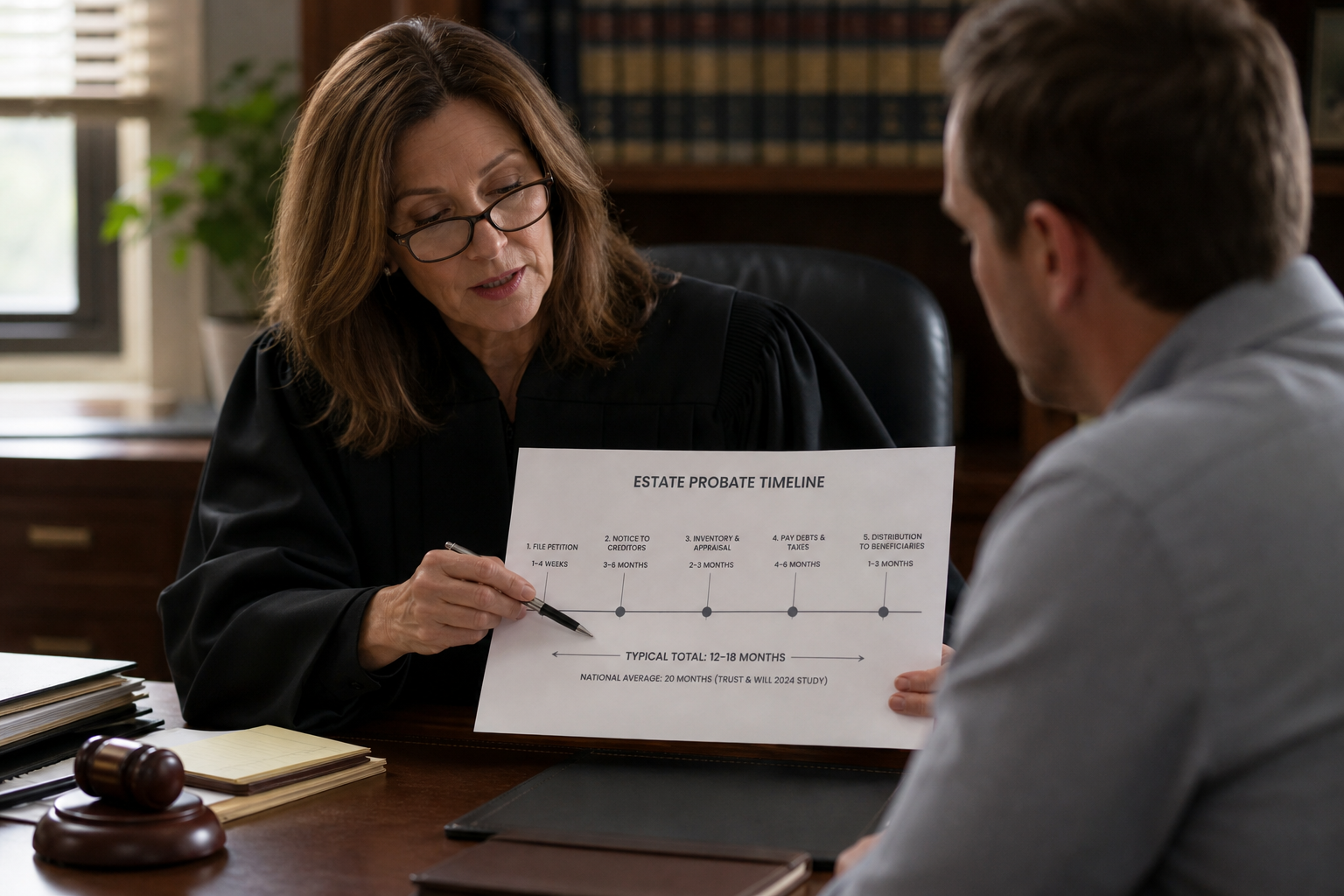
Per a Trust & Will 2024 study, how long probate takes averages 20 months nationally. Intestate estates often run longer because the court must conduct an heirship determination and formally appoint an administrator before any substantive work begins. Those two steps alone can add weeks or months to the front end of the process before a single creditor notice goes out.
The realistic baseline for most estates today is 12 to 18 months. California and New York routinely push past two years, given court backlogs and the procedural weight of their respective probate systems.
One structural reason the timeline can't be compressed past a certain point: the mandatory creditor notice period. Most states require a public notice window of three to six months, during which creditors can file claims. Statute sets that window, and it runs whether the estate is organized or not. You can have every document ready on day one and still wait out the full creditor period before distribution is legally permitted.
Intestate estates carry an additional timing risk that testate estates rarely face: disputed heirship. Without a will to confirm who the deceased intended to benefit, relatives have more room to contest the distribution. A half-sibling who surfaces late, a child from a prior relationship nobody knew about, or a dispute between two equally ranked heirs over who should serve as administrator can each pause the process and send it back to the court for resolution.
There are a few scenarios worth knowing about:
- A single contested hearing can add months to an otherwise straightforward probate timeline, requiring additional court dates, briefing periods, and a judge's ruling before the estate moves forward.
- A drawn-out heirship dispute, especially one involving multiple claimants or unclear paternity, can add years and may require separate litigation outside of probate court entirely.
- Family structures that include stepchildren, half-siblings, or children from prior relationships are statistically more likely to produce competing claims, since intestacy laws assign inheritance by legal relationship, not by the closeness of the actual bond.
Plan for longer than you expect, especially if the family structure is at all complicated.
How Alix Supports Administrators Handling an Intestate Estate
As noted above, front-end heirship determination can add weeks or months before substantive work starts. Beyond that, everything covered in an executor checklist lands on the administrator's desk too, with no letter of instruction or stated preferences to work from.
Alix's estate settlement specialists handle more than 150 administrative tasks that don't require a law license, coordinating them as a single integrated process instead of separate engagements you manage independently. That includes:
- Asset discovery across safe deposit boxes, uncashed checks, brokerage accounts held at smaller institutions, and digital assets that commonly get missed
- Institution outreach across every financial institution in the estate, including requesting account statements, obtaining freeze or closure forms, and following up on pending transfers that stall without a dedicated point of contact
- Creditor and debt coordination covering medical bills, credit card balances, mortgage servicer notices, and utility arrears
- Real estate coordination including locksmith access, utility transfers, insurance continuation, and routine maintenance through the sale or transfer of property
- Beneficiary communication including fielding questions about distribution timelines, explaining what each person is set to receive, and relaying status updates throughout the process
- Tax filing coordination covering prior-year returns, 1099 collection, cost-basis records, and account statements, with outreach to accountants or attorneys on the federal estate return deadline, the fiduciary income return (Form 1041), and applicable state filing dates
An attorney from Alix's network is included in the one transparent, estate-funded fee and handles the licensed legal work: probate filings, creditor notices, court hearings, and formal accountings, whether or not the jurisdiction formally requires one.
Based on Alix's data across client cases, estate settlement typically involves 600+ hours of work over 18 months. An intestate estate, with its added heirship determination and administrator appointment steps, often runs toward the higher end of that range.
Alix is a fit for administrators dealing with real property, multiple accounts, blended-family dynamics, or creditor complexity. Very simple intestate situations resolvable with a single small estate affidavit may not need this level of support. If the estate has real complexity, Alix coordinates the full scope of that work so you don't carry it alone.
Final Thoughts on Managing Intestate Probate as an Administrator
No will means the court sets the terms, and the terms rarely match what your family expected. As administrator, you must follow a statutory process you probably haven't done before while managing accounts, creditors, property, and family dynamics at the same time. The creditor window runs on its own clock, and personal liability is real if you get the order wrong. If that scope sounds like more than you want to manage solo, start your Alix onboarding to see what coordinated support looks like.
FAQ
What happens in probate court when there is no will?
When there is no will, the probate court steps in as the decision-maker for the entire estate. Instead of following a deceased person's stated wishes, the court applies your state's intestate succession statute to determine who inherits and in what shares, appoints an administrator to manage the estate, and oversees each phase of the process from creditor notice through final distribution. The court moves on its own timeline, not yours, which is a major reason no-will probate estates often take longer than those with a will.
Who initiates probate when there is no will, and how long do you have to file?
A surviving spouse, adult child, parent, or other close relative files a petition with the probate court in the county where the deceased lived to open the estate and request appointment as administrator. Most states don't impose a hard deadline for filing, but waiting creates real risk: assets can deteriorate, creditor windows may begin running, and financial institutions won't release funds without Letters of Administration. Filing promptly, typically within a few weeks of death, keeps the process from becoming more difficult.
Can an administrator of an estate sell property, and do all beneficiaries have to approve?
An administrator can sell estate property to pay debts or complete distribution, but most states require court approval before selling real property, and many require advance notice to all heirs. Getting sign-off from all beneficiaries does not substitute for court approval where state law requires it, so confirm your state's specific procedure before proceeding.
No will probate in Texas vs. California: what's the biggest practical difference?
Texas separates community property from separate property and applies different rules to each, which can catch surviving spouses off guard, especially when children from a prior relationship are involved. California's intestacy rules are more straightforward in structure, but California probate is notoriously slow and kicks in at a lower threshold, $239,700 for deaths on or after April 1, 2026. Per a Trust & Will 2024 study, the national average probate timeline is 20 months; California routinely runs well past two years. If you are administering an estate in either state, the property classification question in Texas and the timeline reality in California are the two factors most worth clarifying early.
What is a child entitled to when a parent dies without a will, and does it matter if there's a surviving stepparent?
Biological and legally adopted children rank in the first tier of intestate heirs in every state and typically inherit the entire estate if no surviving spouse exists. When a surviving spouse is present, the child's share depends on whether the child is also the spouse's child. If a child is from a prior relationship, most states assign that child a share of the estate alongside the surviving spouse, which often means the spouse receives less than they expected.
.png)
Related resources