Dealing with probate while you're also grieving is genuinely hard, and the legal process doesn't slow down to give you time to catch up. Most executors go in thinking it'll take about six months, and then reality sets in fast. This guide walks through every step of the probate process, including the parts that tend to cause the most delays, so you can stay ahead.
Key Takeaways:
- Probate is triggered by how assets are titled, not estate size alone; a single solely-owned house forces full probate regardless of total value
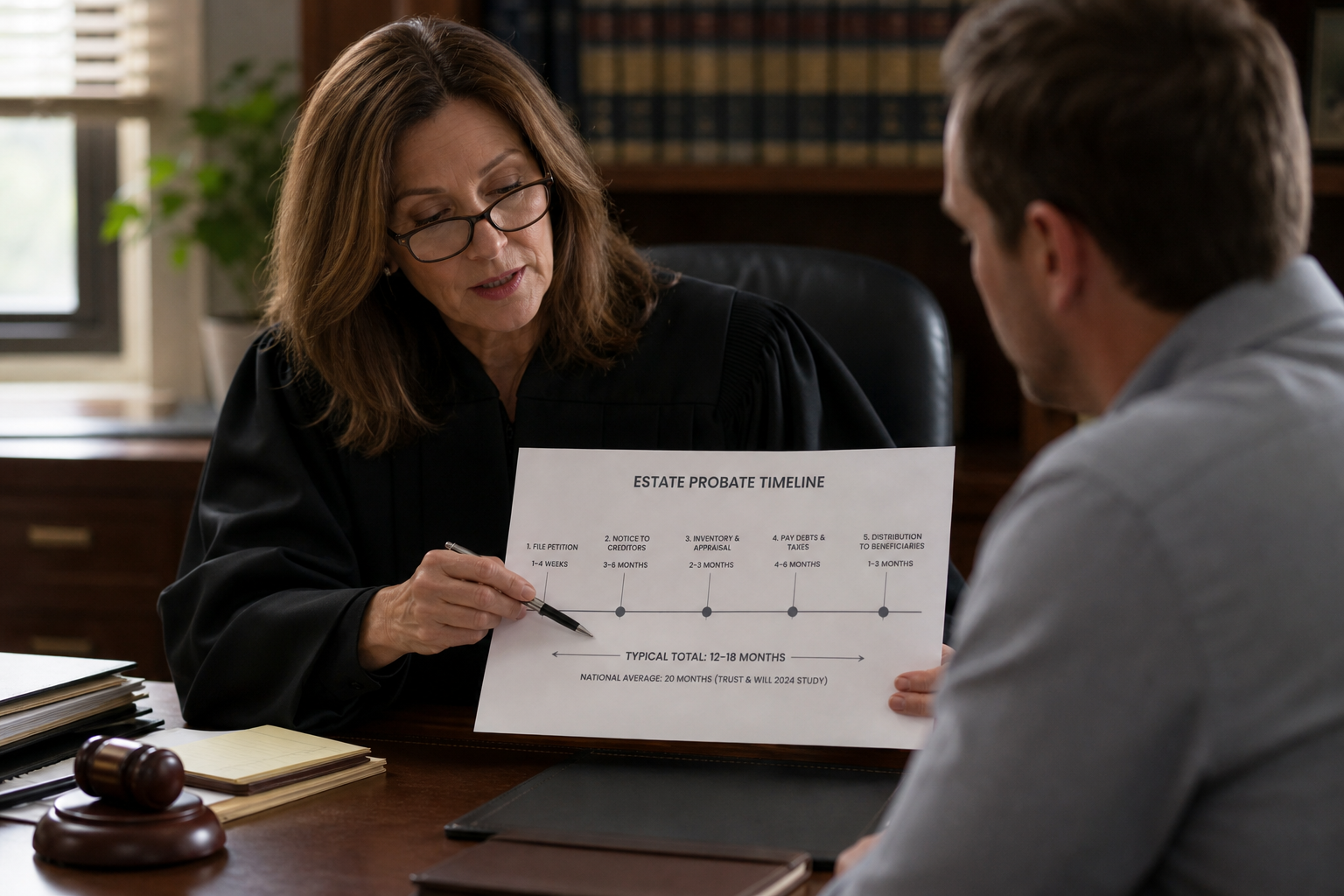
- Expect 12 to 18 months for a typical estate; per a Trust & Will 2024 study, the national average is 20 months, not the 6 months most executors assume
- Probate costs typically run 3% to 7% of gross estate value, so a $500,000 estate can cost $15,000 to $35,000 in total fees before any distribution
- Skipping probate freezes titled assets; you cannot sell the house, retitle the car, or close accounts without court authorization
- Alix is a human-led estate settlement service that coordinates 150+ administrative tasks alongside legal counsel, with fees charged to the estate
What Probate Is and Why It Exists
Probate is the legal process a court uses to settle a deceased person's estate. At its core, it does four things: validates the will, formally appoints an executor, pays outstanding debts and taxes, and transfers remaining assets to the right beneficiaries. Every step happens under court supervision, which gives the process its legal weight.
The reason probate exists is practical. Without it, there is no clean mechanism to transfer property title, no official record that debts were paid before heirs received anything, and no court-backed authority confirming that the person named in the will had the legal standing to act.
There are concrete reasons each of these requirements matters:
- Creditors need a defined window to file claims against the estate before assets move to beneficiaries. Without that window, liability stays open-ended.
- Beneficiaries need documented proof that assets transferred to them legitimately. A court order is what makes that transfer legally defensible.
- Title companies, banks, and government agencies all require that proof before they will move anything, whether that is a house title, a brokerage account, or a vehicle registration.
Think of probate less as a bureaucratic obstacle and more as a paper trail that protects everyone involved, including you as executor. If a creditor surfaces after you have distributed assets, that court record is what determines your personal liability. If a family member later disputes the will, the probate filing is the authoritative record of what the court recognized. The process is slow and sometimes frustrating, but it exists for defensible reasons.
Not every estate goes through full probate, and not every asset is subject to it. But for estates where a will needs to be validated and titled assets need to transfer, probate is the mechanism that makes it official.
Which Assets Require Probate
The real answer is that probate is not about the estate's total value so much as about how each individual asset is titled or designated.
Assets That Typically Require Probate
These are assets owned solely in the decedent's name with no mechanism to transfer ownership automatically:
- Real estate titled only in the decedent's name, which requires court authorization before title can pass to anyone else
- Bank or brokerage accounts with no named beneficiary and no transfer-on-death designation, leaving the court as the only avenue for a lawful transfer
- Vehicles registered only to the decedent, which most states cannot retitle without probate court involvement
- Personal property of considerable value, like jewelry, art, or collectibles, where no beneficiary designation exists to direct ownership
For these assets, the court has to formally authorize the transfer. No other legal path exists to transfer title.
Assets That Generally Bypass Probate
These pass directly to a named person or co-owner by operation of law, regardless of what the will says:
- Retirement accounts (IRAs, 401(k)s) with a named beneficiary pass outside the estate entirely
- Life insurance policies with a named beneficiary pay out directly to that person without court involvement
- Bank or brokerage accounts carrying a payable-on-death (POD) or transfer-on-death (TOD) designation transfer automatically at death
- Jointly owned property with rights of survivorship passes to the surviving co-owner by law
- Assets held inside a revocable living trust are governed by the trust document, not the probate court
The will has no authority over any of these. If the beneficiary designation on a retirement account names someone other than what the will directs, the designation wins every time.
How This Affects the Probate Question
An estate with a $900,000 house titled solely in the decedent's name will go through probate even if everything else passes automatically. An estate worth $600,000 composed entirely of jointly owned property and accounts with POD designations may avoid probate entirely. So when people ask how much an estate must be worth to trigger probate, asset structure matters more than the dollar figure. Most states set a minimum threshold below which a simplified process or small-estate affidavit applies, but the asset-type question comes first.
When Probate Is Not Required
Three situations let you skip formal probate entirely, or replace it with something much lighter.
Small Estate Affidavits
Most states offer a simplified small estate affidavit process for estates that fall under a certain value. Instead of filing for full probate, an heir signs a sworn statement confirming they are entitled to specific assets, and institutions release them directly. The thresholds vary widely:
- California: $239,700 for deaths on or after April 1, 2026; $208,850 for deaths before that date (personal property only; real estate requires a separate summary petition)
- Texas: $75,000 in personal property, excluding the homestead and exempt property
- Other states set their own limits, some as low as $10,000 and others above $100,000
If the estate clears the threshold in any one asset category, the affidavit path closes, and full probate applies to that asset.
Summary or Simplified Administration
Some states offer a middle path between a full probate proceeding and a one-page affidavit. Florida calls it summary administration; other states use similar procedures under different names. These are faster than standard probate but still involve court filing. They are typically available when the estate's total value falls below a state-set ceiling or when the decedent has been dead for a certain number of years.
Estates Composed Entirely of Non-Probate Assets
If every asset in the estate passes by beneficiary designation, joint ownership, or trust, nothing may remain that requires court involvement. When the full estate is structured that way, probate simply has no subject matter to work with.
The Complexity Caveat
Dollar value gets the attention, but complexity determines whether a simplified path holds up. A small estate with disputed title, a missing heir, creditor claims, or a Medicaid lien can be harder to resolve through an affidavit than a larger estate with clean asset structure. Courts can reject affidavit filings when circumstances require judicial oversight, and institutions can refuse to honor them if anything looks contested. The simplified process is a real option for straightforward situations, but it is not a workaround for underlying problems.
Your Role as Executor
Before a single court form gets filed, you carry a set of responsibilities that begin the moment you accept the role.
The executor's job starts with locating the original will. A photocopy typically won't satisfy a probate court; you need the signed original. From there, you need certified copies of the death certificate, usually anywhere from 8 to 15 of them, because banks, brokerage firms, the DMV, and government agencies each require their own copy and won't accept a photocopy.
Your pre-filing obligations generally include:
- Locating the original will and confirming its execution date and signatures
- Obtaining certified death certificates from the funeral home or county records office
- Identifying and taking reasonable steps to secure assets, including real property, vehicles, and financial accounts
- Notifying Social Security, pension administrators, and relevant financial institutions of the death
- Preserving the estate's assets from the date of death forward, which means maintaining property insurance, preventing waste, and keeping accounts from going delinquent
The legal term for your overarching duty is fiduciary. You are not acting on your own behalf; you are acting on behalf of the estate and, by extension, its beneficiaries. That distinction has real teeth. If you distribute assets before paying valid creditors, you can be held personally liable for the shortfall. If you let a property fall into disrepair or allow insurance to lapse, beneficiaries can bring a claim against you for the loss in value.
This is also directly relevant to what happens if you do nothing. Failing to probate a will is not a neutral act. In most states, the executor has a legal duty to file, and sitting on the will while the deadline passes can expose you to liability from beneficiaries who lose their inheritance as a result. Some states, including Texas, set formal deadlines for probate filing after death, and missing them can permanently bar certain legal options.
The fiduciary duty is the through-line across every step that follows. Each decision you make, from which debts to pay first to how you communicate with beneficiaries, gets measured against it.
How to Probate a Will: Step by Step
The sequence below applies to most states. Local courts have their own forms and fees, but the order of operations is consistent enough that this serves as a reliable working framework.
1. File the Will and Petition with the Probate Court
You file in the county where the decedent lived, not where property is located. The court needs the original will, the death certificate, and a petition to open probate and appoint you as executor. Filing fees vary by state but commonly run a few hundred dollars.
2. Attend the Hearing and Receive Letters Testamentary
The probate court schedules a hearing to validate the will and formally appoint you. The outcome of that hearing is a document called Letters Testamentary. Keep multiple certified copies. Banks, brokers, title companies, and government agencies will not work with you without them, and Letters Testamentary are the only thing that gives you legal authority to act on behalf of the estate.
3. Notify Beneficiaries and Publish the Creditor Notice
Most states require you to formally notify named beneficiaries by mail and publish a notice to creditors in a local newspaper. This kicks off the creditor claim window, which typically runs three to six months depending on the state. That window has to close before you distribute anything.
4. Inventory and Appraise Estate Assets
Courts generally require a formal inventory within 60 to 90 days of your appointment. You will need to identify every probate asset, obtain credentialed appraisals for real property and non-cash assets, and file the inventory with the court. Appraisals must be valued as of the date of death.
5. Pay Valid Debts, Taxes, and Expenses
During the creditor window, you review claims, pay valid claims, and dispute invalid ones. Funeral expenses, estate administration costs, taxes, and secured debts generally take priority over general creditor claims. State law sets the exact priority order.
6. File Required Tax Returns
The decedent's final individual income tax return is due April 15 of the year following death. If the estate generates income during administration, a separate estate income tax return (Form 1041) may be required. If the gross estate exceeds the federal exemption threshold, the federal estate tax return is due nine months after the date of death.
7. Distribute Assets to Beneficiaries
Only after the creditor window closes and taxes are settled can you distribute what remains. Distribute before that, and you can be held personally liable if a valid claim surfaces afterward.
8. Petition the Court to Close the Estate
You file a final accounting with the court showing every dollar that came in, every dollar that went out, and what went to each beneficiary. Once the court approves it, the estate is officially closed, and your authority as executor ends.
How to Start Probate Without a Will
When someone dies without a valid will, the estate does not skip probate. It goes through the same court process, just under different rules.
The legal term for dying without a will is intestate succession. State intestacy law takes over and determines who inherits through a fixed priority hierarchy. The order typically runs: surviving spouse first, then children, then parents, then siblings, then more distant relatives. The specifics vary by state, and some states split assets between a spouse and children in ways that surprise families who assumed the spouse would receive everything.
The court process works the same way as standard probate, with one key difference at the start. Instead of filing a Petition for Probate, you file a Petition for Letters of Administration. The court appoints an administrator instead of confirming an executor, but the administrator carries the same fiduciary duties and follows the same sequence: inventory assets, notify creditors, pay valid debts, distribute what remains.
What changes is the timeline. Courts cannot simply validate a named executor and move forward. They must verify who the legal heirs are, which means collecting birth certificates, marriage records, and sometimes death certificates for family members who predeceased the decedent. If the family tree is complicated or heirs are hard to locate, that verification process alone can add months. Disputes among potential heirs about who qualifies, or in what share, can stretch things further.
A few practical notes if you find yourself in this situation:
- Any family member, creditor, or other interested party can petition the court to open intestate administration, so waiting is rarely the right call when the estate has real assets.
- Courts favor close family members when appointing the administrator, but a judge has discretion if no one steps forward or if conflict arises among potential heirs.
- Without a will, no document states the decedent's wishes about specific assets, so sentimental property disputes often surface during administration with no written guidance to resolve them.
What Happens If You Don't Probate a Will
Skipping probate is rarely a neutral choice. Understanding when probate is required matters for any estate with titled assets, as the consequences compound over time.
The most immediate problem is the freeze. Real estate, vehicles, and financial accounts titled solely in the decedent's name cannot be sold, transferred, or refinanced without court authorization. That title stays frozen until a court order says otherwise. You cannot sell the house. You cannot retitle the car. You cannot close the brokerage account. Every one of those actions requires Letters Testamentary, and those only come through probate.
Ongoing costs don't pause while the estate sits in limbo. Property taxes still accrue. Insurance premiums on the estate's home still come due. Maintenance costs continue. If no one is paying those expenses from estate funds, family members sometimes cover them out of pocket with no legal mechanism to recover what they spent.
For beneficiaries, the outcome is straightforward: they cannot legally receive what the will directs until probate runs its course. An unprobated will is not a transfer of assets. It is a document stating intentions that have no legal force until a court validates them.
Creditors face a different issue. Probate creates a defined claim window, typically three to six months, after which valid claims are cut off, and the executor can distribute what remains. Without probate, that window never opens and never closes. Depending on the state, creditors may be able to pursue claims against the estate for years, leaving the entire distribution legally uncertain.
Failing to file is not a criminal offense in most states, according to FindLaw. FindLaw notes that an executor who knowingly withholds a will for personal financial gain can rise to criminal liability in some jurisdictions. And in Texas, a will not filed within four years of death typically loses its legal force entirely, after which the estate defaults to intestacy rules regardless of what the decedent actually directed.
How Long Probate Takes
Per a Trust & Will 2024 study, probate timelines average 20 months nationally, and only 2% of Americans estimate how long the process takes correctly. Most executors expect something closer to six months. The realistic baseline for a typical estate is 12 to 18 months, with complex or contested estates running anywhere from 2 to 5 years.
Two factors account for most delays in ordinary estates. The first is the mandatory creditor notice period, which runs three to six months in most states and cannot be shortened. The second is court scheduling backlogs, which in populous counties can add months before you even get a hearing date. Those two factors alone set a floor on the timeline that no amount of preparation can fully eliminate.
State-by-state variation is real, according to probatebystate.com:
| State | Typical Probate Timeline |
|---|---|
| California | 18 to 24 months or longer |
| New York | 18 to 24 months |
| Texas | 6 to 12 months |
| Florida | 6 to 12 months |
| New Jersey | 9 to 12 months (9-month window before final distributions) |
| Georgia | 12 to 18 months |
California and New York land at the longer end largely because of court-supervised administration requirements and high case volumes that stretch court calendars. Texas and Florida move faster partly because procedural structures limit mandatory court involvement. New Jersey imposes a hard nine-month waiting period before you can make final distributions regardless of how quickly everything else moves.
Contested wills are in their own category. When a beneficiary or potential heir challenges the will's validity, you are looking at two to three times the average timeline because the court must resolve the dispute before administration can proceed. That means depositions, hearings, and sometimes a full trial before anyone inherits anything.
How Much Probate Costs
Probate costs typically run 3% to 7% of the gross estate's value, according to SmartAsset. On a $500,000 estate, that puts total fees somewhere between $15,000 and $35,000 before beneficiaries see a dollar. Those costs come out of the estate itself, not your pocket as executor, but they do reduce what eventually gets distributed.
The main cost categories are:
- Court filing fees, which range from roughly $200 to $500 in most jurisdictions
- Attorney fees, structured as hourly billing, a flat fee (commonly $3,500 to $8,000 for straightforward estates), or a percentage of the estate value
- Executor compensation, which most states authorize as a reasonable fee paid from estate assets
- Appraisal fees for real property and non-cash assets
- Publication costs for the creditor notice, typically a few hundred dollars
- Bond premiums, if the court requires a bond as a condition of your appointment
How Attorney Fees Are Calculated
How attorney fees are structured depends heavily on where you are. California probate fees are set by a statutory fee schedule in the Probate Code, meaning both the attorney and the executor are entitled to a fixed percentage of the gross estate value, set by law and not subject to negotiation. A $600,000 estate in California generates a set statutory fee for each party regardless of how straightforward the work turns out to be. Other states apply a "reasonable compensation" standard, which gives more flexibility but also more unpredictability when you are trying to budget.
One thing worth watching: statutory fees in California and a handful of other states are calculated on the gross estate, not the net. A house worth $700,000 with a $500,000 mortgage still generates fees based on the full $700,000 figure. That distinction can produce a larger-than-expected fee bill on estates where debt is a major factor, so it is worth running the numbers before you assume costs are manageable.
State-by-State Probate Overview
Each state runs its own probate system, with different courts, different deadlines, and different procedural shortcuts. Here is what you need to know for the four states covered most in this guide.
California
File in the Superior Court of the county where the decedent lived. California does not legally require an attorney, but the court-supervised process is procedurally demanding enough that most executors hire one. See whether I need a lawyer for probate for a full breakdown. The statutory fee schedule means both the attorney and executor are entitled to fees set by the Probate Code, calculated on gross estate value. For deaths on or after April 1, 2026, the small estate affidavit threshold is $239,700 for personal property. Real estate does not qualify for the standard affidavit and requires a separate summary petition instead. Timelines typically run 18 to 24 months, driven by mandatory court hearings at multiple stages and high case volumes in populous counties.
Texas
File in the county's statutory probate court or district court, depending on the county. Texas gives executors a meaningful procedural advantage through independent administration, which removes most ongoing court supervision after the initial appointment. An executor operating under independent administration can pay debts, manage assets, and make distributions without returning to court for approval at each step, and that pathway typically runs 4 to 8 months for uncomplicated estates. Texas does not require an attorney for independent administration, though many executors work with one for the initial filing. Two deadlines worth knowing: the will must generally be filed within four years of death, and creditors have a four-month window from the date of the creditor notice to file claims. For qualifying estates where the only asset is real property and there are no unpaid debts, Muniment of Title offers a faster alternative that avoids a full administration.
Georgia
Probate proceedings in Georgia are handled at the county level through the Probate Court. Georgia offers a simplified no-administration process for qualifying estates where the will is uncontested, and debts are manageable, allowing assets to pass without full administration. For more complex estates, standard supervised or unsupervised administration applies. An attorney is not legally required, though county-level filing requirements and petition forms vary enough that local guidance is worth considering. Timelines typically run 12 to 18 months for standard administration.
New Jersey
New Jersey's probate process is among the less court-intensive in the country for routine estates. Filings go through the Surrogate's Court in the county where the decedent was domiciled, and for uncontested wills, most estates can be probated without a court appearance at all. The Surrogate's Court handles the appointment and issues Letters Testamentary or Letters of Administration administratively instead of through a formal hearing. New Jersey does not require an attorney for this process, though many retain one. The main timing constraint is a nine-month waiting period before final distributions can be made, which applies regardless of how quickly earlier steps resolve. Overall timelines typically run 9 to 12 months for straightforward estates.
How Alix Helps Executors Through Estate Settlement
Based on Alix's analysis of estate files, settling an estate involves 600+ hours of work over 18 months. That figure surprises most executors, but it reflects the actual scope: institution outreach that includes requesting account statements, obtaining closure forms, and following up on stalled transfers; creditor coordination across medical bills, credit card balances, mortgage servicer notices, and utility arrears; property coordination covering locksmith access, utility transfers, insurance continuation, and routine maintenance; beneficiary communication fielding distribution questions and status updates throughout; plus tax filing coordination, formal accounting, and asset discovery that covers items executors commonly miss, including safe deposit boxes, uncashed checks, brokerage accounts at smaller institutions, and digital assets.
Alix is a human-led estate settlement service that handles more than 150 of those administrative tasks, namely the ones that do not require a law license. The service operates as an integrated legal service model: Alix sources and manages an attorney from its network as part of the core offering, included in one transparent, estate-funded fee, whether or not the estate requires full probate. That means you do not need to independently find, engage, and coordinate a probate attorney on your own. The attorney handles the licensed legal work: court filings, creditor notices, hearings, and formal accountings. If you already have your own attorney, that works too; those fees are handled separately outside of Alix's fee.
Alix's fee can be as little as 1% of the estate and is charged to the estate itself, not out of your pocket as executor.
The service is a strong fit for estates with meaningful complexity: multiple financial accounts, real property, creditor issues, trust administration, or situations where beneficiary coordination is a real management task. Alix serves both probate and trust-based estates; the determining factor is complexity, not the legal pathway. It is not the right fit for a very simple estate resolvable by a single small estate affidavit and one attorney meeting. If the estate has genuine substance, the 600+ hour workload is real, and Alix is built to help by coordinating it as one integrated process instead of managing each piece independently.
Final Thoughts on Managing Probate as an Executor
The gap between what people expect probate to take and what it actually takes is real, and most executors only find that out once they're in the middle of it. Whether you're working through a straightforward estate or one with multiple assets and competing claims, the fiduciary responsibility stays with you the whole way through. Having a clear picture of the steps, deadlines, and costs before you start is the best thing you can do for yourself and the beneficiaries counting on you. When the estate has meaningful complexity, starting your Alix onboarding is a concrete next step worth taking.
FAQ
How long does it take to probate a will in Texas compared to California or Georgia?
Texas typically runs 6 to 12 months, largely because independent administration removes most ongoing court supervision after the initial appointment. California runs 18 to 24 months or longer, driven by mandatory court hearings at multiple stages and high case volumes. Georgia typically falls in the middle at 12 to 18 months for standard administration.
Can you settle an estate without probate in Texas or California, and what are the actual limits?
You can avoid full probate if the estate qualifies for a simplified path, but the thresholds are narrow. In Texas, the small estate affidavit covers personal property up to $75,000, excluding the homestead and exempt property. In California, the limit is $239,700 in personal property for deaths on or after April 1, 2026, with real estate requiring a separate summary petition. If any single probate asset exceeds those limits, or if title, creditor claims, or heir disputes are involved, the simplified path closes, and full probate applies.
What happens if you don't probate a will in Texas?
Texas's four-year filing deadline is explained above; missing it defaults the estate to intestacy rules regardless of what the decedent directed. Before that deadline, the consequences are still serious: titled assets stay frozen, the house cannot be sold, accounts cannot be closed, and beneficiaries have no legal mechanism to receive what the will directs. Failing to file also leaves creditor claims legally unresolved indefinitely, since the claim window never opens and never closes without probate.
How do I probate a will in Georgia without an attorney?
Georgia does not legally require an attorney to probate a will, and for qualifying estates with an uncontested will and manageable debts, the simplified no-administration process lets assets pass without full administration. For standard administration, you file in the county Probate Court, petition for appointment as executor, inventory assets, notify creditors, pay valid debts, and file a final accounting. That said, filing requirements and petition forms vary by county in Georgia, so local guidance is worth considering even if you handle most of the process yourself.
What is the difference between probating a will with a will versus starting probate without a will in states like New Jersey or Georgia?
When a valid will exists, the court validates it and confirms the named executor, who then follows the standard sequence: inventory, creditor notice, debt payment, distribution. Without a will, the estate is intestate, and state law sets the inheritance hierarchy, typically spouse first, then children, then parents. The court appoints an administrator in place of an executor, but the fiduciary duties are identical. The practical difference is timeline: verifying legal heirs requires collecting birth certificates, marriage records, and sometimes death certificates for relatives who predeceased the decedent, and that process alone can add months before administration even begins.
.png)
Related resources