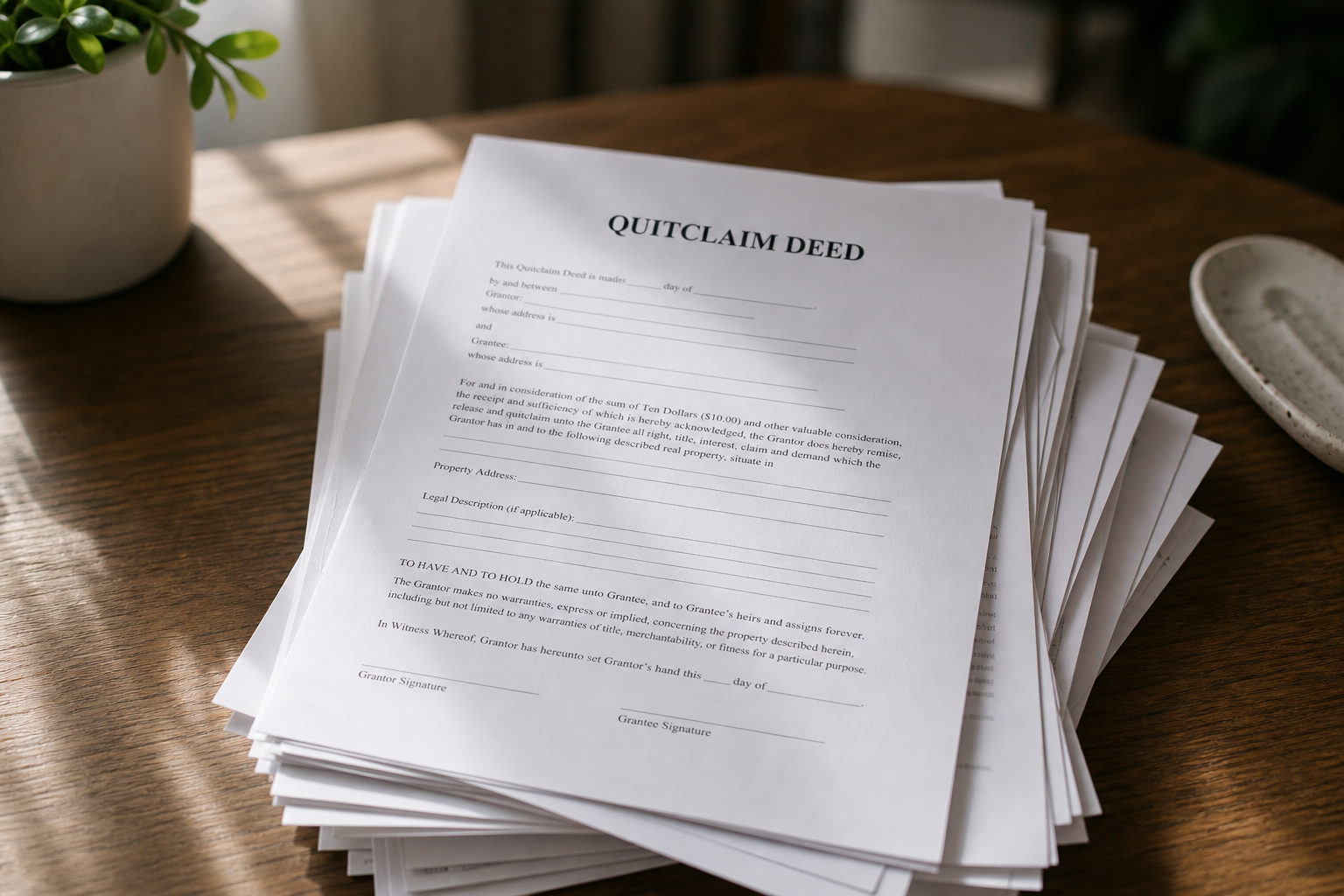
Getting a property out of inherited limbo starts with understanding why it's stuck there in the first place. When someone dies without a will and the deed never changes hands, every heir ends up owning a fractional share of the whole thing, and that list of co-owners can grow with every generation that passes. Figuring out how to get heir property in your name comes down to picking the right legal route for your situation.
Key Takeaways:
- Heir property forms when someone dies without a will and no deed transfer happens, leaving co-owners with fractional shares they cannot sell, finance, or build on independently
- Paying property taxes does not give you ownership; tax receipts alone will not satisfy a title company, lender, or court as proof of legal title
- Your path to clearing title depends on complexity: an affidavit of heirship works for simple cases, while disputed ownership or multi-generational co-owners typically require probate or a quiet title action
- Georgia and North Carolina have enacted the Uniform Partition of Heirs Property Act, giving co-owners buyout rights before a forced sale; Alabama, Mississippi, and Louisiana have not
- Alix coordinates legal work and 150+ administrative tasks as a single estate-funded process for executors managing estates with heir property and title complications
What Heir Property Is and How It Forms
Heir property is real estate that passes from one generation to the next without a will, without formal probate, and without a deed ever changing hands. When someone dies without those legal formalities in place, state intestacy laws determine who inherits, typically a spouse, children, or other close relatives. But because no deed transfer happens, ownership never gets recorded. The property sits, legally speaking, in inherited limbo.
Every heir gets what's called an undivided interest in the property. Nobody owns a specific portion of the land; everyone owns a fractional share of the whole thing. If your grandparent died without a will and left three children who never formally dealt with the title, those three children are co-owners. When one of those children dies without a will, their share passes to their own heirs, splitting ownership further. By the third or fourth generation, a single piece of land can have dozens of legal co-owners, many of whom have never met, and some of whom may not even know they have an ownership interest.
That fragmentation is what makes heir property so difficult to resolve. There are a few concrete ways this plays out:
- No single heir has full authority to sell, refinance, or make improvements without agreement from every other co-owner, which means family disagreements can freeze a property indefinitely.
- Getting a mortgage on heir property is nearly impossible because lenders require clear title before they will approve financing. Understanding when probate is required can help clarify which path forward applies to your situation.
- Qualifying for federal disaster assistance through FEMA has historically been blocked for heir property owners who cannot prove legal ownership of their home.
The compounding problem is time. The longer title goes unresolved, the more co-owners accumulate through natural inheritance, and the harder any forward path becomes. As one widely cited observation in this space holds:
"Heirs' property is thought to be the largest source of Black land loss in the American South, affecting millions of acres and billions of dollars of land value."
That history gives heir property its weight. Getting title into your name is about more than paperwork. It is about preserving what your family built.
The Risks of Leaving Heir Property Unresolved
Unresolved heir property title is not a paperwork inconvenience. It creates real, compounding legal exposure that gets harder to fix the longer it sits.

The most immediate problem is that you cannot sell the property with clear title. Buyers need a title company to insure the sale, and title companies will not insure a property with clouded ownership. Even if every living heir agrees to sell, a buyer's lender will almost certainly walk away when the title search reveals undivided interests spread across a family tree with no recorded deed transfer.
Financing is equally blocked. Banks and credit unions require clear title before approving a mortgage or home equity line of credit. That means an heir living on the property cannot borrow against it to pay for repairs, medical bills, or any other need, regardless of how long the family has been there.
Property tax exemptions are another casualty. In most states, a homestead exemption reduces the taxable value of a primary residence, but you typically have to prove legal ownership to claim it. Heir property owners living in the home often lose that exemption entirely, which according to the Federal Housing Finance Agency means paying a higher effective tax rate on a property they cannot even legally sell.
The forced partition risk is the one that catches families off guard. Any co-owner, including a distant relative or someone who inherited a small fractional interest, can file a partition lawsuit asking a court to divide or sell the property. In many states, courts historically defaulted to a partition by sale, meaning the entire property gets auctioned, often below market value, and the proceeds split among co-owners. One hostile heir or an outside buyer who purchases a small interest can trigger this process without the consent of anyone else.
Finally, federal assistance programs have repeatedly excluded heir property owners. FEMA disaster grants and USDA home repair loans commonly require applicants to document legal ownership. The FHFA has flagged heir property resolution as a direct barrier to wealth preservation for affected families, particularly in rural Southern communities.
Each of these risks compounds over time. The path forward starts with understanding which legal remedy fits your situation.
Your Pathways for Getting Heir Property in Your Name
There is no single process for getting heir property into your name. The right pathway depends on how long ago the original owner died, how many co-owners exist, whether a will was ever filed, and what your state allows. Here is how the main options break down.
Affidavit of Heirship
This is the simplest and least expensive route, available in many states for estates where there was no will and no formal probate was ever opened. You file a sworn document identifying the deceased, the heirs, and the property, signed by disinterested witnesses who knew the family. Once recorded in the county deed records, it creates a chain of title without going through court. It works best when the original owner died relatively recently, the family tree is not too complicated, and no disputes exist among heirs. Mississippi and Texas are two states where this document is commonly used, though requirements vary by state on witness count, waiting periods, and recording requirements.
Formal Probate Administration
If the deceased left an estate with substantial assets, or if no affidavit of heirship will satisfy a title company, full probate may be required. A court-appointed administrator manages the process, assets are inventoried, creditors are notified, and the court issues an order that formally vests title in the heirs. This is the most legally airtight path, though it is also the slowest and most involved.
Petition or Determination of Heirship
Some states allow heirs to file a petition asking the court to formally declare who the legal heirs are without opening a full probate. This is narrower in scope than full administration and is often used when the only asset is real property and the goal is simply to confirm who owns what.
Quiet Title Action
When title disputes exist, when an affidavit alone will not satisfy a lender or title company, or when co-owners are unknown or uncooperative, a quiet title lawsuit asks the court to rule definitively on ownership. It is the most adversarial and expensive route, but sometimes the only one that produces a clean, insurable title.
| Pathway | Best When | Court Required | Typical Complexity |
|---|---|---|---|
| Affidavit of Heirship | Simple family tree, no disputes | No | Low |
| Formal Probate | Will exists or estate has multiple assets | Yes | High |
| Petition/Determination of Heirship | Real property only, no other assets | Yes | Medium |
| Quiet Title Action | Disputed ownership or uncooperative heirs | Yes | High |
The sections below walk through each of these in more detail, including state-specific rules for Alabama, Mississippi, Georgia, North Carolina, and Louisiana.
How to File an Affidavit of Heirship
Filing an affidavit of heirship is largely a documentation exercise, but the details matter. A mistake in witness selection or a missing record can invalidate the document or cause a title company to reject it years later.
There are four steps to get through, and each one has a specific failure point worth knowing before you start.
Step 1: Gather Your Documents
You will need:
- The death certificate for the original property owner
- Marriage certificates for any spouse listed as an heir
- Divorce decrees, if applicable
- Birth certificates or other records that confirm family relationships
- The legal property description from the county deed records, beyond the street address alone
If the deceased left a will but it was never filed with the court, you will typically need to attach a copy to the affidavit or file the will separately. An unprobated will does not automatically resolve title on its own, but it does affect who the legal heirs are.
Step 2: Identify Two Disinterested Witnesses
Most states require two witnesses who knew the decedent personally, have no financial interest in the property, and are not heirs themselves. Family friends, neighbors, or long-time community members often qualify. This step matters more than it looks: a witness who turns out to have even a minor inheritance interest can compromise the entire document.
Step 3: Draft and Notarize the Affidavit
The affidavit should identify the decedent by full name, date and place of death, a description of the property, the names and relationships of all heirs, and a statement confirming no probate was opened. Both witnesses sign in front of a notary.
Step 4: Record It With the County Clerk
File the notarized affidavit in the deed records of the county where the property is located. Recording fees are typically modest. Once recorded, it becomes part of the chain of title.
One important limitation to understand before you finish: recording an affidavit of heirship documents who inherited the property, but it does not produce a new deed in your name. Some title companies will insure a sale based on a recorded affidavit, particularly after a waiting period that varies by state. Others will require a quiet title action or full probate before issuing a policy. Confirm with a local real estate attorney or title company before assuming the affidavit alone will satisfy a buyer's lender.
When You Need Full Probate to Clear Heir Property Title
An affidavit of heirship gets you surprisingly far, but it has a ceiling. Several situations push past that ceiling and into formal court proceedings.
There are specific conditions that reliably signal when a court process is the only path forward:
- The property carries an existing lien, mortgage, or tax debt that requires court authority to resolve
- One or more heirs dispute ownership, or the family tree has gaps that witnesses cannot reliably fill in
- The estate includes business interests, bank accounts, or other probate and non-probate assets beyond the real property itself
- A title company or buyer's lender refuses to insure the transaction based on an affidavit alone
- Ownership has fractured across three or more generations with many co-owners, some unknown or unreachable
Title companies routinely reject affidavits in that last scenario. The more co-owners there are, the more exposure a title insurer faces, and the less willing they are to take the risk without a court order behind the transaction.
The Formal Determination of Heirship
Many states offer a court process designed for this situation: a petition asking a judge to formally declare who the legal heirs are. It is narrower than full probate administration because you are not asking the court to manage assets, pay creditors, or distribute an estate. You are asking for one thing: a court order that names the owners and their fractional shares.
That order gets recorded in the county deed records and produces something an affidavit cannot: a judicially confirmed chain of title that most title companies will accept.
Full probate administration becomes necessary when the deceased left an estate with debts requiring formal creditor notice periods, when a will was left but never probated, or when the property's value or the number of interested parties makes a court process the only path a title company will respect. It is slower and more involved: how long probate takes typically runs 12 to 18 months for straightforward estates, but it produces the most legally durable result.
If you are dealing with heir property that has passed through multiple generations with many co-owners, a local probate attorney's assessment of which process your title situation actually requires is worth getting before you invest time in an affidavit that may not hold up.
Heir Property Laws in Alabama, Mississippi, Georgia, North Carolina, and Louisiana
Heir property law is not uniform across the South. Each state has its own procedures, and the difference between states can mean the difference between a two-page affidavit and a full court proceeding.
Alabama
Alabama allows affidavits of heirship to be recorded in county deed records, but the process has real friction in practice. Many rural counties have fragmented land records going back generations, and title companies often push for a full court determination before insuring a sale. The Alabama Heirs Property Alliance has worked for years to connect affected families with legal aid resources for title clearance, recognizing that the standard probate path is often financially out of reach. According to Alabama Cooperative Extension, clarifying title to heirs property typically requires either a formal determination of heirship through probate court or a quiet title action, depending on how many generations of undivided ownership have accumulated.
Mississippi
Mississippi uses affidavits of heirship for real property, with the document recorded in the chancery clerk's office of the county where the land sits. Mississippi also has a parallel process for personal property: a small estate affidavit for motor vehicles, which allows heirs to transfer vehicle titles without probate when the vehicle value falls below a certain threshold. Real property affidavits in Mississippi require two disinterested witnesses and notarization. Processes and waiting periods vary by county.
Georgia
Georgia adopted the Uniform Partition of Heirs Property Act, which gives co-owners stronger protections against forced partition sales. The Heirs' Property Law Center, based in Atlanta, has been central to pushing legal aid and policy reform in the state. Georgia courts must now consider alternatives to forced sale before ordering one, a meaningful shift for families facing partition suits from outside buyers.
North Carolina
North Carolina has also enacted the UPHPA, giving co-owners buyout rights and requiring courts to weigh partition in kind before ordering a sale. County-level processes for heirship determinations vary across the state, so confirming local procedures with a licensed North Carolina attorney is advisable.
Louisiana
Louisiana operates under a civil law system rooted in French and Spanish legal traditions, which makes it meaningfully different from every other state covered here. Succession in Louisiana is handled through a notarial act of heirship or a formal succession proceeding, not a common-law affidavit. Small successions can sometimes be handled through an affidavit of heirship under Louisiana's small-succession statute, but the document and procedural requirements differ substantially from other states. An attorney licensed in Louisiana is not optional for this process.
Who Pays Taxes on Heir Property
Property taxes on heir property fall on all co-owners jointly, but that shared liability rarely works out equally in practice. The co-owner who actually lives on the property, or who has been managing it, typically ends up paying the full tax bill out of pocket while other co-owners contribute nothing. Courts generally will not reimburse that paying co-owner for the others' shares unless a formal partition or accounting proceeding is opened.
A common misconception worth clearing up: paying property taxes does not give you ownership. In every state, tax payment alone cannot transfer legal title. Some people assume that if they have been paying taxes on a piece of heir property for years, they have built some claim to it. That is not how title works. Adverse possession is a separate legal doctrine, and even in jurisdictions where long-term exclusive possession and tax payment can be factors in an adverse possession claim, multiple additional requirements apply and the bar is high. Tax receipts are not a substitute for a deed.
The Homestead Exemption Gap
Most jurisdictions require documented proof of legal ownership before granting a homestead exemption on a primary residence. Heir property owners living in the home often cannot satisfy that requirement, which means they pay taxes on the full assessed value instead of the reduced homestead value. Over time, that gap adds up in ways that are easy to underestimate when you are focused on other parts of settling the estate.
There are a few things worth keeping in mind on the tax side:
- Heir property co-owners share tax liability equally on paper, but the person living in or managing the property usually absorbs the entire bill with no guaranteed right to reimbursement from the others without a formal legal proceeding.
- The homestead exemption requires documented ownership, so heirs who live on the property but have not formally cleared title typically pay more in annual taxes than they should.
On the federal side, one of the few genuine advantages heir property carries is the stepped-up cost basis. When property passes at death, its tax basis resets to the fair market value at the date of death instead of what the original owner paid. If the property has gained value considerably over decades, this matters: when heirs eventually sell, capital gains are calculated from the stepped-up value instead of the original purchase price, which can substantially reduce the tax owed. That benefit is worth preserving, and it is one reason getting title formally resolved sooner is worth the effort over waiting.
Can Heir Property Be Sold, Divided, or Built On
Three questions come up constantly about heir property: Can you sell it? Can you split it up? Can you build on it? The answers are rarely simple, but here is what you actually need to know.
Can It Be Sold?
Technically, yes. Practically, it is complicated. Selling an inherited house with heir property complications means every co-owner with a recorded interest needs to agree to the transaction. One holdout can block the sale entirely, regardless of how many other heirs are on board. And even when all heirs agree, a buyer's lender and title company still need to see clear, insurable title before the sale can close. Cloudy heirship usually fails that test without a formal legal process first.
Can It Be Divided?
Co-owners can pursue a legal partition to divide heir property into separate, individually owned parcels. Two paths exist:
- Partition in kind splits the land physically, with each co-owner receiving a deeded portion of the property they can then hold and use independently.
- Partition by sale forces the entire property to be auctioned, with proceeds divided proportionally among co-owners, often regardless of who has lived there or maintained the land.
Courts in states that have adopted the Uniform Partition of Heirs Property Act are now required to consider partition in kind before ordering a forced sale, which gives family members a stronger chance of keeping their portion instead of losing everything to an auction.
Can You Build on It?
Building on heir property is possible, but lenders will not finance construction without clear individual title in your name. You would also need co-owner consent before breaking ground, since any improvement you make sits on land you only partially own. Local zoning and permitting offices may require proof of ownership to issue a building permit as well.
Some families do build on heir property informally, but any structure built without clear title carries real risk. If a partition sale is ever ordered, the value of improvements you paid for out of pocket may not be fully recovered in the split. Getting title cleared before construction is the only reliable way to protect that investment.
Do All Heirs Have to Agree to Sell Heir Property
The short answer is no, but the longer answer is more complicated and matters more.
Under tenancy in common, which is how heir property is typically held, no single co-owner can unilaterally sell the entire property. Every co-owner holds an undivided fractional interest, and a deed to a buyer requires the signatures of everyone on title. One heir who refuses to sign can stop a sale completely, for as long as they choose to.
The catch: that same co-owner, or any other, can file a partition lawsuit asking a court to resolve the deadlock. A partition action does not require consent from anyone else. One heir with a 5% interest can file, and the court can still order the property sold at auction if it cannot be divided fairly in kind. States that have adopted the Uniform Partition of Heirs Property Act give co-owners the right to buy out the petitioning party before a forced sale is ordered, which can preserve the property for the family. Where the UPHPA is not in effect, a partition petition from even a minority co-owner can force everyone's hand.
How Long Can an Heir Delay a Sale
Delay is possible but has limits. A co-owner can contest the partition, request a buyout evaluation, appeal a court's ruling, or challenge the appraised value used in the proceedings. That litigation can stretch out a year or more in contested cases. What heirs cannot do is block the process indefinitely once a court has jurisdiction. Eventually, the court will act.
Executor Authority Versus Heir Property Co-Tenancy
There is an important distinction worth understanding here. In a formally probated estate, the court-appointed executor or administrator has legal authority to sell estate property to pay debts and distribute assets, subject to court approval. The executor acts on behalf of the estate, and individual beneficiaries generally cannot veto a sale the executor and court have authorized, though they may have rights to object through the probate proceeding.
Heir property held informally outside of probate is a different situation entirely. There is no executor and no court oversight. Every co-owner has equal standing, which means equal power to cooperate or obstruct. That is precisely why getting heir property through a formal legal process, whether probate or a partition proceeding, changes the dynamics so substantially.
The Uniform Partition of Heirs Property Act
The UPHPA was drafted by the Uniform Law Commission and first approved in 2010 to address a specific problem: under traditional partition law, any co-owner could force a sale of the entire property, and courts defaulted to auction without much scrutiny. Outside investors learned to purchase small fractional interests from a single heir, then file partition suits to force a below-market auction sale of the whole parcel. Families with deep roots in a property had almost no protection against it.
The Act changes that in four concrete ways for states that have enacted it:

- All co-owners must receive formal notice before a partition proceeding moves forward, closing the gap where distant relatives or heirs with small interests were simply left out of the process.
- The court orders an independent appraisal to determine fair market value before any sale decision is made.
- Non-petitioning co-owners have the right to buy out the co-owner requesting partition at the appraised fair market value, giving families a genuine path to keeping the property instead of watching it go to auction.
- If partition by sale is ordered, the court must use an open-market sale process instead of an immediate forced auction, which tends to produce a price closer to actual market value.
Courts in UPHPA states are also required to consider partition in kind before ordering a sale at all, a requirement that did not exist under common-law partition rules.
Per the Uniform Law Commission, 20 states have enacted the UPHPA as of 2026, including Georgia, North Carolina, and a growing number of Southern states where heir property is most concentrated. Alabama, Mississippi, and Louisiana have not yet adopted it, which is a meaningful gap given where heir property disputes are most common. According to the American Bar Association's Probate & Property publication, uniform law updates in the trusts and estates space continue to move through state legislatures, but adoption remains uneven.
If you are in a state without the UPHPA, the traditional partition rules still apply, and a minority co-owner or outside investor can still initiate a forced sale with limited procedural obstacles. That reality is one of the strongest practical arguments for getting title formally cleared before a dispute arises.
How Alix Helps Executors Settle Estates That Include Heir Property
Heir property adds a specific layer of complexity that sits on top of everything else an executor already has to manage. You may be coordinating among co-owners who have never met, waiting on a court proceeding to clear title, and communicating with beneficiaries about a timeline that keeps extending because the property situation is unresolved. All of that runs alongside the standard estate settlement work: asset discovery, creditor claims, tax filings, account closures, and distribution.
Per Alix's data across client cases, settling an estate requires 600+ hours of work over 12 to 18 months. Heir property adds to that load. An executor dealing with clouded title still has to work through the full executor checklist: obtaining an estate EIN, filing a final income tax return, managing creditor notice windows, and keeping beneficiaries informed while a quiet title action or heirship determination works through the courts.
Alix's estate settlement specialists coordinate more than 150 administrative tasks that do not require a law license, and a probate attorney from Alix's network is included as part of the standard service. You do not need to find, hire, or separately coordinate legal counsel. The attorney handles all licensed legal work, including probate filings, heirship determinations, and any court proceedings the situation requires. For estates with heir property, that means legal coordination and administrative work move as a single integrated process, not as two separate engagements you have to independently manage and sequence.
Here is what that looks like in practice:
- The attorney from Alix's network handles court filings, creditor notices, heirship determinations, and any quiet title proceedings the jurisdiction requires.
- Alix's estate settlement specialists handle document gathering, beneficiary communication, creditor management, account closures, property coordination, and the administrative sequencing that keeps everything moving while the legal work runs its course.
- The whole process is coordinated under one fee charged to the estate, not out of your pocket.
Alix is built for estates with real complexity. If your situation involves real property, multiple heirs, title issues, or any combination of the three, that is exactly the kind of estate Alix handles. Very simple situations that resolve through a single small-estate affidavit with no other moving parts may not need this level of support, and we will tell you that directly. If you are unsure which category your estate falls into, the right first step is to talk to someone who can assess it.
Final Thoughts on Clearing Heir Property and Protecting What Your Family Built
Heir property is one of those situations where waiting rarely works in your favor. The co-owners multiply, the records get harder to trace, and the legal options narrow. If you're settling an estate that includes property with clouded title, connect with an Alix specialist to get a straight answer on what your path forward looks like.
FAQ
Can heir property be sold if one heir refuses to sign?
No single co-owner can force the others to sell, but a refusal does not end the matter. Any co-owner, including one with a small fractional interest, can file a partition lawsuit, and a court can order the property auctioned without unanimous agreement. In states that have adopted the Uniform Partition of Heirs Property Act, such as Georgia and North Carolina, co-owners have buyout rights before a forced sale is ordered; in states like Alabama, Mississippi, and Louisiana that have not yet enacted the UPHPA, a minority co-owner has far fewer procedural obstacles to triggering that outcome.
Does paying property taxes on heir property give you ownership?
No. Paying property taxes, even for many years, does not transfer legal title to heir property. Tax receipts will not satisfy a title company, a lender, or a court as proof of ownership. Heir property owners who cannot document legal title typically lose access to the homestead exemption as well, meaning they pay taxes on the full assessed value of a home they cannot legally sell or borrow against.
What's the fastest way to get heir property in your name without a will in Alabama, Mississippi, or Georgia?
An affidavit of heirship is typically the lowest-cost starting point in all three states, but how far it gets you differs by state. Mississippi records the affidavit with the chancery clerk and requires two disinterested witnesses; Georgia courts now carry UPHPA protections that give co-owners stronger standing if a partition dispute arises; Alabama title companies frequently push past the affidavit entirely and require a formal court determination of heirship or a quiet title action before insuring a sale. A local real estate attorney's read on which process your county will actually accept is worth getting before you invest time in a document that may not hold up.
How do I know whether an affidavit of heirship or full probate is required to clear heir property title?
An affidavit of heirship works when the family tree is straightforward, no disputes exist among heirs, and a title company is willing to insure based on the recorded document. Full probate, or a court determination of heirship, becomes necessary when the property carries a lien or tax debt, ownership has fractured across three or more generations, co-owners are unknown or unreachable, or a buyer's lender refuses to accept the affidavit alone. If you are unsure which applies, the threshold question is whether a title company in your county will insure the transaction on the basis of the affidavit; if the answer is uncertain, a local probate attorney's assessment of the title situation is the right first move.
Can you build a house on heir property?
You can physically build on heir property, but lenders will not finance construction without clear individual title in your name, and local permitting offices commonly require proof of ownership before issuing a building permit. Any improvement you pay for out of pocket sits on land you only partially own, and if a partition sale is ever ordered, you may not recover the full value of what you built. Getting title formally cleared before breaking ground is the only reliable way to protect that investment.
.png)
Related resources