If someone close to you died without a will, you're probably trying to figure out who legally inherits what and in what order. Every state has a default inheritance ladder for exactly this situation, called intestate succession, and it doesn't always match what anyone assumed would happen. This guide walks through how that ladder works, where state rules differ, and what it means for you as the person responsible for settling the estate.
Key Takeaways:
- State law decides who inherits when there is no will, following a ranked list: spouse, children, parents, siblings.
- A surviving spouse does not automatically get everything; prior-relationship children and separate property change the split.
- Your power of attorney ends at death; only a court-appointed administrator with Letters of Administration can act on the estate.
- Bank accounts with a named beneficiary skip probate entirely; solely owned accounts without one must go through court.
- Alix coordinates the full settlement workload across 150+ administrative tasks, with an attorney included in one estate-funded fee.
What Intestate Succession Actually Means
When someone dies without a valid will, their estate is called an intestate estate. The property doesn't go into limbo; it gets distributed according to your state's default rules, not any instructions the deceased left behind. Those rules are called intestate succession laws.
Every state has them, and they exist to answer one question: when there are no written instructions, who gets what? The answer is a ranked list of relatives, set by your state legislature, not by what the deceased would have wanted.
Intestate succession and probate applies to probate assets: solely owned bank accounts, real property held in one name, and personal belongings. Probate and non-probate assets, like life insurance or retirement accounts, and jointly held property pass outside probate entirely and are unaffected by intestacy rules, as FindLaw notes.
How Common Dying Without a Will Is
According to one estimate, as many as 67% of Americans die without a will or estate plan (though sources vary, with figures ranging from 60% to 70%), leaving asset distribution entirely to state law, which makes intestate succession less of an edge case and more of the default outcome for most estates.
The reasons vary: procrastination, discomfort with the subject, a belief that wills are only for the wealthy. But the result is the same: state legislatures decide who inherits, not the person who spent a lifetime accumulating what's left behind.
Who Is in Charge of an Intestate Estate
Without a will, no one automatically has legal authority over the estate. A court has to appoint someone first.
That person is called an administrator, not an executor. The distinction matters: what an executor does applies when named in a will; an administrator is appointed by a probate court because no will existed. The court issues Letters of Administration, which gives the administrator legal authority to collect assets, pay debts, and distribute what remains.
Most states rank appointments in a set order: the surviving spouse typically goes first, followed by adult children, then parents, then siblings, following a process similar to how someone becomes an estate executor. Until Letters of Administration are issued, no one has legal standing to access accounts or begin any formal settlement work, which is part of when probate is required.
The General Order of Inheritance Without a Will
Most states follow a priority ladder that looks roughly the same, even if the exact shares vary.

- Surviving spouse
- Children (biological and legally adopted)
- Parents
- Siblings
- Grandparents
- Aunts, uncles, cousins
The spouse and children sit at the top of nearly every state's list. Parents only inherit if there is no surviving spouse or children. Siblings inherit if there are no parents. Each tier gets nothing if someone in the tier above is still alive.
One concept worth understanding is per stirpes, sometimes called "by representation." If an heir dies before the decedent, their share drops down to their own children instead of being divided among surviving siblings.
"State intestate succession laws determine who receives your property, in what order, and in what proportions," as one Virginia estate attorney summarizes. The process can create delays, disputes, and unintended outcomes that a will could have prevented.
The ladder only covers blood relatives and legal spouses. Unmarried partners, stepchildren who were never legally adopted, close friends, and caregivers receive nothing under intestacy laws regardless of how close the relationship was.
How Surviving Spouses Inherit Under Intestacy Laws
Most people assume a surviving spouse automatically inherits everything. In many situations, that's close to true, but the details matter: in states like Florida, a spouse can receive as little as 30% when stepchildren are involved.
In common-law property states, if the deceased had children only with the surviving spouse, the spouse typically inherits the full estate. Bring children from a prior relationship into the picture, and most states split the estate between the spouse and those children, often unevenly. In Florida, for example, if any children are from outside the current marriage, the spouse and children share equally, with the spouse receiving no less than 30%.
Community property states, including California, Texas, and Arizona, work differently. Property acquired during the marriage is generally owned 50/50 already. The surviving spouse keeps their half outright; only the deceased spouse's half passes through intestacy. Separate property owned before the marriage follows the standard inheritance ladder.
The short version: a surviving spouse does not automatically get everything once children from prior relationships or separate property are involved. The exact share depends on your state and the family's specific composition, a question related to whether wills always require probate.
How Children Inherit When There Is No Will
Biological and legally adopted children rank immediately after the surviving spouse in every state's intestacy order. What they inherit depends on how many children there are and whether a spouse is also surviving.
If there is no surviving spouse, children typically split the estate equally. Stepchildren are different: unless they were formally adopted by the deceased, they inherit nothing under intestacy laws, regardless of how long the family lived together.
When a child dies before the parent, their share usually passes to their own children via the per stirpes principle. The grandchildren collectively receive what their parent would have received, then divide that share among themselves.
One category worth flagging: children born outside of marriage. Most states allow them to inherit from their biological parent, but proof of parentage may be required, particularly if the father never legally acknowledged the child, a detail that can complicate estate administration.
State-by-State Differences in Intestate Succession
Intestate succession rules follow a broadly similar priority ladder across states, but the dollar amounts, community property distinctions, and edge cases vary in ways that can materially change who receives what.
A few concrete examples:
| State | Property System | How the Spouse Inherits | Key Rule / Edge Case |
|---|---|---|---|
| Texas | Community property | Keeps their half of community property outright; deceased's half flows through intestacy | Separate property split differs depending on whether children are from the current marriage or a prior one, per the Texas Estates Code |
| California | Community property | Receives outright ownership of half of all marital assets; only deceased's half passes through intestacy | Separate property follows a tiered formula based on how many surviving relatives exist |
| New York | Common law | Receives a flat $50,000 first, then splits the remainder equally with surviving children | The $50,000 carve-out applies before any per-share division between spouse and children |
| New Jersey | Common law | Inherits through strict family branches under a parentelic system | Relatives outside the third family branch are excluded as heirs entirely |
| Florida | Common law | Spouse inherits the full estate if all children are shared; if any children are from outside the marriage, spouse and children split equally with spouse receiving no less than 30% | The 30% floor protects the surviving spouse when children from a prior relationship are heirs |
| Illinois | Common law | Spouse receives half the estate; children share the remaining half equally | If there is no surviving spouse, the entire estate passes equally to children; if no children, entirely to parents |
The controlling state is wherever the decedent was domiciled at death, which governs personal property. Real property follows the laws of whichever state it physically sits in, meaning a single estate can fall under two different states' rules at once.
What Happens to a Bank Account When Someone Dies Without a Will
Bank accounts don't all follow the same path after death. The account type determines everything.
Accounts with a payable-on-death (POD) or beneficiary designation transfer directly to the named beneficiary with no probate or court involvement. According to Bankrate, the beneficiary simply needs a death certificate and valid ID.
Joint accounts with rights of survivorship work similarly, passing automatically to the surviving account holder.
Solely owned accounts with no named beneficiary become part of the intestate estate and must go through probate. The court-appointed administrator gains legal authority to access the account, pay outstanding debts, and distribute what remains to heirs according to the state's intestacy order.
What Happens to the House When There Is No Will
Real property follows its own path. A house with no will attached doesn't automatically transfer to anyone, even a surviving spouse, unless the title was already set up to allow it.
If the home was jointly titled with rights of survivorship, the surviving owner inherits outright regardless of intestacy rules, with no probate required. If the house was solely owned by the deceased, it becomes part of the intestate estate and must pass through the probate process before title can transfer to any heir.
Once probate determines the rightful heirs, they typically take ownership as tenants in common, meaning multiple people own percentage shares of the same property. Every decision about the house requires agreement among all owners, and when heirs disagree, courts can force a partition sale that rarely produces the outcome anyone wanted.
One detail worth knowing: real property follows the laws of whichever state it physically sits in, not where the deceased lived at death. If the decedent was domiciled in Texas but owned a cabin in North Carolina, North Carolina intestacy law governs that property.
What Happens If There Is No Living Relative
When no heirs can be located, the estate escheats, meaning ownership passes to the state government. Every state has an escheat statute that triggers this outcome when intestate succession runs out of relatives.
States don't take assets immediately. Most require a waiting period and a genuine effort to locate heirs first. The court will typically publish a notice, search public records, and in larger estates may appoint a special administrator to conduct a formal heir search. Only after that process produces nothing does the property formally revert to the state, often a year or longer, though exact waiting periods vary by state statute.
Unclaimed financial assets like bank balances are usually turned over to the state's unclaimed property fund, where a long-lost heir could theoretically claim them later if they surface and can prove their relationship. States differ on whether an heir who appears after escheat has any recourse: some allow claims within a set window; others treat the transfer as permanent once complete.
Power of Attorney Does Not Survive Death
A power of attorney ends the moment someone dies. That legal authority evaporates at death, and having one gives you no standing over the estate afterward.
This trips up many people who were handling a loved one's affairs in their final months. From that point forward, only a court-appointed administrator has authority to act on the estate.
If there is no will, nobody has automatic authority. You have to petition the probate court, get appointed, and receive Letters of Administration before you can access any accounts or assets.
Why Intestate Estates Often Become Complicated
Intestate estates clear a higher bar than wills-based ones, and the reasons compound quickly.

Blended families are a common source of friction. When the deceased had children from multiple relationships, the intestacy ladder applies mechanically: a spouse and children from a prior relationship may each have competing claims of equal legal standing. Courts apply the formula; they don't arbitrate what's fair.
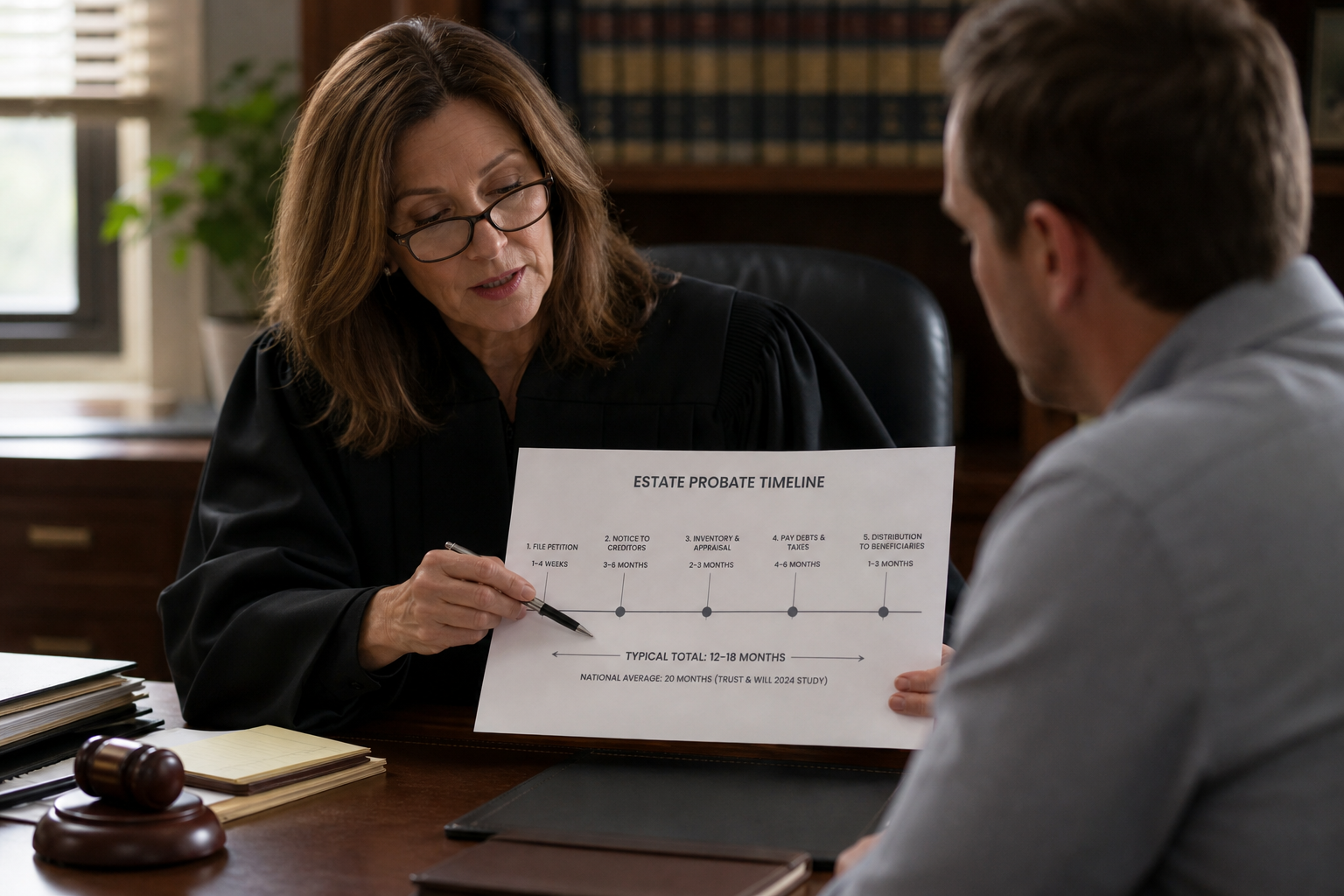
Disputed heirship adds another layer. Some states require a formal heirship proceeding before any distribution can happen, where the court determines who qualifies as a legal heir. Per a Trust & Will 2024 study, the national average probate timeline is 20 months, and intestate estates can stretch beyond that when heirship must first be formally confirmed.
Administrators also carry personal liability. If assets are distributed before creditor claims are fully resolved, the administrator can be held responsible for the shortfall. No heir receives anything until that statutory window closes and valid debts are paid.
Every step also requires court approval that a wills-based estate might skip: inventory filings, creditor notices, distribution orders, all moving through the court on the court's schedule.
How Alix Helps When There Is No Will
Intestate or not, the administrative workload is the same. An administrator faces the same asset discovery, institution outreach, creditor coordination, property management, and beneficiary communication involved in settling an estate that any executor does, often with more court oversight layered on top.
Based on Alix's data across client cases, estate settlement involves 600+ hours of work over 18 months. Alix's estate settlement specialists handle the full administrative load across more than 150 administrative tasks, including tracking down overlooked accounts, digital assets, and safe deposit boxes, coordinating property access and insurance continuation, managing creditor claim windows, and keeping heirs informed on distribution timelines.
Alix also includes an attorney from its network as part of one transparent, estate-funded fee, so you do not have to independently find or coordinate probate counsel. The attorney handles licensed legal work; the specialist handles everything else.
Alix is built for estates with real complexity. If the estate settles cleanly through a single small estate affidavit with no outstanding debts or property, a simpler path may be the better fit. For everything else, reach out to get started.
Final Thoughts on What Happens to an Estate When There Is No Will
The absence of a will does not leave property in limbo. Instead, it hands the distribution decision to your state legislature, which wrote those rules long before your family existed. People who are deeply important to the deceased but outside the legal definition of heir get nothing, regardless of the relationship. If your family is working through an intestate estate and the process is more involved than expected, get started with Alix to see how the workload can be handled.
FAQ
Who inherits when there is no will and the deceased had children from a prior relationship?
The surviving spouse does not automatically receive the full estate in that situation. Most states split the estate between the spouse and the children from outside the current marriage, often unevenly. Florida, for example, gives the spouse no less than 30% while the remaining share goes to the children. The exact division depends on your state's intestate succession laws and the family's specific composition.
If a spouse dies without a will, does the wife or husband get the house automatically?
Only if the home was jointly titled with rights of survivorship. If the house was solely owned by the deceased, it becomes part of the intestate estate and must pass through probate before title transfers to any heir, including a surviving spouse. Once probate runs its course, surviving heirs often take ownership as tenants in common, meaning multiple people share percentage ownership and every decision about the property requires agreement among all of them.
What is the order of inheritance without a will, and does it differ by state?
Every state uses a ranked priority ladder: surviving spouse first, then biological and legally adopted children, then parents, then siblings, and so on down through more distant relatives. The priority order is broadly consistent across states, but the dollar amounts, community property rules, and edge cases vary in ways that can change who receives what. California, Texas, and New York each handle the spouse-and-children split differently, and real property follows the laws of the state where it physically sits, which means a single intestate estate can fall under two states' rules at once.
What happens to a bank account when someone dies without a will?
It depends on how the account was set up. Accounts with a payable-on-death designation or a named beneficiary transfer directly to that person with no probate required. Jointly held accounts with rights of survivorship pass automatically to the surviving account holder. Solely owned accounts with no beneficiary become part of the intestate estate, go through probate, and are distributed by the court-appointed administrator according to your state's intestacy order after outstanding debts are paid.
Who handles an intestate estate, and how do you get legal authority to act after someone dies without a will?
A probate court appoints an administrator, which is the correct title when no will exists, as opposed to an executor who is named in a will. The court issues Letters of Administration, which give you legal standing to collect assets, correspond with financial institutions, pay debts, and distribute what remains to heirs. Until those letters are issued, no one has authority to access accounts or begin formal settlement work. As noted above, any power of attorney ends at death.
.png)
Related resources