If you can't find a will, the first instinct is panic, but that's usually premature. A missing will could be registered somewhere, held by an attorney, or filed with a probate court without anyone in the family knowing. Walking through a structured search before drawing any conclusions can change everything about how the estate gets settled.
Key Takeaways:
- Search home safes, the drafting attorney, probate court, and The U.S. Will Registry before treating a will as missing
- Whoever holds the original will typically has a legal duty to file it with probate court; withholding it is a criminal offense in many states
- A photocopy can be admitted to probate, but you'll need clear and convincing evidence the original wasn't intentionally destroyed
- Without a will, state intestacy law controls who inherits; unmarried partners, stepchildren, and friends typically receive nothing regardless of intent
- Alix's estate settlement specialists handle 150+ administrative tasks, including account closures, creditor tracking, property coordination, and more, with an attorney from Alix's network included under one transparent, estate-funded fee
Where Wills Are Typically Stored
Before assuming no will exists, it helps to know where people actually keep them. The original document could be in any of these places:

- A fireproof safe or lockbox at home
- A safe deposit box at a bank
- With the attorney who drafted it
- Filed with the local probate court (some states allow this during the testator's lifetime)
- With a national will registry, such as The U.S. Will Registry, which has offered will registration since 1997
- In a filing cabinet, desk drawer, or stored with other important documents
Start close to home, then work outward.
A Step-by-Step Search for a Missing Will
If you've checked the obvious spots and come up empty, work through these steps before drawing any conclusions:
- Search personal files, fireproof safes, and lockboxes thoroughly, including places the deceased used for tax records or insurance papers.
- Contact the drafting attorney. If you don't know who that was, check old invoices, email folders, or the deceased's address book.
- Visit the local probate court. Some states permit filing a will for safekeeping before death, making it a public record you can request.
- Search The U.S. Will Registry, which allows free will searches by the deceased's name, though registration is voluntary, so a missing result doesn't confirm no will exists.
- Check any safe deposit boxes. You'll typically need a death certificate and letters testamentary to gain access.
- Ask the deceased's financial advisor, accountant, or banker whether they have a copy on file or know where one was stored.
- Review email and cloud storage accounts for scanned copies or attorney correspondence referencing a will.
Only after exhausting these options should you treat the will as genuinely missing.
Who Keeps the Original Copy of a Will
There's no single universal rule here. Custody of the original will depends on what the testator arranged during their lifetime.
There are a few common places the original typically ends up:
- The testator themselves most often keeps the original, usually in a fireproof safe or safe deposit box. There's no legal requirement to give it to anyone else during their lifetime.
- Many attorneys hold the original as a courtesy, particularly for long-term clients. Retention practices vary by firm and state, so calling the drafting attorney's office is worth doing even years after the will was signed.
- Several states allow testators to file a will with the probate court for safekeeping while still alive. Once filed, it becomes a sealed court record, retrievable only after death by an authorized party.
Once someone passes, whoever physically holds the original typically has a legal duty to file it with the probate court promptly. In many states, failing to file a known will is a civil or even criminal violation. Holding onto it does not give that person any legal authority over the estate.
How to Search Will Registries and Probate Records Online
If the physical search turns up nothing, online registries and court records are your next move. Here's where to look:
The U.S. Will Registry
The U.S. Will Registry has operated as a national will registry since 1997. Its free search tool lets you look up a deceased person's name to check whether a will, its storage location, or the drafting attorney was ever registered. Registration is voluntary, so a missing result does not confirm no will exists, but a match can save a considerable amount of time.
State-Level Will Registries
A handful of states maintain their own registries. New Jersey, for example, runs one through the Office of the Secretary of State, where testators or their attorneys can register basic will information. If the deceased lived in a state with a similar program, contact that state's secretary of state office directly.
Probate Court Records
Once a will is submitted to probate, it becomes a public record. Most county probate courts maintain searchable online dockets. Search the probate court in the county where the deceased lived at the time of death. For each state, search "[county name] probate court records" to find the court's public access portal.
When a Family Member May Be Hiding the Will
Most states impose a legal duty on anyone who possesses a will to file it with the probate court after the testator's death. Sitting on a will is not a gray area. In many jurisdictions, knowingly suppressing or destroying a will is a criminal offense, separate from any civil consequences.
If you suspect a relative is holding back a will, you have a few concrete options:
- File a petition with the probate court requesting that anyone holding the will be compelled to produce it
- Ask the court to issue a subpoena requiring the suspected party to appear and explain what they know
- Contact a probate attorney to send a formal demand letter, which sometimes moves things faster than a court filing
Courts take will suppression seriously because intestate distribution often benefits whoever controls the process. A relative who stands to inherit more under state intestacy laws than under the actual will has a financial motive to keep it hidden.
Before escalating, work through the standard search steps. If after that you still have reason to believe a will exists and is being withheld, the probate court is the right place to raise it.
Can a Copy of a Will Be Used If the Original Is Lost
In most states, losing the original will does not automatically mean the estate falls to intestate succession. Courts can admit a photocopy or draft to probate, but you'll need to clear a high evidentiary bar first.
The standard in most jurisdictions is "clear and convincing evidence," which sits between the typical civil standard (preponderance) and the criminal one (beyond a reasonable doubt). You need to show two things: that the copy is an accurate, unaltered version of what the testator signed, and that the original was not intentionally destroyed by the testator to revoke it.
That second point is where things get complicated. In many, but not all, states, if the original was last known to be in the testator's possession and cannot now be found, courts presume the testator destroyed it on purpose. That presumption can be rebutted, but it takes real evidence, such as:
- Witness testimony that the testator never intended to revoke the will
- Medical records showing the testator lacked the physical or mental capacity to destroy the document
- Evidence of accidental destruction such as fire, flood, or a move gone wrong
- Proof the will was stored somewhere the testator could not easily access
Some states allow probating a lost will upon sufficient proof to the court, though the process is often rooted in case law and not codified statute. Rules vary by state, and the burden on the person seeking to admit the copy is real. For a broader look at how intestate succession works when no will exists at all, it helps to understand the process before it applies to your situation.
The Presumption of Revocation and How to Overcome It
State law shapes how far this presumption reaches. In some jurisdictions it applies only when the testator had sole access to the original; in others, it kicks in regardless of where the will was stored.
California is a clear example of the narrower rule. Under California Probate Code § 6124, the presumption of revocation applies only when the will was last known to be in the testator's possession and cannot be found after death. If the will was held by an attorney or in a bank safe deposit box the testator did not control alone, the presumption does not arise at all; the proponent simply needs to explain where the original is and why it's unavailable.
If the drafting attorney retained the original, that fact alone can defeat the presumption, since the testator plainly could not have destroyed a document in someone else's possession. Attorney retention records, safe deposit box logs, and notarized storage receipts all carry weight for this reason.
To overcome the presumption in states that apply it more broadly, the most effective evidence typically falls into three categories: testimony from people who knew the testator's intentions (friends, financial advisors, or family members who heard the testator speak about the will), records showing the testator lacked physical access to wherever the original was stored, and documentation of circumstances such as fire, flood, or a chaotic move that could explain an accidental loss. Courts weigh the totality of this evidence; a single piece rarely settles the question on its own.
What Happens If No Will Can Be Found: Intestate Succession
When no will surfaces, the estate proceeds under intestate succession: state law decides who inherits, in what order, and in what shares.

The typical priority order runs as follows:
| Priority | Heir | Who Qualifies | Key Notes |
|---|---|---|---|
| 1 | Surviving spouse | Legally married spouse | May inherit everything, or share with children depending on the state |
| 2 | Children | Biological and legally adopted children | Stepchildren generally receive nothing unless legally adopted |
| 3 | Parents | Living biological or adoptive parents | Inherit only if no spouse or children survive |
| 4 | Siblings | Full and half siblings (varies by state) | Inherit only if no spouse, children, or parents survive |
| 5 | Distant relatives | Grandparents, aunts, uncles, cousins | Last resort; unmarried partners and friends receive nothing regardless of intent |
State laws vary on the specifics. A spouse may inherit everything, or may share the estate with children depending on the jurisdiction. Unmarried partners, stepchildren, and close friends generally receive nothing under intestacy regardless of the deceased's actual intentions. FindLaw's intestate succession guide breaks down how each state applies these rules. The results frequently diverge from what the person would have chosen.
How Intestate Administration Works in Probate Court
When there's no will, the probate court appoints an administrator instead of confirming an executor. The role carries the same legal duties an executor holds, but who fills it is decided by state priority rules, not the decedent's wishes. Typically, a surviving spouse has first claim, followed by adult children, then parents, then siblings. When multiple relatives want the role, the court resolves competing petitions.
Once appointed, the administrator must:
- File an inventory of estate assets with the court
- Notify creditors and allow the statutory claim period to run
- Pay valid debts, taxes, and administrative costs before distributing anything
- Distribute remaining assets strictly according to state intestacy law
- File a final accounting with the court before closing the estate
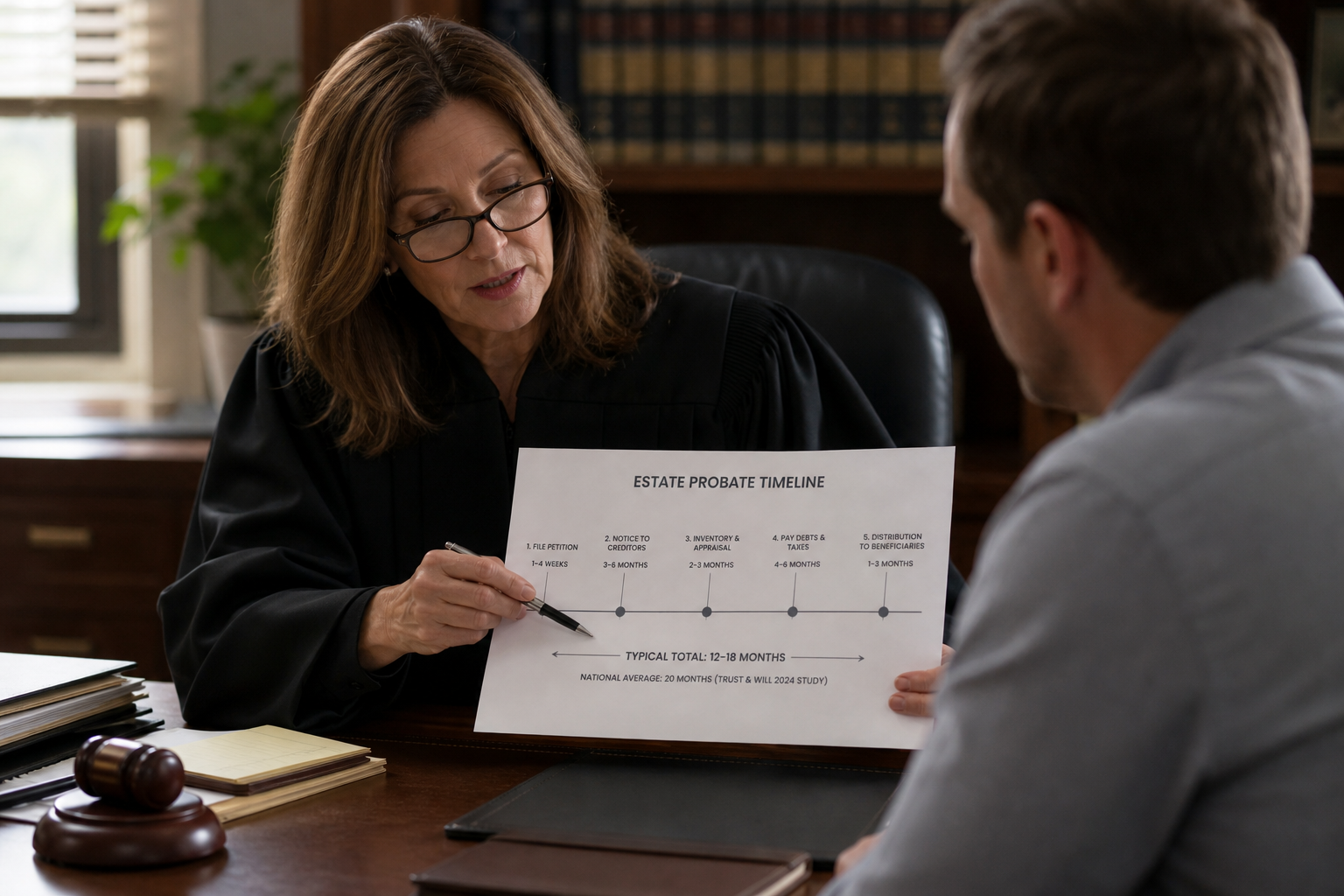
The process is fully court-supervised, with filing deadlines at each stage. Per a Trust & Will 2024 study, the national average probate timeline is 20 months, and intestate cases often run longer because there's no will to guide asset distribution or confirm the administrator's authority upfront. Every contested appointment or disputed creditor claim adds time on top of that baseline.
Which Assets Pass Outside a Will Regardless
Even if no will ever surfaces, a meaningful portion of most estates moves without it. Certain assets pass by contract, title, or trust, bypassing both the will and the probate court entirely.
Assets that transfer outside a will include:
- Retirement accounts (401(k), IRA) with named beneficiaries
- Life insurance policies with a named beneficiary
- Bank and brokerage accounts designated as payable-on-death (POD) or transfer-on-death (TOD)
- Jointly held property with right of survivorship, such as a home titled as joint tenants
- Assets held in a revocable living trust
For these, the beneficiary designation or title controls. A will cannot override them, and neither can intestacy law. If a 401(k) names a sibling as beneficiary but the will leaves everything to a spouse, the sibling gets the retirement account regardless.
What intestacy law does govern is the probate estate: assets titled solely in the deceased's name with no beneficiary designation attached. Knowing which bucket each asset falls into tells you exactly what the missing will was actually responsible for distributing.
How Alix Supports Executors When a Will Is Missing or the Estate Is Complex
Finding no will doesn't reduce your workload as executor or administrator. Asset discovery, creditor outreach, property oversight, court filings, and beneficiary communication all still fall on you, whether or not a will directed any of it.
Based on Alix's data across client cases, estate settlement typically involves 600+ hours of work over 18 months, whether the estate has a clear will or none at all.
Alix's estate settlement specialists handle more than 150 administrative tasks that don't require a law license: account closures, creditor tracking and negotiation, property coordination, tax document organization, and beneficiary communication throughout the process. An attorney from Alix's network is included in the service and handles the licensed legal work, including court filings, creditor notices, and formal accountings. It all runs under one transparent, estate-funded fee that can be as little as 1% of the estate.
If you're working through a missing will or stepping into an intestate administration, learn more about how Alix works.
Final Thoughts on What to Do When You Can't Find a Will
The absence of a will doesn't simplify the process. It just changes who decides what, with state intestacy law stepping in where the decedent's wishes would have otherwise guided things. A thorough search, starting at home and working outward through attorney records, The U.S. Will Registry, and probate court files, is worth completing before you treat the will as truly gone. If you're working through this and want to understand what settlement involves from here, start your Alix onboarding.
FAQ
How do I find out if a will exists for free in the USA?
Start with The U.S. Will Registry at theuswillregistry.org, which has offered free will searches by the deceased's name since 1997. From there, check the probate court in the county where the deceased lived. Once a will enters probate, it becomes a public record you can request at no cost. If those searches come up empty, contact the drafting attorney's office directly, since many attorneys retain original wills for long-term clients.
Does the attorney keep the original will, and how long do they hold it?
Many attorneys do hold the original as a courtesy, particularly for clients they worked with over many years, though retention practices vary by firm and state. There is no universal rule requiring an attorney to keep the original; some return it to the testator after signing. If you are trying to locate a will in California, Texas, Georgia, or another state, calling the drafting attorney's office is worth doing even years after the will was executed, since some firms maintain storage indefinitely.
What happens if the original copy of a will is lost and no copy can be found?
If no will surfaces, the estate moves through intestate succession and state law controls who inherits, but before reaching that conclusion, courts in most states will consider admitting a photocopy to probate under the standards covered in the sections above on lost wills and the presumption of revocation.
Can a family member hide a will, and what can you do about it?
Yes, and sitting on a will is treated seriously by courts. In many jurisdictions, knowingly suppressing or destroying a will is a criminal offense, separate from civil consequences. If you suspect a relative is withholding the will, you can file a petition with the probate court to compel production, ask the court to issue a subpoena, or have an estate attorney send a formal demand letter. The financial motive is real: whoever controls the process often stands to inherit more under state intestacy rules than under the actual will.
Are beneficiaries entitled to a copy of the will, and where do they get one?
Once a will is filed with the probate court, it becomes a public record. Any interested party, including named beneficiaries, can request a copy directly from the court. Before probate opens, beneficiaries have no automatic legal right to demand a copy from whoever holds the original, though the person in possession typically has a legal duty to file it promptly after the testator's death. If you believe a will exists but has not been filed, the probate court is the right place to raise it.

Related resources