If you're settling an estate, you're probably wondering whether you need a probate lawyer. The questions are common: what one does, what they cost, how long probate takes, whether you can handle it without legal help, and what changes if there's no will. A probate lawyer is the attorney who files court petitions, manages creditor claims, and represents the estate in hearings, and their fees, timelines, and necessity depend entirely on the size of the estate, the state where probate is filed, and whether anyone is contesting the will. This post breaks down exactly when hiring one is worth the cost and when you can manage the process on your own.
Key Takeaways:
- A probate lawyer guides executors through court-supervised estate settlement, handling legal filings, creditor notices, and will validation.
- Fees vary widely: hourly ($150–$400), flat-rate, or percentage-based (California's $500K estate costs ~$13K in attorney fees alone).
- You need one if the estate has solely-titled assets, no will, substantial debt, or contested claims; small estates may qualify for simplified processes.
- Probate typically runs 12–18 months nationally; California often exceeds 18 months due to mandatory creditor-claim windows and court schedules.
- Alix provides an integrated settlement service that includes a probate attorney from its own network, plus coordinates asset discovery, account closures, property management, and the full administrative layer of estate settlement. Alix steps in only after any will contest, executor challenge, or beneficiary dispute is fully resolved, and its network attorneys handle standard probate work, not litigation.
What Is a Probate Lawyer?
A probate lawyer is a licensed attorney who specializes in helping executors, administrators, and beneficiaries get through the court-supervised process of settling a deceased person's estate. When your loved one passes, their assets and debts don't resolve on their own. The probate court steps in to oversee what happens next, and a probate attorney is the professional who guides you through that legal proceeding.

The court's role is to confirm the will (if there is one), formally appoint an executor or administrator, and supervise how assets get distributed to heirs. The probate lawyer's job is to keep that process on track. They file the required petitions and handle creditor notice requirements. When disputes arise, they represent the estate in hearings.
That scope is wider than most people expect going in. Probate lawyers advise on which assets are subject to probate in the first place, help interpret an ambiguous or contested will, and make sure filings hit the court's deadlines. In states like California and Texas, the procedural requirements are detailed enough that missing a step can delay the entire proceeding by months.
What a Probate Lawyer Actually Handles
The work breaks down across a few distinct areas, and understanding each one helps you figure out how much attorney involvement your estate actually needs.
- Filing the initial petition to open probate and notify the court of your loved one's passing, which starts the official legal clock on creditor claims and distribution timelines.
- Identifying which assets fall under the court's supervision and which pass outside of probate entirely, such as jointly held property, beneficiary-designated accounts, or assets held in a trust.
- Managing creditor notice requirements, which vary by state, and advising you on which claims are valid before any debts get paid from estate funds.
- Representing the estate if a beneficiary or creditor challenges the will or disputes how assets are being handled.
- Coordinating the final distribution of assets to heirs once the court closes the estate, making sure transfers happen in the right order and with proper documentation.
Think of a probate attorney as a licensed guide through a formal legal process that carries real consequences if mishandled. They know the local court rules, the creditor-claim timelines that differ from state to state, and the specific forms your jurisdiction requires. That local expertise is a substantial part of what you're paying for.
How Is a Probate Lawyer Different From an Estate Planning Attorney?
People often use "probate lawyer" and "estate planning attorney" interchangeably, but they handle very different stages of the legal process around death and assets.
An estate planning attorney works with someone while they are still alive. Their job is to help you arrange your affairs so that your wishes are carried out after you pass. That typically includes drafting wills, creating trusts, setting up powers of attorney, and structuring asset ownership in ways that minimize taxes or sidestep probate altogether. The goal is to plan ahead.
A probate lawyer, by contrast, is brought in after your loved one has passed. Their role is to handle the legal process of settling the estate through the court system. If the deceased left a will, a probate lawyer guides the executor through getting it validated, notifying creditors, and eventually distributing assets. If there was no will, they help the court-appointed administrator follow state intestacy rules to accomplish the same outcome.
Here is a quick way to think about the distinction:
- An estate planning attorney helps you build the road map before the trip.
- A probate lawyer helps the executor follow that road map, or figure out a new route, after the trip can no longer be redirected.
Can One Attorney Do Both?
Yes, and many do. Plenty of attorneys practice in both areas, especially at smaller firms. If your loved one had an estate planning attorney who drafted their will, that same attorney may be willing to handle the probate process. In practice, though, not every estate planning attorney actively takes on probate cases, so it is worth asking directly whether they handle administration work or whether they would refer you to someone who does.
Why the Difference Matters When You Are the Executor
If you are settling an estate right now, you are not looking for estate planning help. You need someone who knows probate procedure in your state, understands court filing timelines, and can move the estate through the process without costly delays. Hiring an attorney whose primary focus is drafting trusts for living clients may slow things down if they are not actively working probate cases week to week. Asking a prospective attorney how much of their current caseload involves active probate administration is a reasonable and worthwhile question.
What Does a Probate Lawyer Do?
When an estate enters probate, a probate lawyer steps in to guide the legal process from start to finish. Their work spans both the courtroom and the administrative side of estate settlement, and understanding exactly what that looks like helps you decide how much legal support you actually need.
At a high level, a probate lawyer handles the legal tasks that require a licensed attorney. That typically includes:
- Filing the petition to open probate with the court and shepherding the case through any required hearings, so the estate is formally recognized and the executor is legally authorized to act.
- Notifying creditors according to state-mandated timelines and procedures, which is a step that protects you from personal liability if it's done incorrectly or missed entirely.
- Identifying and validating the will, or advising on intestate succession rules if there is no will, so the distribution of assets follows the legally correct path.
- Preparing and filing formal accountings with the court that document how estate assets were managed, spent, and distributed.
- Advising on tax obligations tied to the estate, including whether an estate tax return is required and coordinating with the executor on deadlines.
- Representing the estate if disputes arise, whether that's a contested will, a creditor claim that needs to be challenged, or a disagreement among beneficiaries.
What a Probate Lawyer Doesn't Typically Handle
It's worth knowing where most attorneys stop. Probate lawyers focus on the legal work: court filings, formal notices, hearings, and legal compliance. The broader administrative work of settling an estate sits outside that scope.
Tracking down financial accounts, closing subscriptions, coordinating property sales, managing ongoing creditor communications, organizing decades of documents, transferring vehicle titles, and distributing personal property are all tasks that fall to you as executor. An attorney may point you in the right direction, but in most cases you are managing that work yourself or finding separate help for it.
This division matters because the legal work and the administrative work happen in parallel. A probate lawyer can keep you legally protected without lifting the day-to-day burden off your plate.
How Much Does a Probate Lawyer Cost?
Probate lawyer fees vary more than most folks expect, and the structure of those fees matters as much as the total number.

Most probate attorneys charge in one of three ways: a flat fee for the entire estate, an hourly rate, or a percentage of the gross estate value. The right structure depends on the complexity of the estate and the state where probate is filed.
Fee Structures You'll Likely Encounter
- Hourly billing is common for contested estates or those with unusual complexity. Rates typically range from $150 to $350 per hour depending on the attorney's experience and your location, though rates in major metro areas in California or Texas can run higher.
- Flat fees are more predictable and work well for straightforward estates where the scope of work is clear from the start. These can range from a few hundred dollars for a simple filing to several thousand for a full probate administration.
- Percentage-based fees are used in several states, including California, where statutory fees are set by law. In California, attorney fees are calculated as a percentage of the gross estate value: 4% on the first $100,000, 3% on the next $100,000, 2% on the next $800,000, and so on. On a $500,000 estate, that adds up to roughly $13,000 in attorney fees alone.
Who Pays and When
Attorney fees in probate are generally paid out of the estate, not out of your own pocket. That said, some attorneys require a retainer upfront before work begins, so it is worth asking directly how billing works before you sign anything.
Court filing fees, publication costs, and appraisal fees are separate from attorney fees and also come out of the estate. These vary by state and county but commonly add several hundred to a few thousand dollars to the total cost of probate.
How Costs Vary by State
Probate costs by state range widely. States like California and Florida have more formal, court-supervised processes that tend to cost more and take longer. Other states have simplified procedures for smaller estates that can reduce attorney involvement considerably.
As a general reference:
| State | Typical Attorney Fee Structure | Notes |
|---|---|---|
| California | Statutory percentage | Set by Probate Code; applies to gross estate |
| Texas | Hourly or flat fee | Independent administration reduces court involvement |
| Florida | Percentage or hourly | Statutory fee schedule exists but is not mandatory |
| Georgia | Hourly or flat fee | No statutory schedule; fees negotiated directly |
These figures are general ranges. Actual costs depend on whether the estate is contested, how many assets need to be transferred, and how long the process takes. Probate in most states runs 12 to 18 months on average, and a contested estate can extend well beyond that, which directly affects what you pay if your attorney bills hourly.
If cost is a concern, ask any attorney you consult whether the estate qualifies for a simplified or small-estate process in your state. That single question can save thousands of dollars in fees.
When Do You Need a Probate Lawyer?
Not every estate requires a probate attorney, but several situations make hiring one the right call. Knowing where those lines fall can save you time, money, and personal liability.
Here are the scenarios where legal counsel is worth the cost:
- The estate includes assets titled solely in your loved one's name with no joint owner or named beneficiary. these assets cannot transfer without court, and a probate attorney can file the petition, manage the court calendar, and handle any objections.
- There is no will, or the will is being contested. When your loved one passes without a will, state law governs who inherits what, and disputes between heirs can escalate quickly. If anyone challenges the validity of the will, you are looking at litigation that requires licensed legal representation.
- The estate carries substantial debt, including unpaid taxes, mortgages, medical bills, or creditor claims. An attorney can advise you on which debts must be paid, in what order, and how to respond to creditor notices without exposing yourself to personal liability.
- You are administering an estate in a state you are unfamiliar with, or the estate holds property in multiple states. Each state has its own probate code, deadlines, and court procedures. What works in Texas does not automatically apply in California or Florida.
- The estate is large enough to trigger estate tax considerations. The federal estate tax return is due 9 months after the date of death, and missing that deadline carries real penalties.
- There are minor beneficiaries, blended family dynamics, or a trust that needs to be interpreted alongside the will. These situations create competing interests that a neutral legal authority can help resolve.
When You May Not Need One
Smaller estates can sometimes avoid formal probate entirely. Many states offer simplified procedures for estates under a certain dollar value. In California, for example, the small-estate affidavit threshold is $208,850 for deaths on or after April 1, 2025, according to California Judicial Council form DE-300. If the estate qualifies and the asset picture is straightforward, a single attorney consultation may be all you need instead of full representation through probate court.
Data cited November 2026. Information subject to change.
That said, even in simpler cases, a one-time consultation with a probate attorney is worth considering before you take any formal steps. Filing the wrong documents or distributing assets before the creditor-claim deadline expires can create personal liability for you as executor.
Do You Need a Probate Lawyer If There Is No Will?
When your loved one passes without a will, the estate is called "intestate," and probate becomes the primary legal process for sorting out what happens next. There is a common assumption that no will means no complicated process. In practice, the opposite is often true.
Without a will, the court does not have your loved one's instructions to work from. That means a judge must appoint an administrator (instead of an executor named by your loved one), and state intestacy laws determine who inherits what. These laws follow a fixed hierarchy, typically putting spouses first, then children, then other relatives. If your family's actual relationships or wishes do not match that hierarchy, the results can be contentious and slow.
Here is where a probate attorney becomes especially useful in an intestate estate:
- Intestacy laws vary by state, and the rules are not always intuitive. An attorney can explain exactly how your state's hierarchy applies to your family structure, including situations involving stepchildren, half-siblings, or unmarried partners who may have no legal claim at all.
- When no administrator has been named, the court must formally appoint one. An attorney can help you petition for that appointment, which is a required legal step before you can take any action on behalf of the estate.
- Disputes among potential heirs are more common when there is no will to reference. An attorney can help identify who has standing, manage competing claims, and reduce the risk of the process stalling in contested hearings.
- Creditors still have the right to file claims against an intestate estate, and the administrator carries personal liability if assets are distributed before those claims are resolved. Legal guidance here is not optional if you want to protect yourself.
What If the Estate Is Small?
If the estate is modest, some states allow simplified procedures, like a small-estate affidavit, that bypass full probate. Whether that option is available depends entirely on the state and the total value of assets. In California, for example, the threshold for simplified transfer procedures is $208,850 for deaths on or after April 1, 2025, according to California Judicial Council form DE-300. Estates above that threshold go through standard probate regardless of whether a will exists.
If you are unsure whether full probate is required, an initial consultation with a probate attorney can answer that question quickly. Many attorneys offer a free first conversation, and some legal aid organizations provide free guidance for those who qualify based on income.
Data cited November 2026. Information subject to change.
How Long Does Probate Take?
Probate timelines vary more than most people expect, and the range is wide enough to affect how you plan everything from paying bills to selling property.
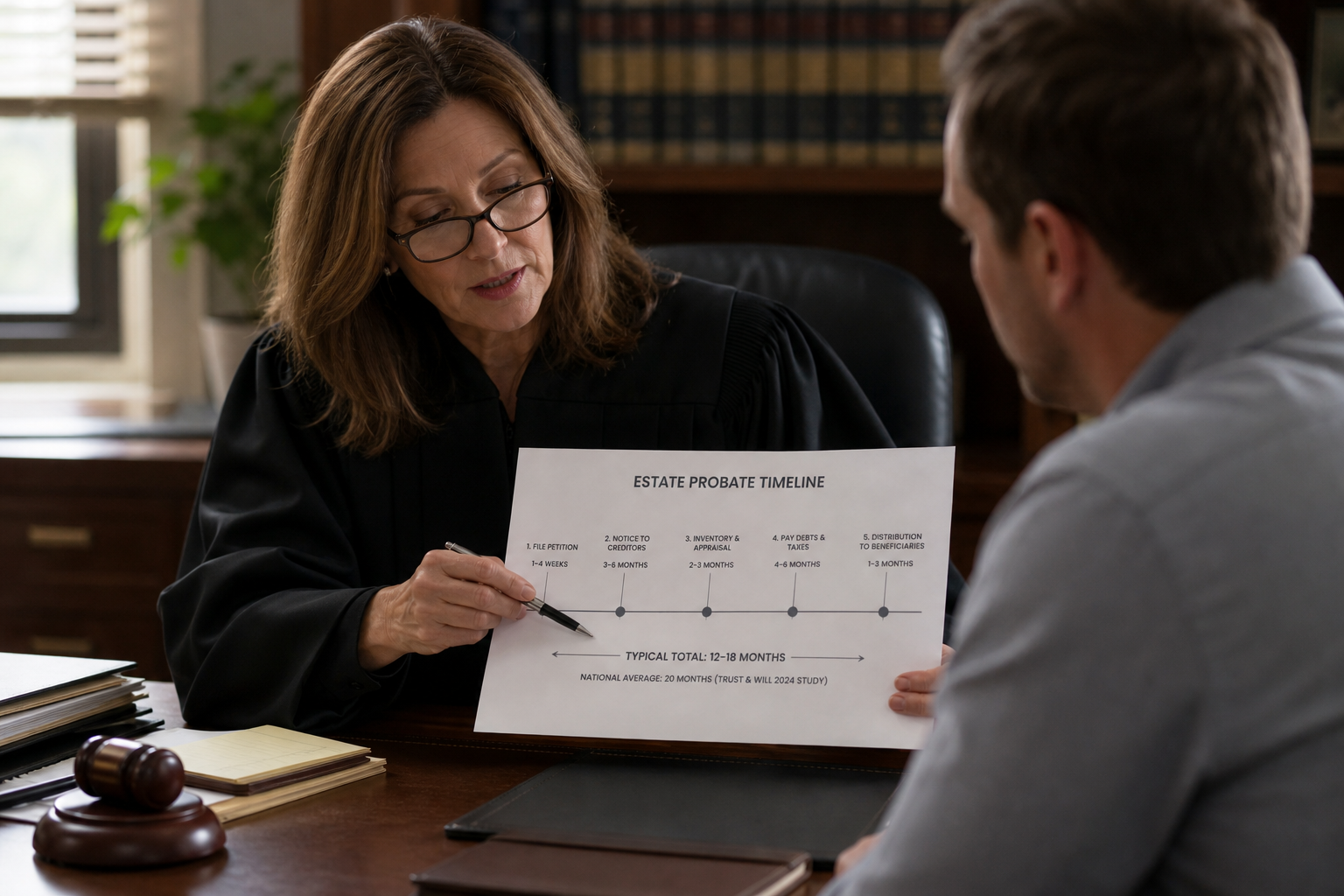
probate typically runs 12 to 18 months from the time the will is filed with the court to the final distribution of assets. That figure holds for straightforward estates with clear documentation, cooperative beneficiaries, and no contested claims. According to a 2024 study by Trust & Will, the national average is closer to 20 months once you account for court backlogs, creditor claim windows, and the pace of asset transfers. Catalina Structured Funding's state comparison shows probate timelines ranging from 9 to 24 months depending on state-specific court procedures and mandatory waiting periods.
What Slows Probate Down
Several factors can push a timeline well past that average:
- Contested wills or disputed asset ownership require court hearings that can add months to the process, sometimes years in complex family situations.
- Real estate takes longer than financial accounts because property must be appraised, maintained, and either transferred or sold before the estate can close.
- Estates with business interests, out-of-state property, or foreign assets often require ancillary probate proceedings in additional jurisdictions, running on their own separate timelines.
- Creditor claim windows are set by state law and cannot be shortened. In most states, creditors have several months to come forward after being formally notified, and the estate cannot distribute assets until that window closes.
- Court scheduling delays are increasingly common in busy probate courts, particularly in California and Texas, where dockets can push hearings out by weeks or months beyond what you'd expect.
California in Particular
California runs long. Routine probate in the state commonly exceeds 18 months, and estates with real property or any complexity frequently stretch to two years or more. The state's statutory notice and creditor claim requirements add mandatory waiting periods regardless of how organized your documentation is.
When Probate Moves Faster
Some estates do move more quickly. If the estate is small enough to qualify under your state's small estate threshold, a simplified affidavit process may apply and can resolve in weeks instead of months. Assets held in a trust, jointly titled property, and accounts with named beneficiaries pass outside of probate entirely and on their own timelines.
For everything else, the plain reality is that probate is a slow process by design, built around waiting periods and court schedules that exist to protect creditors and beneficiaries alike.
Can You Handle Probate Without a Lawyer?
In some states, you can handle probate without hiring an attorney. It's called "pro se" probate, and whether it's a realistic option depends heavily on where you live, the size of the estate, and whether any complications arise along the way.
When Going It Alone Is Feasible
A few situations lend themselves to DIY probate:
- The estate is small and falls below your state's small-estate threshold, making it eligible for a simplified affidavit process instead of full probate court.
- All assets were jointly owned or had named beneficiaries, meaning most of the estate passes outside of probate entirely.
- There is a clear, uncontested will, no creditor disputes, no real property to transfer, and all beneficiaries are cooperative.
Even in these cases, you will still need to file paperwork with the probate court, meet filing deadlines, and follow your state's specific procedural rules. A single misstep can delay the process by months or trigger a court rejection.
Where It Gets Complicated Fast
Most estates do not fit the simplified scenario above. If the estate includes real property, business interests, retirement accounts without named beneficiaries, or any outstanding debts, the administrative work multiplies quickly. The same is true if a beneficiary contests the will, a creditor pushes back on a claim, or your loved one had assets in multiple states.
Probate timelines in the general case run 12 to 18 months, and courts in states like California routinely exceed that. Trying to manage that process without legal guidance while also handling the broader responsibilities of settling an estate is a major undertaking.
The Direct Answer
Pro se probate is legal, and in the simplest cases it can work. But the threshold for "simple enough to do alone" is lower than most executors expect when they first take on the role. If you are unsure whether the estate qualifies for simplified procedures in your state, that question alone is worth a brief consultation with a probate attorney before you decide to proceed without one.
Who Pays Probate Attorney Fees?
Probate attorney fees come out of the estate itself, not from your personal pocket. The executor does not pay these costs individually; they are treated as an administrative expense of the estate and settled before assets are distributed to beneficiaries.
That said, how fees are calculated varies widely by state, and the method matters.
Percentage-Based Fees
Several states, including California and Florida, set statutory fee schedules that tie attorney compensation to the gross value of the estate. In California, for example, the fee is calculated on a sliding scale: 4% on the first $100,000, 3% on the next $100,000, 2% on the next $800,000, and so on. An estate worth $500,000 could generate roughly $13,000 in statutory attorney fees before any extraordinary fees are added for complex work like litigation or selling real property. According to Lawvex's California probate fee analysis, total probate costs in the state can reach 4% to 7% of the estate's value when you factor in executor fees, court filing fees, and appraisal costs on top of attorney compensation.
Hourly Billing
Many states leave fee structures to the agreement between the attorney and the estate. Hourly rates for probate attorneys typically range from $150 to $400 per hour depending on location and complexity. A straightforward estate might require only 10 to 20 hours of legal work; a contested or multi-asset estate can run much longer.
Flat Fees
Some attorneys offer flat-fee arrangements for routine, uncontested probates. This can be a predictable option for simpler estates where the scope of work is clear upfront.
Who Actually Approves the Fees
In formal probate proceedings, the court often reviews and approves attorney fees before they are paid, particularly in states with statutory schedules. This is a built-in check that gives beneficiaries some protection against unreasonable billing. As executor, you have a fiduciary duty to the estate, which includes making sure professional fees are reasonable and documented.
One important note: if the estate lacks sufficient liquid assets to cover attorney fees upfront, some attorneys will defer payment until assets are sold or distributed. You should clarify this arrangement before retaining counsel, as the answer varies by firm and by state.
How Alix Handles Estate Settlement, Attorney Included
Losing a loved one puts you in the middle of a process that few people have been through before. Most executors assume they need to find a probate attorney on their own, then separately manage the administrative side of settling the estate. Alix handles both through one coordinated service: a probate attorney from Alix's network covers the court-facing legal work, and Alix's estate settlement specialists handle the administrative layer around it.
That work is substantial. Tracking down financial accounts, going through decades of financial documents to uncover hidden assets such as safe deposit boxes, uncashed checks, and brokerage accounts at smaller institutions, closing subscriptions and utilities, coordinating property sales, managing creditor claims, handling fraud protection on your loved one's identity, communicating with beneficiaries, and coordinating with CPAs on tax filings are all tasks that sit outside what your attorney is paid or licensed to do. The complete estate settlement process involves both legal and administrative work. Most executors underestimate how much of this work exists until they are already in it.
Alix is built to cover both sides. One transparent fee, paid from the estate rather than your own pocket, includes an attorney from Alix's network for licensed legal work, regardless of whether your state requires one for your specific estate, plus Alix's specialists for the administrative work surrounding it, so you are not sourcing, coordinating, or managing either on your own.
Here is how that division of responsibility works in practice:
- The attorney from Alix's network files legal documents with the court, handles creditor claim objections that require legal judgment, and appears at hearings on the estate's behalf for standard probate and settlement work, not will contests or litigation. If you prefer to work with your own attorney, Alix can coordinate alongside them instead, and those attorney fees are handled separately, outside of Alix's fee.
- Alix's estate settlement specialists handle the administrative layer: asset discovery, account closures, going through financial documents to uncover hidden assets, property coordination, creditor management, identity fraud protection, transfers, beneficiary communication, and over 150 related tasks that fall to the executor.
The two roles are not interchangeable. An attorney cannot cost-effectively spend billable hours tracking down a forgotten brokerage account or calling a utility company to close an account. Alix is staffed to handle exactly those tasks, at volume, as part of a coordinated settlement process.
For most executors managing a moderately complex estate, Alix means the legal work gets handled by a licensed attorney and the surrounding administrative work gets handled by specialists. One coordinated service covers both, at a single transparent fee, during an already difficult time.
Final Thoughts on Probate Lawyers and Estate Settlement
Knowing what a probate lawyer does and what they do not do is the first step toward building the right support around yourself as executor. Attorneys file the petitions, manage the creditor notices, and represent the estate in court. The broader administrative work of settlement is on you unless you bring in separate help. Alix includes a probate attorney from its own network as part of the service, and its specialists handle the administrative pieces around the legal work, so both sides of settlement get covered without you sourcing or coordinating either on your own. Start your Alix onboarding to map out what your estate needs, legal and administrative.
FAQ
What's the difference between a probate attorney and an estate attorney?
An estate planning attorney works with someone while they're still alive to draft wills, create trusts, and plan ahead, while a probate attorney handles the court process of settling an estate after someone has died. Many attorneys practice in both areas, but the work happens at different stages.
Do I need a probate attorney if there is no will?
Yes, in most cases hiring a probate attorney for an intestate estate is worth the cost. When there's no will, state intestacy laws determine who inherits what, the court must appoint an administrator, and disputes among potential heirs are more common. An attorney can guide you through the hierarchy of claims, help you petition for appointment, and protect you from personal liability when managing creditor claims.
What does a probate lawyer cost in California?
California uses a statutory fee schedule based on the gross estate value: 4% on the first $100,000, 3% on the next $100,000, 2% on the next $800,000, and decreasing percentages above that. A $500,000 estate would generate roughly $13,000 in statutory attorney fees before any extraordinary fees for complex work like litigation or property sales.
Can I handle probate without a lawyer if the estate is small?
In some cases, yes. If the estate falls below your state's small-estate threshold and qualifies for a simplified affidavit process, you may be able to handle it pro se. In California, that threshold is $208,850 for deaths on or after April 1, 2025, according to California Judicial Council form DE-300. Even in straightforward cases, though, a brief consultation with a probate attorney before you start filing is worth considering to avoid mistakes that create personal liability.
What to expect from a probate attorney after death of a loved one?
Your probate attorney will file the petition to open probate, manage court deadlines, publish creditor notices, prepare formal accountings, and represent the estate in any hearings. They handle the licensed legal work, but the broader administrative tasks (tracking down accounts, organizing documents, coordinating property sales, closing subscriptions, and managing ongoing creditor communications) fall to you as executor unless you coordinate separate help for that administrative layer.

Related resources